
Good to Great by Jim Collins - Book Summary
Have you ever wondered why some companies, and some leaders, break through to lasting greatness while others, doing seemingly all the right things, stay stuck in "good"? That question sat at the center of Jim Collins' landmark research project, and it's the question that's driven a big chunk of my own leadership journey too.
I've written before about individual pieces of this book: Level 5 Leadership, First Who, Then What, Confronting the Brutal Facts, The Flywheel Effect, and even pulled together my favorite Good to Great quotes and thoughts on what greatness actually requires. This post is the pillar: the one place that brings the whole framework together, chapter by chapter, so you can either get the full picture in one sitting or jump to the piece you need right now.
Grab a coffee. Let's dig into one of the most important leadership books ever written, and let's talk about what it actually means for you and the team you lead.
Why You Should Read This Book
Here's the honest truth: there is no shortage of leadership books promising a silver bullet. A hack. A 30-day plan to transform your culture. Good to Great isn't that book, and that's exactly why it's stood the test of time since its 2001 release.
Jim Collins and his research team didn't start with a theory and go looking for companies to prove it. They started with a hard, disciplined question: which companies made a sustained leap from good performance to great performance (measured as cumulative stock returns at least three times the market over fifteen years), and what set them apart from similar companies that never made that leap?
They spent five years combing through data, comparing eleven good-to-great companies against a set of "unsustained comparisons," and refused to settle for surface-level answers.
You should read this book if:
You're a leader who wants results that outlast you. This isn't about a quarterly win. It's about building something durable.
You're tired of chasing the next shiny strategy. Collins found that vision and strategy were never the starting point for the companies that made the leap.
You lead a team, a department, a church, a nonprofit, or a family business, and you sense there's a gap between where you are and where you could be.
You want a framework, not just inspiration. Level 5 Leadership, First Who Then What, the Stockdale Paradox, the Hedgehog Concept, the Flywheel: these aren't just catchy phrases. They're a sequence you can actually apply.
I'll say this plainly. Almost every leader I coach eventually runs into one of these concepts, whether they've read the book or not. Understanding them changes how you hire, how you make decisions, and how you talk about hard truths with your team. That's why this one belongs on your shelf, dog-eared, underlined, and revisited more than once.
Key Takeaways
Before we go chapter by chapter, here's the 30,000-foot view. If you only remember one section of this post, let it be this one.
Level 5 Leadership is the multiplier. Every good-to-great company was led by an executive who blended deep personal humility with fierce professional will, not a celebrity CEO, but a quiet, resolute builder.
Who comes before what. Get the right people on the bus, the wrong people off, and the right people in the right seats, before you decide where you're driving.
Confront the brutal facts, but never lose faith. This is the Stockdale Paradox: absolute faith you will prevail, combined with total honesty about your current reality.
Simplicity beats complexity. The Hedgehog Concept is the intersection of what you can be best in the world at, what drives your economic engine, and what you're deeply passionate about.
Discipline beats bureaucracy. A culture of self-disciplined people operating inside a clear framework outperforms a culture of rules built to manage the wrong people.
Technology accelerates; it doesn't create. Good-to-great companies never chased fads. They asked whether a technology fit their Hedgehog Concept first.
Greatness is a flywheel, not a single push. There's no single defining moment, no miracle announcement, just consistent, disciplined turns of the wheel that eventually build unstoppable momentum.
Good is the enemy of great. The reason so few things become great is that we settle, in our companies, our leadership, and often in our own lives.
Now let's slow down and walk through it, chapter by chapter.
Memorable Quotes from Good to Great
Some books give you information. This one gives you lines you'll find yourself repeating in meetings for years. Here are some of my favorites (and for the full curated collection with categories, check out my Good to Great quotes post):
"Good is the enemy of great."
"Greatness is not a function of circumstance. Greatness, it turns out, is largely a matter of conscious choice, and discipline."
"Those who build great companies understand that the ultimate throttle on growth for any great company is not markets, or technology, or competition, or products. It is one thing above all others: the ability to get and keep enough of the right people."
"The good-to-great leaders never wanted to become larger-than-life heroes. They were seemingly ordinary people quietly producing extraordinary results."
"You must retain faith that you will prevail in the end, regardless of the difficulties, and at the same time confront the most brutal facts of your current reality, whatever they might be."
"If you have the right people on the bus, the problem of how to motivate and manage people largely goes away."
"Technology is an accelerator of momentum, not a creator of it."
"The moment you feel the need to tightly manage someone, you've made a hiring mistake."
"Few people attain great lives, in large part because it is just so easy to settle for a good life."
That last one has stuck with me longer than almost any other line in the book. Read it again. Sit with it for a second. It's not just about companies. It's about you.
Introduction and Overview of the Book
Jim Collins wrote Good to Great: Why Some Companies Make the Leap ... and Others Don't as a kind of prequel to his earlier bestseller, Built to Last. That book studied companies that had always been great. But readers kept asking a different question: what about companies that wake up in the middle of their history and realize they're merely good? Can they become great?
To answer it, Collins assembled a research team that screened thousands of companies and landed on eleven that met a strict standard: fifteen years of stock returns at or below the general market, followed by a transition point, followed by returns at least three times the market for the next fifteen years, a pattern independent of their industry.
The eleven good-to-great companies were Abbott, Circuit City, Fannie Mae, Gillette, Kimberly-Clark, Kroger, Nucor, Philip Morris, Pitney Bowes, Walgreens, and Wells Fargo.
Notice who's not on that list. No Intel. No GE. No Coca-Cola. That's part of what makes the research so compelling. Greatness, in this study, wasn't about starting with advantages. It was about a repeatable pattern of disciplined people, disciplined thought, and disciplined action.
Collins organizes the findings into a simple visual: a flywheel with a buildup phase and a breakthrough phase, moving through six core concepts before addressing how it all sustains itself over time. That's the shape we'll follow below.
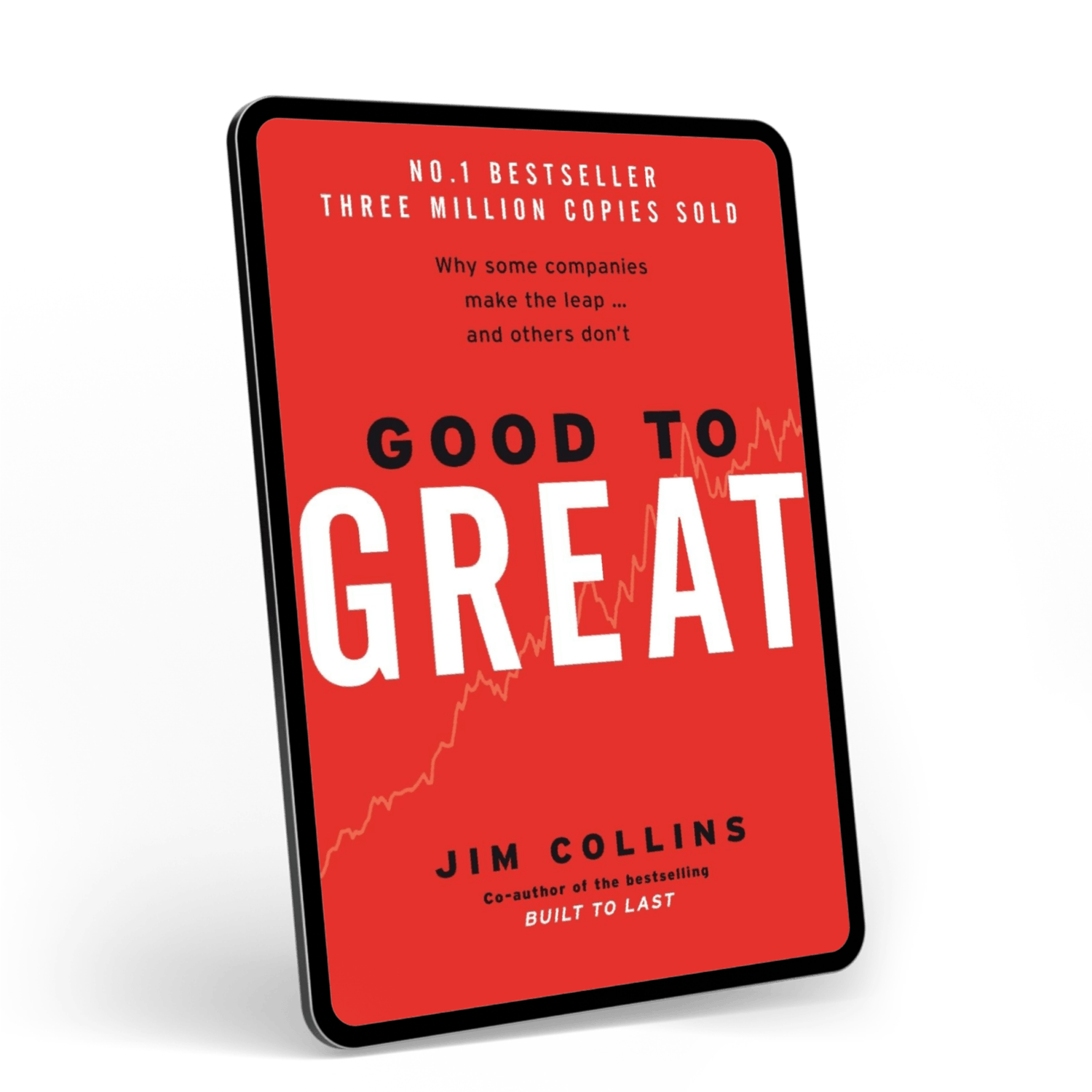
Chapter 1: Good Is the Enemy of Great
Collins opens with the premise that gives the book its title. Most organizations never become great precisely because they become good, and good is comfortable enough that people stop pushing. The good-to-great companies in the study averaged returns 6.9 times the market over fifteen years. A dollar invested in 1965 in a mutual fund of these companies would have grown 471 times by January 2000, compared to 56 times for the general market. That's not a marginal improvement. That's an entirely different trajectory.
The chapter's real gift is permission: it's possible to turn good into great from the most unlikely starting points, in unglamorous industries, without a charismatic visionary at the helm. If Kroger and Walgreens could do it, so can you.
Reflection Questions:
Where in your life or leadership have you quietly settled for "good enough"?
What would it cost you, and what would it cost the people who depend on you, if you never pushed past good?
Chapter 2: Level 5 Leadership
This is the chapter that launched a thousand leadership conversations, and I've written a deeper dive on it here: Level 5 Leadership.
Collins found something nobody expected: the leaders of good-to-great companies were almost never larger-than-life, celebrity executives. Instead, they were a paradoxical blend, deeply humble, yet fiercely willful. He built a five-level hierarchy of executive capabilities:
Level 1: Highly Capable Individual. Makes productive contributions through talent, knowledge, skills, and good work habits.
Level 2: Contributing Team Member. Contributes individual capabilities to group objectives and works effectively with others.
Level 3: Competent Manager. Organizes people and resources toward the effective pursuit of predetermined objectives.
Level 4: Effective Leader. Catalyzes commitment to and vigorous pursuit of a clear, compelling vision.
Level 5: Executive. Builds enduring greatness through a paradoxical blend of personal humility and professional will.
Darwin Smith of Kimberly-Clark is the poster child. An unassuming, almost shy company lawyer, he became CEO and, without fanfare, sold off the company's traditional paper mills, the "safe" core business, and threw everything into the more competitive consumer products space. It looked reckless. Twenty-five years later, Kimberly-Clark owned Scott Paper outright and beat Procter & Gamble in six of eight product categories.
Level 5 leaders share a pattern Collins calls "the window and the mirror." When things go well, they look out the window and credit other people, good fortune, and factors outside themselves. When things go poorly, they look in the mirror and take responsibility. They never blame bad luck. That's the opposite of what most self-serving leaders do, and it's a small but telling signal of who's actually building something that will outlast them.
Reflection Questions:
Do you channel your ambition toward your own reputation, or toward the mission and the people you lead?
The next time something goes wrong on your team, will you look in the mirror first?
Chapter 3: First Who, Then What
Most of us assume transformation starts with a bold new vision. Collins found the opposite. The good-to-great leaders got the right people on the bus, the wrong people off, and the right people in the right seats, before they figured out where to drive it. I go much deeper on this one in First Who, Then What.
Three simple truths emerged:
If you start with "who" instead of "what," you adapt more easily to a changing world. You're not locked into a strategy that outlives its usefulness.
If you have the right people, the problem of motivation mostly disappears. The right people are self-motivated; they don't need to be managed, only guided.
If you have the wrong people, the right direction won't save you. Great vision without great people is irrelevant.
Wells Fargo's CEO Dick Cooley foresaw disruptive change coming to banking in the 1970s. He couldn't predict its exact shape, so instead of guessing at strategy, he focused on injecting "an endless stream of talent" into the company, hiring outstanding people even without a specific role in mind.
When the industry upheaval came, Wells Fargo had the bench strength to handle anything thrown at it, outperforming the market three to one.
Collins is careful to distinguish rigorous from ruthless. Good-to-great companies weren't cutthroat. They were disciplined about three practices:
When in doubt, don't hire; keep looking.
When you know you need to make a people change, act. The moment you're tempted to tightly manage someone, that's usually a sign you've made a hiring mistake.
Put your best people on your biggest opportunities, not your biggest problems.
Reflection Questions:
Are you managing someone right now that you know, deep down, doesn't belong in that seat?
Are your best people working on your best opportunities, or are you burning them out patching your worst problems?
Chapter 4: Confront the Brutal Facts (Yet Never Lose Faith)
Every good decision starts with an honest read of reality. I unpack this concept further in Confront the Brutal Facts, but here's the core of it.
Collins names this the Stockdale Paradox, after Admiral James Stockdale, the highest-ranking military officer held prisoner during the Vietnam War. When asked how he survived years of captivity when others didn't, Stockdale said the ones who didn't make it were the optimists, the ones who kept saying "we'll be out by Christmas," and when Christmas came and went, their hearts broke.
Stockdale's own posture was different: unwavering faith that he would prevail in the end, combined with total acceptance of the brutal facts of his current reality, whatever they were.
That paradox, faith and facts, held together without flinching, separates good-to-great companies from the rest. A&P and Kroger both saw the writing on the wall for the old-style grocery store. A&P didn't like what it found and closed the experimental store rather than face the truth. Kroger acted on it, rebuilding its entire system store by store, city by city, and became the number one grocery chain in America.
Four practices create a culture where truth gets heard:
Lead with questions, not answers.
Engage in dialogue and debate, not coercion.
Conduct autopsies, without blame.
Build red flag mechanisms that turn information into information that cannot be ignored.
Reflection Questions:
What's a brutal fact about your team, your business, or your own performance that you've been avoiding?
Do the people around you feel safe enough to tell you the truth, or do they tell you what you want to hear?
Chapter 5: The Hedgehog Concept
Isaiah Berlin's essay "The Hedgehog and the Fox" gives Collins his central metaphor. The fox knows many things; the hedgehog knows one big thing. Foxes are scattered, chasing every promising idea. Hedgehogs simplify a complex world into one organizing concept, and when the two face off, the hedgehog always wins.
The Hedgehog Concept sits at the intersection of three circles:
What you can be the best in the world at (not merely good at, or competent in, genuinely the best).
What drives your economic engine (the single denominator, profit per X, with the greatest leverage).
What you are deeply passionate about.
This is not a goal to be the best. It's an honest, sometimes uncomfortable understanding of what you can and cannot be the best at. Abbott Laboratories realized it couldn't be the best pharmaceutical company in the world, even though 99% of its revenue came from pharmaceuticals, so it shifted toward hospital nutritionals and supplies, where it genuinely could lead. Walgreens shifted its economic driver from profit per store to profit per customer visit, which completely changed where they built stores and what they offered inside them.
It took the good-to-great companies an average of four years to fully crystallize their Hedgehog Concept. This isn't a weekend retreat exercise. It's an iterative process of vigorous debate, guided by brutal honesty.
Reflection Questions:
What can you (or your organization) genuinely be the best in the world at, not just good at?
What's the one number, if you moved it consistently, that would change everything for you?

Chapter 6: A Culture of Discipline
Once you have disciplined people who share a Hedgehog Concept, the next step is disciplined action inside a framework of freedom and responsibility. Collins is emphatic that discipline is not the same as tyranny. Bureaucracy exists to compensate for the wrong people and a lack of discipline. Hire the right people, give them a clear system, and you can eliminate most of the rulebook.
The good-to-great companies followed a simple, almost religious mantra: "Anything that does not fit with our Hedgehog Concept, we will not do." No unrelated acquisitions. No unrelated joint ventures. If it didn't fit inside the three circles, it didn't happen, no matter how tempting the opportunity looked on paper. A "stop doing" list mattered just as much as a "to-do" list.
Reflection Questions:
What's on your "stop doing" list, and are you actually honoring it?
Where has bureaucracy crept into your team because you haven't dealt with the wrong people?
Chapter 7: Technology Accelerators
Here's a chapter that feels more relevant now than it did in 2001. Collins found that fully 80% of good-to-great executives didn't even mention technology as a top-five factor in their transformation, not because they ignored it, but because they refused to treat it as a magic bullet.
The rule was simple: technology is an accelerator of momentum, never the creator of it. Good-to-great companies asked whether a given technology linked directly to their Hedgehog Concept before investing a dime of attention in it. Circuit City pioneered point-of-sale and inventory tracking because it fit their concept of consistent, "McDonald's-style" big-ticket retailing.
Walgreens moved carefully and deliberately into the internet, tying it to their core concept of convenience, rather than panicking during the dot-com bubble.
Mediocre companies, by contrast, reacted out of fear of being left behind, lurching from one bandwagon to the next. Great companies moved with calm, deliberate discipline, pioneers of the right technology, never chasers of the newest one.
Reflection Questions:
Are you adopting new tools because they truly accelerate your core concept, or because you're afraid of being left behind?
What's one piece of technology you've adopted recently that has nothing to do with what you're actually trying to become the best at?
Chapter 8: The Flywheel and the Doom Loop
This might be my favorite chapter in the whole book, and I go deep on it in 3 Key Drivers of the Flywheel Effect.
Picture an enormous, heavy flywheel, thirty feet across, five thousand pounds. To get it moving at all, you have to push with everything you've got, and it inches forward. You push again. And again. Eventually, seemingly out of nowhere, momentum kicks in, and the same effort produces far greater speed.
There was no single push that caused the breakthrough. It was the cumulative effect of every push, moving consistently in the same direction.
That's exactly how transformation felt from the inside at every good-to-great company. No press release. No tagline. No miracle moment. Just a quiet, deliberate, cumulative process of turning the flywheel one more time, day after day, until the breakthrough arrived.
The opposite pattern is the doom loop: a company launches a big new initiative with fanfare, it fails to produce sustained results, so they launch another one, then another, lurching in a new direction each time, never building real momentum, and eventually spiraling downward.
You're on the flywheel if you:
Follow a pattern of buildup leading to breakthrough
Confront the brutal facts to identify what steps build momentum
Stay consistent with a clear Hedgehog Concept
Maintain consistency over time
You're in the doom loop if you:
Skip buildup and jump straight to breakthrough
Implement big programs and chronic restructuring
Chase fads instead of confronting brutal facts
Sell the future to compensate for a lack of results in the present
Reflection Questions:
Is your team on the flywheel, or caught in the doom loop right now?
What's the one action, repeated consistently, that would build real momentum for you, even if it feels small today?
Chapter 9: From Good to Great to Built to Last
Collins closes by connecting this research back to Built to Last. His conclusion: the enduringly great companies from that earlier study simply followed the good-to-great framework from day one, as young entrepreneurial companies. Good to Great is really a prequel, not a sequel.
He introduces the concept of a BHAG (Big Hairy Audacious Goal), a clear, daunting, galvanizing goal that only becomes a good BHAG when it's set with understanding of the three circles, rather than bravado. Boeing's bet on commercial aviation in the 1950s, spending a quarter of the company's net worth on the 707 prototype, is Collins' favorite example: audacious, yes, but grounded in a real understanding of what Boeing could be the best at, what would drive its economics, and what its people were passionate about.
Enduring greatness, Collins argues, requires preserving a set of core values while endlessly adapting strategy and practice to a changing world. Profits are like blood and water to a healthy body: essential for life, but not the point of life.
Reflection Questions:
What core values are non-negotiable for you, regardless of how the world around you changes?
If you set a BHAG today, would it come from bravado, or from genuine understanding of your three circles?
A Note on Good to Great and the Social Sectors
If you lead a church, school, nonprofit, or any mission-driven organization, don't skip Collins' companion monograph, Good to Great and the Social Sectors. He makes a crucial adjustment: in the social sector, there's no single "economic engine."
Instead, there's a resource engine built on time, money, and brand. And because social sector leaders often can't rely on positional authority the way a corporate CEO can, Level 5 Leadership shows up more as "legislative" leadership, building coalitions and using persuasion rather than command. The core disciplines (right people, brutal facts, Hedgehog Concept, flywheel) apply just as powerfully. Greatness, Collins reminds us, is not a function of circumstance. It's a matter of conscious choice and discipline, in a boardroom or a church basement alike.
Conclusion (And Your Next Step)
Here's what I'm coming back to after reading this book more times than I can count: none of this requires you to be a genius. It doesn't require a lucky break, a booming market, or a magnetic personality. What it requires is a series of good decisions, made consistently, by disciplined people, applied with humility and resolve, over a long enough runway to let the flywheel build unstoppable momentum.
That's good news for you. It means greatness isn't reserved for the naturally gifted or the well-funded. It's available to the leader willing to get the right people in the right seats, confront the truth without flinching, find the one thing they can be the best at, and then simply, relentlessly, push the flywheel one more turn.
So here's your call to action: don't close this post and move on to the next thing. Pick one concept from above (Level 5 humility, a brutal fact you've been avoiding, your Hedgehog Concept, or your flywheel) and take one real step on it this week. Write it down. Tell someone you trust. Then come back and read the deeper dives linked throughout this post:
You don't need a miracle moment. You just need to start pushing.
Other Books by Jim Collins
If Good to Great resonated with you, here's where to go next in Collins' body of work:
Built to Last: Co-authored with Jerry Porras, this is the book that started it all: what makes visionary companies endure across generations, built around core ideology and the discipline to preserve the core while stimulating progress.
How the Mighty Fall: A sobering companion piece exploring the five stages of decline, and how even great companies can unravel if they stop confronting the brutal facts.
Great by Choice: Written with Morten Hansen, this one studies companies that thrived in uncertain, turbulent environments, introducing concepts like "fanatic discipline," "productive paranoia," and "return on luck."
BE: 2.0 (Beyond Entrepreneurship 2.0): Co-authored with his late mentor, Bill Lazier, this is Collins' guide for entrepreneurs and founders building a company from the ground up. Originally published nearly thirty years before Good to Great, this updated edition adds four new chapters and fifteen new essays, pulling together three decades of Collins' research into a single integrated framework he calls "The Map." If Good to Great is about the leap from good to great, BE 2.0 is about laying the right foundation from day one, so your company has something worth sustaining.
What to Make of a Life: (His Latest): Collins turns his research lens from companies to people. After a decade studying the lives of remarkable individuals, from Olympians to scientists to public figures who weathered scandal, Collins examines the "cliffs" that upend a life's direction, the disorienting "fog" that follows, and what it takes to keep your inner "fire" burning long after. For the first time, Collins also shares his own story, tracing how the project changed him. It's a fitting capstone to a body of work that's always really been about one question: what does it take to build something that matters, whether that something is a company or a life?
Good to Great and the Social Sectors: The monograph adapting the framework for nonprofits, schools, and mission-driven organizations.
Each one builds on the same foundation: disciplined people, disciplined thought, disciplined action. Read them in order, or read them out of order; either way, you'll come away with a sharper, more honest picture of what it actually takes to build something great and make it last.
Enjoyed this breakdown? Subscribe to the Learning to Lead Newsletter for more book summaries, leadership frameworks, and practical encouragement delivered weekly.

Join over 4,000 Growth-Minded Leaders reading The Learning To Lead Newsletter each week!
Latest Blog Post
Join over 4,000 Fellow Leaders reading The Learning To Lead Newsletter each week!
©2025 Learning To Lead | Helping Good Leaders Become Great Leaders