
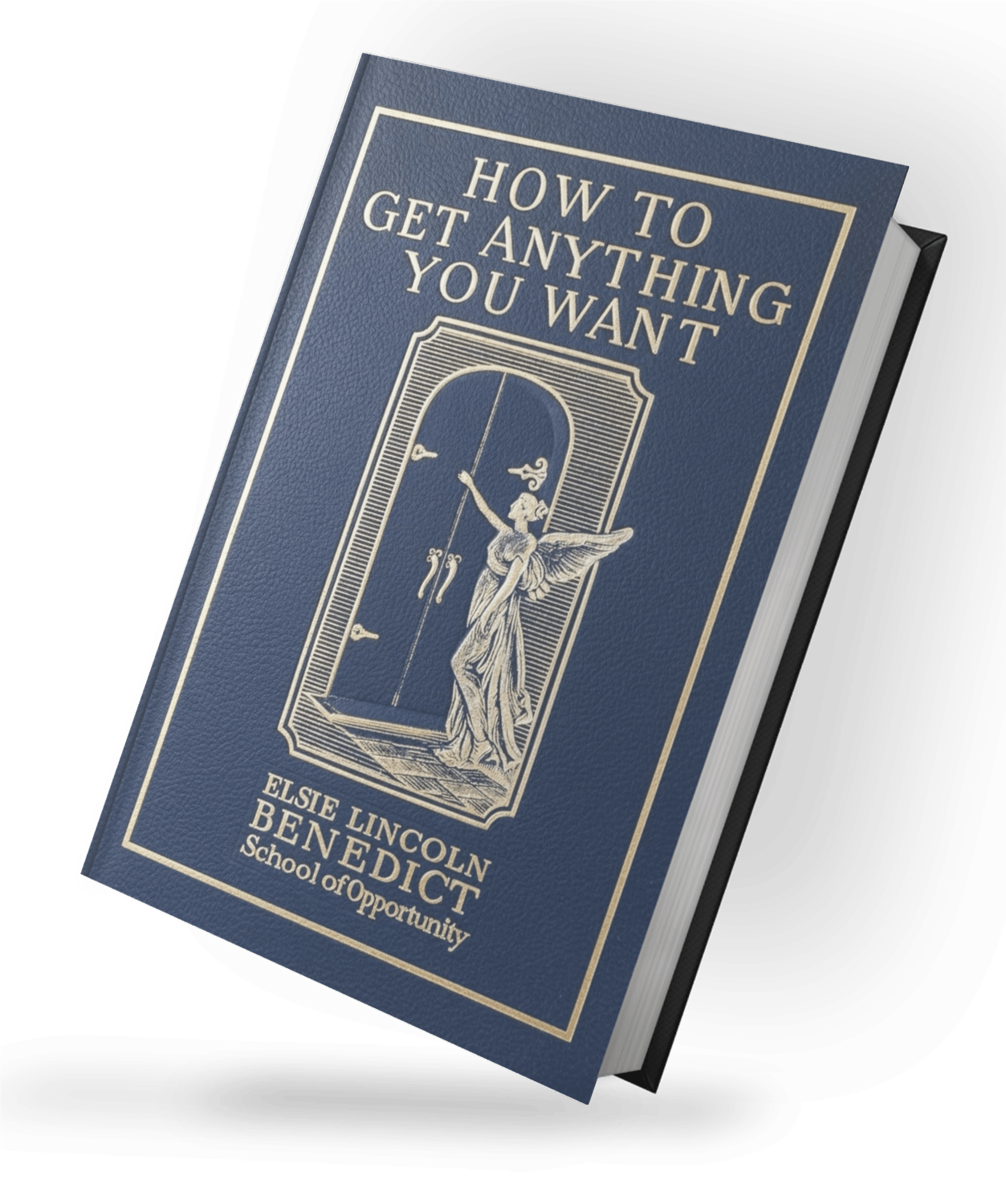
How To Get Anything You Want by Elsie Lincoln Benedict - Book Summary
Have you ever watched someone get everything: the promotion, the relationship, the "lucky break," while you're still waiting for your turn? Have you ever wondered what they know that you don't?
That's the question Elsie Lincoln Benedict set out to answer nearly a century ago, and it's a question I still hear from leaders and dreamers alike almost every single week.
This post is the pillar: the one place that brings together all fourteen lessons in one sitting, with the stories, quotes, and reflection questions you need to actually put them to work.
Whether you're chasing a career goal, rebuilding your health, repairing a relationship, or just trying to figure out why some people seem to get "lucky" over and over again, this book has something for you. Grab a pen and a notebook, and let's walk through one of the earliest and most influential personal development books ever written.
Why You Should Read This Book
There's no shortage of manifestation content promising a vision board, a hack, or a five-minute morning ritual that changes everything overnight. How to Get Anything You Want isn't quite that, even though it planted the seeds for a lot of what followed. Written in 1923 by a woman who lectured to over 100,000 students in person, it's one of the true root texts of modern self-improvement, a direct ancestor of Think and Grow Rich, The Secret, and nearly everything in between.
Here's what makes this book different: Benedict wasn't a theorist locked away in an office. She built her ideas on stage, in front of massive live audiences, testing and refining her material lecture after lecture until it actually moved people to change.
You should read this book if:
You've ever done everything "right" and still not gotten the results you wanted. Benedict's core argument is that surface-level effort isn't enough. Your predominant, subconscious mood is doing more of the work than your to-do list ever will.
You want to understand where modern manifestation and mindset teaching actually came from. If you've read newer books in this space, you'll recognize entire frameworks here in their earliest form.
You're tired of vague goals and want a genuinely practical system for getting specific about what you want and setting your mind to work on it.
You want proof that this isn't just modern hype. A U.S. government health bulletin, cited in this very book, was already telling Americans in the 1920s that worry, not overwork, was the real threat to their health.
I'll say this plainly: some of this book's language is dated, and a few of its claims deserve a raised eyebrow rather than a nod. But strip away the 1920s phrasing, and you'll find a genuinely useful framework for taking responsibility for your inner life, one that, a hundred years later, is still the hardest and most important work any of us ever do.
Key Takeaways
Before we walk through all fourteen lessons individually, here's the view from 30,000 feet. If you remember nothing else from this post, remember this:
Your predominant mood, not the event itself, builds your life. It's never what happens to you that counts, but how you take it.
Vague wanting produces vague results. A definite desire focuses your energy the way a burning glass focuses sunlight into a flame.
You get what you prepare for, whether or not you ever admit to yourself what that preparation has really been.
Opportunity rarely announces itself. You have to look for it, recognize it, and push it open yourself.
Most people already have what they most deeply want. They just haven't been honest with themselves about what that actually is.
Your conscious mind handles the details. Your subconscious mind handles the results. Learning to work with both, instead of fighting your own subconscious, changes everything.
Every person has one Supreme Subconscious Wish underneath all their smaller goals, and knowing yours is often the difference between success and struggle.
Rest isn't the opposite of progress. Sometimes the fastest way through a problem is to set it down and let your subconscious finish the work quietly.
Memorable Quotes from How to Get Anything You Want
This book is loaded with lines that still hit just as hard a century later. Here are some of my favorites:
"It is never what happens to you that counts, but how you take what happens to you."
"Yes, they are trifles. But trifles make perfection, and perfection is no trifle." A line Benedict borrows from Michelangelo to make her point about consistency.
"You get what you prepare for."
"Definite desire focuses and harnesses a thousand energies you are not even aware of now, and burns a hole to what you want."
"There are no accidents. Everything in the universe occurs in accordance with law."
"The trouble with the unsuccessful is not that they lack ability or opportunity... they lack... a willingness to pay the price."
"A genius is one who cannot be kept away from his work."
"Change your thoughts about yourself, and you will change yourself."
That line about paying the price is worth reflecting on. Benedict isn't talking about money. She's talking about the willingness to actually do the inner work most people quietly avoid.
About Elsie Lincoln Benedict
Elsie Lincoln Benedict (1885-1970) was an American author and public speaker who became one of the most famous lecturers of the early 20th century, drawing crowds of thousands to hear her speak on human psychology and the art of getting what you want out of life.
Benedict was born in San Francisco to a family of modest means. As a young woman, she struggled with a series of health issues, which sparked her early interest in natural healing and holistic medicine. That curiosity eventually pulled her toward the study of human behavior and psychology more broadly, and she began developing the lecture material that would make her a household name.
She and her husband, Ralph Paine Benedict, co-wrote this book together and went on to found the Benedict School of Salesmanship, training salespeople and business professionals in the psychology of influence and persuasion. Their most famous joint work outside of this one is How to Analyze People on Sight, which introduced her theory of "The Five Human Types," a system for reading personality from physical traits that she references several times throughout this book.
It's worth being honest here: Benedict's ideas were controversial even in her own time, and some of her theories, particularly around personality "types," have never held up to scientific scrutiny. She's occasionally been described by critics as a "self-help charlatan," and that criticism isn't entirely without merit. But her influence on the personal development field is undeniable, and the core psychological insight running through this book, that your habitual inner state shapes your outer results far more than most people realize, has aged remarkably well, even where her supporting science hasn't.
Introduction and Overview of the Book
How to Get Anything You Want began its life as a spoken lesson-lecture, delivered by Benedict to more than 100,000 students in classrooms across the United States, before being printed at their request so they could carry it with them and revisit it "as inspiration in your daily life."
Her premise, stated plainly in the opening pages, is this: our lives are not a series of accidental happenings. They are outer circumstances built, directly or indirectly, and usually unknowingly, by our predominant inner feelings. Change the mood, and you change the harvest.
A few ground rules shape how Benedict wants you to approach the book:
You don't need to have "full belief" before you start. She's emphatic about this: the laws work whether you believe in them yet or not, the same way gravity works whether you believe in it or not.
The lessons build on each other, but each one also stands alone. Learning to reset just one predominant mood will change your results. Learning all fourteen compounds the effect.
Preparation matters more than most people admit. You don't get what you say you want. You get what you've actually, quietly prepared for.
Your conscious and subconscious minds are two different workers, and real mastery comes from understanding what each one is actually built to do.
Benedict organizes her fourteen lessons loosely around a progression: first, understanding how your moods build your life; then, learning to define and focus your desires; then, understanding the subconscious mechanics behind manifestation; and finally, applying all of it to love, success, health, and daily work. We'll walk through all fourteen below, in the order she presents them, with a story, an application, and reflection questions for each.
Lesson I: How Your Predominant Moods Make Your Life
Your subconscious mind is a cannon on a boomerang principle: every shot you fire comes back to you, loaded with results.
Benedict opens with a story about a man on a country road who's told that continuing in his current direction will take him twenty-five thousand miles out of his way, while turning around would get him there in a mile and a half. That's her metaphor for most of us: we keep wondering why we haven't arrived, without ever checking whether we're pointed the wrong way.
Her key distinction in this opening lesson: it's not what you say, do, or pretend that shapes your life. It's what you genuinely feel, deep down, over time. She tells the story of a woman who insisted, "Good people stay poor and wicked people get rich," and then spent her whole life staying exactly, precisely poor. Her belief about money, her predominant mood toward it, was manufacturing her reality penny for penny.
Reflection Questions:
What's the feeling you keep coming back to about money, relationships, or opportunity, not what you say you believe, but what you actually feel when no one's watching?
Where in your life have you been "expending your energies in exactly the opposite direction" from what you actually want?
Lesson II: How to Remake Our Moods for Mastery
While destructive moods take years to build, constructive ones can take root with astonishing speed.
Here's the encouraging turn in the book: because constructive attitudes work with the grain of the universe instead of against it, they can be rebuilt far faster than most people assume. Benedict's most useful tool in this lesson is what I call the Little House metaphor: your conscious mind as the front parlor, your subconscious as the basement. Every event walks through the front door of your awareness, but it's not the event itself that goes down into the basement. It's the ghost of that event, colored entirely by how you reacted to it.
She illustrates this with Michelangelo, who spent six weeks making tiny refinements to a nearly finished statue. When a younger artist scoffed that he'd "accomplished nothing," Michelangelo replied that trifles make perfection, and perfection is no trifle.
Reflection Questions:
Think of a difficult event from this past year. Did you let it go down into your basement as a "helpful worker," or as something destructive?
What's one small, "trifling" habit you could refine this week that would compound into something bigger?
Lesson III: How to Know What You Want Most
Definite desire focuses and harnesses a thousand energies you are not even aware of now.
This lesson opens with an image of unfocused sunlight spread across a whole field: it warms everything but burns nothing. Focus that same light through a burning glass, though, and it burns a hole straight through. Most of us never get specific enough to focus our energy. We want "a lot of things" in a vague, sweeping way, and life responds to vagueness with vagueness.
Benedict gives eleven rules for getting clear on your wants, but the ones that matter most are: write your desires down tonight, no matter how unattainable they look on paper; tell no one about your list while it's forming; and refuse to entertain the inner voice that insists you're too old, too far behind, or too handicapped to start.
Reflection Questions:
If you sat down right now and tried to list the ten things you want most, could you actually finish the list, or would you stall out?
What's one desire you've been afraid to write down because it looks "silly" on paper?
Lesson IV: How to Set the Next Gauge for What You Want
Your subconscious speaks in words, and the right words, set like gauges on a machine, set the current in motion.
Benedict uses the image of an electric stove with precise gauges and timers: set it correctly, walk away, and dinner cooks itself. Your subconscious works the same way. It doesn't need you hovering over it; it needs you to set the gauge correctly and trust the mechanism. The gage in this lesson is your own affirmation, a phrase built by you that genuinely fits your desires rather than one borrowed wholesale from someone else.
She uses Émile Coué's famous formula, "Every day, in every way, I am getting better and better," as a case study: it worked powerfully for some and did nothing for others because it simply didn't reach everyone's subconscious in the same way.
Reflection Questions:
Have you ever tried an affirmation that felt hollow or borrowed? What would a version in your own words actually sound like?
What are the "dead moments" in your day, waiting in line, sitting at a red light, where you could practice a phrase that actually means something to you?
Lesson V: How to Prepare for What You Want
"You get what you prepare for."
This is one of the sharpest lines in the whole book. Not what you deserve. Not what you talk about wanting. What you actually, secretly, in your bones, get ready for. Benedict argues that people who "stumble into success" have almost always been quietly preparing, in ways invisible to outside observers, for exactly what eventually showed up.
She quotes opera singer Mary Garden's advice to young performers: even genius needs more preparation than most people realize, and talent without preparation is useless.
Reflection Questions:
Stop asking "why hasn't success come to me yet," and ask instead: what have I actually been preparing for?
In what ways has your daily behavior been preparing you for the opposite of what you say you want?
Lesson VI: How to Find the Open Doors to What You Want
Look for them. Recognize them. Push them open.
This lesson gives us a beautifully simple three-step framework for opportunity. Benedict makes a sharp observation: opportunities don't announce themselves with fanfare. They're already ajar, waiting, but most of us miss them because we're not actively looking, or we don't recognize them when they show up in an unfamiliar shape.
She contrasts this with a cautionary example: the overly sensitive person who expects to be slighted, prepares for it, looks for it everywhere, and then reacts to imagined offenses, literally manufacturing the very rejection she feared and reinforcing the cycle.
Reflection Questions:
What you expect, you prepare for. What you prepare for, you look for. What you look for, you find. Is that cycle currently working for you or against you?
What's one door of opportunity you may have walked right past because you weren't recognizing it as one?
Lesson VII: How to Make Your Desires Materialize
Once you have paid the toll at one gate, you never have to pay it again, and every gate you pass through makes the next one easier.
Benedict compares life to a great city with many gates, each with its own toll. This lesson delivers one of the most honest truths in the whole book: most people already have what they most deeply want, even when they insist otherwise. She tells the story of a friend who claimed she wanted a $35 suit "more than anything," but when handed the chance to buy it on the spot, chose to keep the money instead. She didn't actually want the suit more than she wanted comfort and security. And that's fine, but it's honest.
Reflection Questions:
Look at your actual behavior, not your stated goals. What does it reveal about what you truly want most?
Is there a gap between what you say you want and what you consistently choose? What would it take to close it?
Lesson VIII: Your Secret, Subconscious Self
Your mind is like an iceberg: the conscious mind is the one-tenth above the surface; the subconscious is the nine-tenths below.
This is the "textbook" lesson of the book, and it went on to shape a century of popular psychology. Your conscious mind is the "retailer," dealing in the small, daily details. Your subconscious is the "wholesaler," dealing only in the massed, cumulative result of everything you've ever felt, whether or not you consciously remember the original event.
Reflection Questions:
What decisions have you been trying to force with willpower that might actually need a change in your predominant feeling state instead?
What's one recurring pattern in your life that might trace back to something below the surface you've never fully examined?
Lesson IX: Your Emotions
Every human being organizes their entire personality around one deep, consuming desire: their Supreme Subconscious Wish.
Benedict argues that the most successful people simply know what their Supreme Wish is, while everyone else is guessing, and guessing produces half-results. She also makes a bold claim worth sitting with: your subconscious will back you with tireless energy when your work aligns with that wish, and quietly sabotage you with fatigue when it doesn't, no matter how hard you try to force it.
Reflection Questions:
If a goal exhausts you every single time you approach it, is that laziness, or is it your subconscious telling you this isn't actually your deepest desire?
Can you name your own Supreme Subconscious Wish? If not, what would it take to find it?
Lesson X: Mental Miracles
Fixed fears, fixed faiths, and fixed fancies: the emotional imprints that shape our instant likes and dislikes without us ever knowing why.
Here, Benedict explains why we instantly like or dislike certain people for no logical reason, often because that person symbolically resembles someone or something tied to a strong emotion from our past. She tells the story of a grocer who, for thirty years, gave special attention to any woman wearing a fur hat, because his beloved mother, who died when he was seven, always wore one. He had no conscious memory of the connection until it was pointed out to him.
Reflection Questions:
Before you trust an instant "gut feeling" about someone completely, ask: Is this wisdom, or is this an old symbol wearing a new face?
Can you trace one of your own strong, unexplainable reactions back to an early experience you'd forgotten?
Lesson XI: Love, Courtship and Marriage
Identical experiences produce completely different reactions in different people because of type and temperament, not the event itself.
This lesson applies the book's psychology to relationships and explores the subconscious "flight from reality," the tendency to escape pain that's too difficult to face directly, whether through dreams, distraction, or (in extreme WWI-era cases) "shell shock" with no physical cause. It's a striking early articulation of what we'd now call trauma response.
Reflection Questions:
"None ever achieved greatness without a great love," Benedict writes. Are you sidelining your relationships while you chase achievement?
Where might you be quietly escaping a painful reality instead of walking through the front door of it?
Lesson XII: Success and Your Supreme Wish
The trouble with the unsuccessful is not that they lack ability or opportunity: they lack a willingness to pay the price.
This is where the book gets genuinely inspiring. Benedict lays out what separates a genius from a big success from an average person, and it isn't talent. The genius has a supreme wish to do a certain kind of thing, regardless of consequences. The big success has a supreme wish to achieve a certain goal and is willing to do anything honorable to reach it. The average person wants to have it without doing anything, waiting for fate to hand something over.
Reflection Questions:
Which category are you currently operating from: do you want to do the work, or do you just want the outcome?
What price have you been unwilling to pay for the thing you say you want most?
Lesson XIII: Healing Ourselves and Helping Others
The same four-step process that manifests anything else, thinking about it, looking for it, concentrating on it, preparing for it, also manifests illness.
Benedict applies her whole framework to physical health, arguing, in language decades ahead of its time, that fear and worry are among health's greatest enemies. She even cites an actual U.S. Public Health Service bulletin from her era that makes the same claim. Her point: reverse the direction of your thinking, and you reverse the outcome.
Reflection Questions:
Where might fear or rumination be quietly adding weight to a physical or emotional struggle you're carrying?
What would it look like to stop rehearsing the worst-case scenario, even just for one day?
Lesson XIV: How to Let Your Subconscious Help You in Your Work
Mr. Conscious and Mr. Subconscious: two workmen inside you, each built for a different job.
The final lesson is deeply practical. Benedict encourages readers to notice their own "high tides," the conditions, times of day, and environments where their mind works best, and stop apologizing for them. She shares a story from her own childhood: a teacher, recognizing she'd exhausted herself wrestling with arithmetic, told her to set it down completely for two months and not think about it at all. When she returned to it, the answers came easily, because her subconscious had quietly kept working while her conscious mind rested.
Reflection Questions:
What are your own "high tides," the times and conditions where your best thinking actually happens?
Is there a problem you've been grinding on that might actually need rest, not more effort?
Conclusion (And Your Next Step)
Here's what I keep coming back to after studying this book: a hundred years before "manifestation" became a buzzword, Elsie Lincoln Benedict was teaching a room full of ordinary Americans that their predominant mood, not their luck, not even their hard work alone, was quietly building the life around them. Strip away the dated language and the occasional pseudoscience, and the core truth still holds up: you are not the victim of your circumstances. You are, more often than you'd like to admit, their architect.
That's genuinely good news. It means you don't need a lucky break, a wealthy family, or a natural gift to start changing your results. You need honesty about your predominant moods, clarity about what you actually want, and the willingness to prepare, quietly and consistently, for the life you say you're after.
So here's your call to action: don't just close this post and move on. Pick one lesson, the one that stung a little as you read it, and take one concrete step on it this week. Write down what you actually want. Build your own formula instead of borrowing someone else's. Then come back to this post and dig deeper into whichever lesson your life needs from you most right now.
You don't need to master all fourteen lessons overnight. You just need to start with one.
Other Works by Elsie Lincoln Benedict
If How to Get Anything You Want resonated with you, here's where to go next in Benedict's body of work:
How to Analyze People on Sight (The Five Human Types): Benedict's best-known work, co-written with Ralph Paine Benedict and referenced several times in this book. It lays out her theory that all people fall into five biological "types," each with distinct traits, a controversial but historically influential framework that shaped decades of popular personality typing that followed.
How to Unlock Your Subconscious Mind (Through the Science of Mental Analysis): A deeper dive into the exact subconscious mechanics Benedict introduces in Lessons VIII through X of this book: the iceberg model, fixed fears and faiths, and the science she called Mental Analysis.
Read Benedict with the same clear eyes you'd bring to any book nearly a century old: keep what still holds up, question what doesn't, and take the parts that genuinely help you build a more intentional inner life.
Enjoyed this breakdown? Subscribe to the Learning to Lead Newsletter for more book summaries, leadership frameworks, and practical encouragement delivered weekly.

Join over 4,000 Growth-Minded Leaders reading The Learning To Lead Newsletter each week!
Latest Blog Post
Join over 4,000 Fellow Leaders reading The Learning To Lead Newsletter each week!
©2025 Learning To Lead | Helping Good Leaders Become Great Leaders