
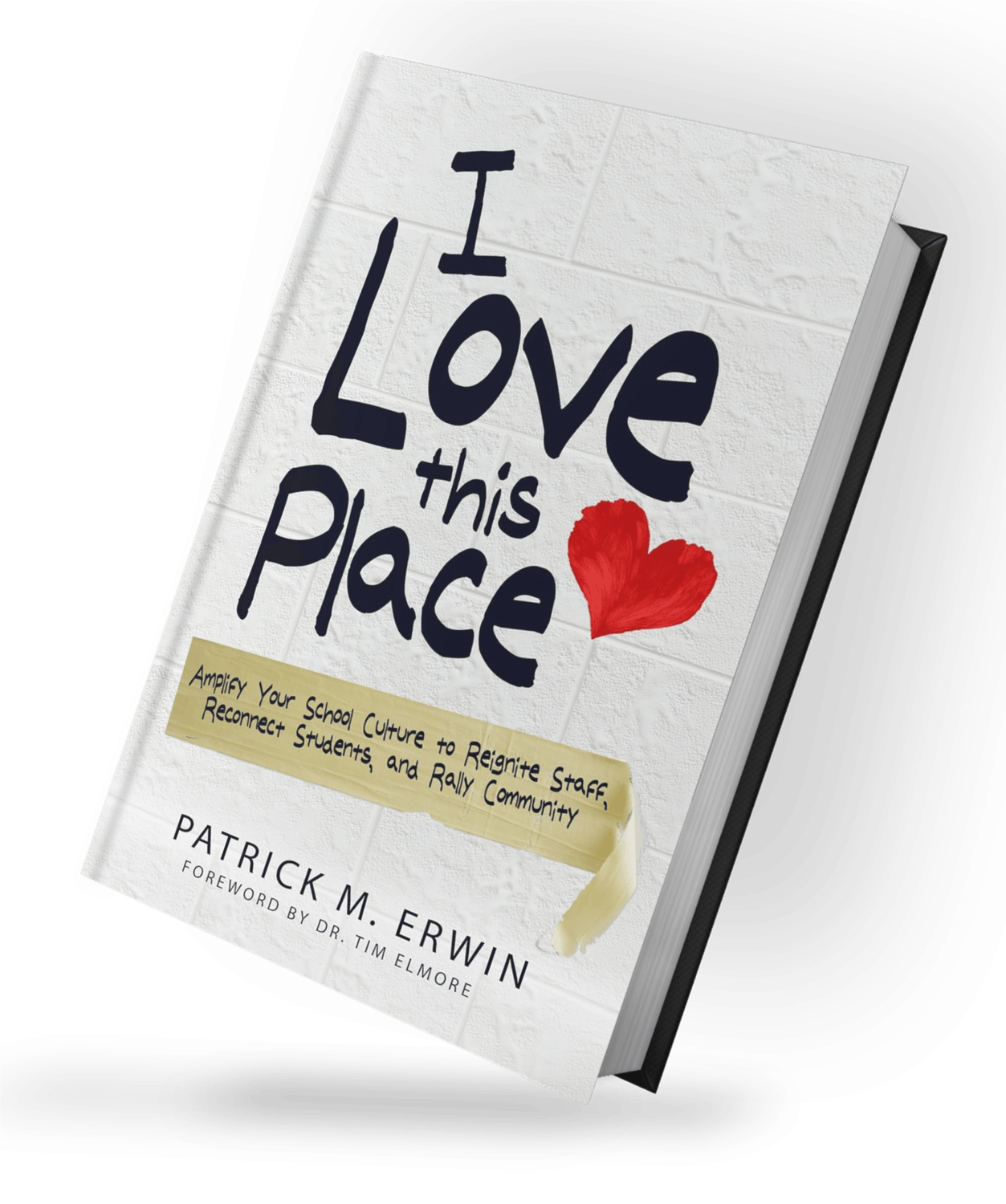
I Love This Place by Patrick M. Erwin - Book Summary
Have you ever walked into your building and felt the culture before anyone said a word to you?
You know the feeling. Some hallways hum. People make eye contact, laugh a little too loud, and greet each other by name. And some hallways just feel heavy, even when nothing is technically wrong. Culture is like that. You feel it before you can explain it.
Patrick Erwin spent seventeen years feeling both sides of that hallway as a band director at Hillgrove High School in Cobb County, Georgia, and he recently joined me on The Learning to Lead Show to talk about what he learned building a program where students, staff, and eventually an entire community started saying the same three words: I Love This Place.
You can listen to our conversation here: #52 Tough and Tender Leadership with Patrick Erwin, Director of Content & Training at The Maxwell Leadership Foundation
Grab a coffee. Let's talk about what it actually takes to build a culture people don't want to leave.
Why You Should Read This Book
Here's the trap a lot of us fall into as leaders, especially in schools: we assume that if we just get better at our job (better lesson plans, better systems, better strategy) a great culture will follow. Patrick believed that too, right up until his recruiting numbers cratered and his own wife told him he was "talking the talk and not walking the walk."
I Love This Place is Patrick's answer to that wake-up call. It's built around a simple but convicting idea: techniques and strategy are not enough. Culture isn't a byproduct of doing your job well. Culture is the product of intentional, visible, daily leadership, and it starts with you looking in the mirror before you look at your team.
You should read this book if:
You've noticed people slipping away: students not re-enrolling, teachers browsing job boards, staff quietly checking out, and you know it's not really about pay or curriculum.
You lead in a school, on a team, or in any organization where "culture" has become a buzzword, and you want a practical, memorable framework instead of another vague mission statement.
You want language your team can actually use. Patrick gives you a vocabulary (Tough and Tender, HUSTLE, Minutes and Moments) that turns into everyday conversation, not a binder that sits on a shelf.
You believe leadership is caught more than taught. This book is built on the conviction that "how you do anything is how you do everything," and it will challenge you to lead yourself before you try to lead anyone else.
Patrick organizes the heart of the book around one unforgettable acronym: HUSTLE, Humility, Understanding, Scholarship, Trust, Leadership, and Excellence. Once you see it, you'll start using it as a lens everywhere: in your own team meetings, in your own blind spots, in the moments when your leadership either builds culture or quietly erodes it.
Key Takeaways
Here's the big picture before we walk through it chapter by chapter.
Leadership, not strategy, builds culture. Better techniques will make you better at your job. They won't make people love where they work. Only intentional leadership does that.
Your response is your responsibility. You can't control the weather, the world, or most of what happens to you, but you can always control your attitude, habits, and how you show up for the people you lead.
Great leaders are Tough AND Tender. Care without accountability breeds entitlement. Accountability without care breeds rebellion. The leaders people follow hold both at once.
HUSTLE isn't hustle culture. It's not about running yourself ragged. It's about maximizing every minute (excellence) and maximizing every moment (connection) with the people in front of you.
Diversity is your symphony, not your obstacle. The friction that comes from different voices and strengths on your team is worth it: a symphony will always outperform a soloist.
You can't lead well while spinning too many plates. Discipline and focus aren't extras for a leader. They're the difference between being trusted and being a distraction.
Trust = Gratitude + Growth. People won't accept your feedback until they know you're grateful for them. Recognition comes first. Accountability comes second.
Your attitude determines who joins you. Your habits determine your destination. Your attitude determines who's standing next to you when you get there.
Excellence is an environment, not an achievement. Chase culture first, and excellence follows. Chase achievement first, and you'll burn people out chasing scores and rankings instead.
Amplification is the whole point. You can add value by growing yourself. You can multiply it by growing leaders around you. That's how culture spreads beyond what any one person could do alone.
Now let's slow down and go deeper into each part of the book.
Memorable Quotes from I Love This Place
A few lines worth writing on a sticky note and putting on your monitor:
"How you do anything is how you do everything."
"My response is my responsibility."
"Caring and accountability are both forms of compassion. They are two sides of the same coin."
"Maximize every minute by pursuing excellence. Maximize every moment by pursuing connection."
"We can do anything, but we cannot do everything."
"We leave no one behind because we care about them. We leave no one where we found them because we know they need to grow."
"Your attitude determines who will join you in your future."
"Excellence isn't uncommon. It's everywhere. It just needs the right environment."
"Leadership development is how you amplify your culture."
"Amplification happens when people know they are free to lead."
That last one might be the whole book in a sentence. Culture doesn't scale because a leader controls more. It scales because a leader releases more.
Meet Patrick M. Erwin

Patrick spent seventeen years as a Band Director, including sixteen at Hillgrove High School, where he led a program that averaged over 300 students and a nearly $300,000 booster club budget, essentially its own miniature organization inside a larger one. He describes himself in year one as a twenty-six-year-old with "100 percent confidence" that he had all the answers, until an anonymous student review on a now-defunct rate-my-teacher website suggested otherwise.
That humbling moment started a journey that took years to fully land. It wasn't until a rough recruiting season in 2018 and a hard, honest conversation with his wife, Aaren, a fellow teacher, that Patrick realized he'd been preaching leadership to his students without practicing it himself. From there, he rebuilt his own leadership from the inside out, using a curriculum called Habitudes (now iLead) to grow leaders in his classroom, not just musicians.
Today, Patrick serves at Maxwell Leadership Foundation as Curriculum Director, working alongside founder Dr. Tim Elmore, who wrote the foreword to this book. I Love This Place is Patrick's distillation of nearly two decades spent learning, sometimes the hard way, what actually makes people want to stay.
Introduction and Overview of the Book
"How you do anything is how you do everything."
Patrick opens with his own origin story: the confident young teacher, the humbling review, and years spent chasing better pedagogy and better technology, only to discover his recruiting numbers were still sliding. The missing ingredient wasn't a better classroom. It was better leadership.
"How you do anything is how you do everything."
That single sentence becomes the thesis for the entire book. You can't compartmentalize leadership to your title or your best moments. It has to show up everywhere: in the hallway, the cafeteria, the parking lot, and yes, even the group chat.
Part One: Looking in the Mirror
The first three chapters are about becoming the kind of leader your people actually need, before you try to change anything around you.
Chapter 1: Techniques and Strategy Are Not Enough
"Unhappy people blame their leaders; happy people talk about how they feel"
Patrick traces his own journey from a teacher chasing better techniques to a leader who realized culture doesn't happen by accident. It has to be built on purpose. He leans on Michael Fullan's definition of school culture (the values, attitudes, and expected behaviors that shape a school's daily life) and draws a hard line: unhappy people blame their leaders, happy people talk about how they feel, and either way, culture and leadership are what determine whether people stay, engage, or walk away.
Reflection Questions:
In what ways might a shift toward intentional leadership improve your culture?
Think of a time when you realized your leadership style wasn't working. What changed, and what did you learn about yourself in that moment?
How can you model daily leadership so that the people around you begin to feel, "I love this place"?
Chapter 2: The Struggle Is Real
"My Response Is My Responsibility"
Patrick anchors this chapter in March 2020, the week his band was about to perform Shostakovich's Fifth Symphony and schools shut down instead. The lesson wasn't strategy. It was leadership: showing up for his students in a moment they needed reassurance, not a plan. From there, he introduces one of the book's most repeated phrases:
"My response is my responsibility."
Leaders can't control the weather, the pandemic, or the inbox. They can control their attitude, habits, and how they show up.
Reflection Questions:
How do you usually respond to struggle, and why?
Have you ever seen a leader who was bent on controlling things they couldn't? What was the result?
What values, attitudes, and behaviors are you modeling that shape your culture right now?
Chapter 3: The Leader They Need
"Caring and accountability are both forms of compassion. They are two sides of the same coin."
This chapter introduces the book's central paradox: leaders need to be tough AND tender. Drawing on John Maxwell's 360-Degree Leadership, Patrick shows what it looks like to lead down, sideways, and up: being visible in the cafeteria with peers, inviting his principal into his classroom, and leading his own boss well. He names the balance leaders must strike:
"Caring and accountability are both forms of compassion. They are two sides of the same coin."
Care without challenge creates entitlement. Challenge without care creates rebellion.
Reflection Questions:
Would the people you lead say you're tougher or more tender? What might they need more of from you?
How have you seen "funnel style" leadership play out in your career, dumping information instead of filtering it? What could shift to help you become more of a filter for people?
Who in your circle needs more care from you right now, and who needs more accountability?
Part Two: The HUSTLE Framework
Chapter 4: Good Things Come to Those Who HUSTLE
HUSTLE means maximizing every minute (pursuing excellence) and every moment (pursuing connection).
This is the hinge chapter of the entire book. Patrick unpacks the phrase that echoed through sixteen years of practices at Hillgrove, HUSTLE, and reframes it away from burnout culture. HUSTLE means maximizing every minute (pursuing excellence) and every moment (pursuing connection).
He introduces the full acronym that structures the rest of the book:
Humility
Understanding
Scholarship
Trust
Leadership
Excellence
Three of the six are Tender (Humility, Understanding, Trust) and three are Tough (Scholarship, Leadership, Excellence): a built-in framework for balancing both sides of great leadership.
Reflection Questions:
How are you maximizing your minutes (planning, strategy, systems) and your moments (connection, presence, encouragement)?
Which part of HUSTLE comes most naturally to you, and which one needs your attention right now?
How would your team describe the way you show up daily, in your effort, energy, and presence?
Part Three: The Six Pillars of Tough and Tender Leadership
Six chapters, one for each letter of HUSTLE.
Chapter 5: Humility – "Turn Your Back to the Crowd"
"Humble leaders draw others in by being self-aware. As they do, those people will start to love the place and the leader."
Patrick draws on his years conducting musical ensembles, literally standing with his back to the audience so the performance can happen, as a picture of humble leadership.
"Humble leaders draw others in by being self-aware. As they do, those people will start to love the place and the leader."
Humility isn't weakness; it requires confidence to pair with it, or it slides into passivity. And if leaders don't choose humility, Patrick warns, life has a way of choosing humiliation for them.
Reflection Questions:
What does "turn your back to the crowd" mean in your role?
Where are you modeling humility in ways your team can actually see?
How do you balance confidence with not becoming arrogant?
Chapter 6: Understanding – "Leading Your Symphony"
The Power of the Symphony Is in the Diversity of Its Voices
Drawing on his experience conducting a full orchestra at Carnegie Hall, Patrick contrasts the soloist (talented but limited) with the symphony (powerful because of its range).
Great leaders don't flatten their teams into sameness. They learn each person's strengths and conduct themselves accordingly, knowing when to spotlight a voice and when to step back.
Reflection Questions:
In what ways are you appreciating and leveraging the different perspectives and voices on your team?
How well do you actually know the strengths of the people you lead?
What are you doing to build belonging on your team?
Chapter 7: Scholarship – "Beware Spinning Too Many Plates"
Discipline means knowing your limits so you don't drop the plates that matter.
Patrick opens with Erich Brenn, the famous Ed Sullivan Show plate spinner who kept exactly thirteen plates going, not more.
The lesson: discipline means knowing your limits so you don't drop the plates that matter.
"We can do anything, but we cannot do everything."
Scholarship, in Patrick's framework, is being a student of your own craft, disciplined enough to stay focused and present for the people counting on you.
Reflection Questions:
What's one plate you need to stop spinning so you can focus on what matters most?
How are you modeling discipline and focus to those you lead?
If your team followed your lead with your time, energy, and follow-through, what would that look like?
Chapter 8: Trust = "Gratitude + Growth"
People won't receive your feedback until they know you're grateful for them first.
Anchored in the story of Sherri Thoroughman, an athletic director who balanced tough evaluations with genuine appreciation, this chapter offers a simple formula:
Trust = Gratitude + Growth.
People won't receive your feedback until they know you're grateful for them first. Patrick recommends a 5:1 ratio of positive-to-negative interactions and highlights rituals, recognition, and specific feedback as the building blocks of a trusting culture.
Reflection Questions:
What's one way you can recognize someone this week that feels personal and specific?
Who on your team needs gratitude right now, and who needs growth?
What is your typical approach to giving feedback, and how can you improve in this area?
Chapter 9: Leadership – "What Colors Are in Your Box?"
Your habits determine your destination, but your attitude determines who's willing to make the journey with you.
Borrowing Allen Klein's image of attitude as a box of crayons, Patrick shares the six words he chose to define his own leadership tone:
Humorous
Tenacious
Sensitive
Urgent
Encouraging
Listener.
His point: your habits determine your destination, but your attitude determines who's willing to make the journey with you.
"Your attitude determines who will join you in your future."
Reflection Questions:
What "colors" are most present in your leadership right now? Is anything missing?
How would your team describe the emotional tone you bring to work?
What's one word you want others to associate with your leadership this year?
Chapter 10: Excellence – "Environment Not Achievement"
"Excellence isn't uncommon. It's everywhere. It just needs the right environment."
Patrick deliberately places Excellence last in HUSTLE, not because it's least important, but because it's the result of everything before it, not the starting point. He draws a sharp line between achievement (GPA, test scores, performance indices) and excellence (an environment where people's best naturally shows up).
"Excellence isn't uncommon. It's everywhere. It just needs the right environment."
Reflection Questions:
What messages does your environment send about what's expected and what's accepted?
Where are you already seeing excellence show up on your team? Why there?
What's one part of your environment that could better support excellence?
Part Four: Amplifying Your Culture
Chapter 11: Amplify Your Culture
You add value by growing yourself. You amplify it by growing others.
Patrick uses the physics of sound waves, constructive versus destructive interference, as a metaphor for leadership development. When leaders get their people "on the same frequency" through intentional training, the result is amplification: a louder, more resonant culture.
This is where the book's second big idea lands fully: you add value by growing yourself. You amplify it by growing others.
Reflection Questions:
How are you actively growing leaders around you, not just managing tasks?
Where might you be limiting growth by doing too much yourself?
What small leadership opportunity could you hand off to someone this week?
Chapter 12: "I Love This Place" in Your Place
When people feel seen, loved, and challenged, culture becomes something you can count on, not something you hope for.
Patrick offers a simple but grounding framework: you control your own leadership; you cannot control the people or community around you; and in between lies the space you can influence by growing leaders.
Leadership training, he argues, is predictive of behavior: when people feel seen, loved, and challenged, culture becomes something you can count on, not something you hope for.
Reflection Questions:
Who in your building or circle needs to be invited into leadership, and what may be holding them back?
How can you move from leading alone to leading alongside others?
How can you intentionally spread the culture you want through your team and into your community?
Chapter 13: It's Not About Us
Amplification Happens When People Know They Are Free to Lead
Patrick closes with the story of Brenna, a student who didn't ask for his help. She asked for his permission and support to launch a peer-mentoring program pairing band students with special-needs learners.
"Leadership development is how you amplify your culture."
He also honors his own mentor, principal Joe Boland, whose auditorium now bears his name because of the culture he built, one that was both tough and tender.
The final challenge is simple:
"We leave no one behind because we care about them. We leave no one where we found them because we know they need to grow."
Reflection Questions:
How can you help others say, "I love this place," this year?
How can you create more opportunities for leadership around you?
What legacy do you want to leave long after you're gone?
Conclusion (And Your Next Step)
Here's what stays with me most after sitting with this book. I Love This Place isn't really a book about band programs, even though it's dressed in trumpet fanfares and marching field metaphors the whole way through. It's a book about the mirror every leader has to look into before they ever try to change the room around them.
You don't need a new strategy this week. You need to ask yourself the question Patrick asked himself back in 2018, standing in front of a recruiting number that told him the truth before anyone else would:
Am I leading myself well enough to lead the people who are counting on me?
So here's your call to action. Don't just close this out and move to the next thing on your list. Pick one letter of HUSTLE, the one that convicted you most as you read, and ask yourself honestly where you stand today.
Then go find one person you can pour it into this week.
Culture doesn't happen by accident. It happens because a leader deliberately built a place people don't want to leave.
Go build that place!
Connect with Patrick M. Erwin

Join over 4,000 Growth-Minded Leaders reading The Learning To Lead Newsletter each week!
Latest Blog Post
Join over 4,000 Fellow Leaders reading The Learning To Lead Newsletter each week!
©2025 Learning To Lead | Helping Good Leaders Become Great Leaders