
Built from Scratch, Nearly Broken, Rebuilt Stronger: Leadership Lessons from The Home Depot Story
This post draws on the Acquired podcast episode "The Home Depot" (Fall 2026 Season), hosted by Ben Gilbert and David Rosenthal. All credit for the research, storytelling, and analysis goes to Ben and David. The leadership reflections are mine.
Executive Summary
The Home Depot is one of the most remarkable leadership stories in American business. In 1978, two retail executives, Bernie Marcus and Arthur Blank, were fired from their jobs at Handy Dan, a hardware chain in Los Angeles. Bernie was 48 years old, with no savings and no equity. Within about a year, together with investment banker Ken Langone and merchandising genius Pat Farrah, they opened the first two Home Depot stores in Atlanta.
As Ben Gilbert and David Rosenthal share on Acquired, a $1,000 investment at Home Depot's 1981 IPO would be worth about $17 million today, making it the top-performing stock in the S&P 500 in total return since it went public. Today the company employs roughly 470,000 people, runs about 2,400 stores, and is worth around $350 billion.
But the story is not a straight line. Rapid growth hid real problems: no succession plan, chaotic decentralization, and cultural blind spots. An outside CEO brought operational discipline but stripped away the expertise, ownership culture, and customer obsession that made the company special. Customer satisfaction fell to last among major U.S. retailers. The board famously failed to show up at the 2006 shareholder meeting.
Then came Frank Blake, a quiet former lawyer who restored the culture, aligned his pay with shareholders, stopped building new stores, doubled down on the core business, and built a leadership bench so deep that it produced the current CEO of Lowe's.
For leaders, this is a story about complementary teams, customer-first culture, shared ownership, succession, humility, and the difference between founding values and founding tactics.
A Question to Start
Have you ever been told that your time was up, only to discover later that the ending was really a beginning?
I think about my own first leadership role. After 12 years in sales, I was promoted to plant manager of a small plant in North Mississippi in 1999. I had no formal leadership training. I had drive, relationships, and a willingness to learn, and I had people around me who knew things I didn't. What I learned quickly is that leadership is less about having all the answers and more about building a team, creating a culture, and serving the people who serve the customer.
That is exactly why this episode grabbed me. The Home Depot story is full of people who were underestimated, overlooked, or shown the door. It is also full of leaders who got it wrong, sometimes badly wrong. And it is a powerful reminder that culture is fragile, that success can hide problems, and that humility can save a company.
Let's walk through it together.
The Story at a Glance
Fired into founding. Bernie Marcus grew up poor in Newark, New Jersey, became a pharmacist, and worked his way up in retail. He and his CFO, Arthur Blank, turned Handy Dan into the best operator in the hardware industry. Wall Street didn't notice, but Ken Langone did. Ken bought nearly 20% of the company and joined the crew. When Daylin's new CEO, Sandy Sigoloff, forced Ken out, Ken warned Bernie that selling would be "your own death warrant." Three months later, Sigoloff fired Bernie, Arthur, and audit manager Ron Brill on a trumped-up labor investigation.
The golden horseshoe. The next day, over breakfast at the Waldorf Astoria, Ken told a panicked Bernie he'd just been kicked with a golden horseshoe. Bernie had already been dreaming of a warehouse-style home improvement store after visiting Sol Price's new Price Club. Now they would build it.
Assembling the team. After a deal with Ross Perot fell apart (over, of all things, Bernie's old Cadillac), Ken raised $2 million from about 40 investors in $50,000 chunks. Then they found Pat Farrah, a flamboyant retail genius whose store, HomeCo, was insolvent because he wasn't paying his suppliers. Rather than buy the store, they recruited the man. The team was complete: Bernie the retailer, Arthur the finance and operations mind, Ken the capital and glue, and Pat the merchandiser.
Scrappy beginnings. The first two stores opened in Atlanta on June 22, 1979, in secondhand space subleased from J.C. Penney. The newspaper ad never ran, so Bernie and his associates stood in the parking lot handing out dollar bills. They filled the shelves with empty boxes and paint cans to make them look fully stocked. Pat scuffed up freshly polished floors with forklifts because the store needed to look busy.
The growth machine. The model worked: low prices, huge selection, one-stop shopping, and something the copycats missed. Home Depot hired former tradespeople to teach customers how to do their own projects. Employees owned stock, and many became millionaires. The company went public in 1981 as a four-store chain, hit $1 billion in sales by 1986, passed Lowe's in 1989, and by 1996 was opening a new store every four days.
The fall. Bernie retired in 1997, and Arthur became CEO. Cracks emerged: a major gender discrimination settlement, chaotic decentralization, a resurgent Lowe's, and no successor. The board brought in Bob Nardelli from GE in 2000. He centralized operations and doubled revenue and store count, but he also cut floor staff, replaced experts with part-time workers, required college degrees for store managers, and refused to tie his pay to the stock price. The stock fell while Lowe's soared. After the infamous 2006 shareholder meeting, he was fired in January 2007.
The comeback. Frank Blake, a former lawyer with no operating experience, became CEO. He called Bernie first. He tied 90% of his pay to stock options. He stopped opening new stores, sold HD Supply, bought back massive amounts of stock, and invested in distribution and e-commerce. Home Depot thrived through the financial crisis and was ready when COVID hit.
Today. Frank's successors, Craig Menear and Ted Decker, came up through the company. Home Depot generates about $165 billion in revenue and holds roughly half of the home improvement store market.
Key Takeaways
Great companies are built by complementary teams. Ben and David describe Home Depot's founders as the "Avengers of retail." Nobody could have done it alone. Bernie knew his weakness was finance, so he brought in Arthur. They lacked merchandising genius, so they brought in Pat.
Culture is the real competitive advantage. The warehouse format was easy to copy. Many competitors tried, and none survived. What they couldn't copy was a culture of expert associates who would stop what they were doing to teach a customer.
Ownership changes behavior. When associates on the floor owned stock and understood how their service connected to the share price, they acted like owners. When a CEO's pay was disconnected from that same stock, trust collapsed.
Growth can hide your problems. Opening new stores masked flat same-store sales for years. As Ben put it, opening stores was treated as though it were virtuous in itself.
Succession is a leadership responsibility, not an afterthought. Home Depot built an incredible promotion path for store managers but never developed a successor for the founders. That gap led directly to its darkest chapter.
Operational excellence and entrepreneurial spirit must be balanced. Nardelli fixed real problems. But Ben warns that a company can "operationally excellence" itself out of being entrepreneurial.
Keep your founding values, but let go of founding tactics. No aisle numbers, no pro pricing, manufacturers shipping direct to stores: many early tactics are gone, and that's okay. The values of customer service and ownership are what matter.
Memorable Quotes from The Home Depot Story
A few lines from the episode stayed with me. Here they are, attributed to the speakers as presented on Acquired:
"You just got kicked in the ass with a golden horseshoe." - Ken Langone, to Bernie Marcus, the day after he was fired
"Our stores are action places." - Bernie Marcus
"In the retail business, when you can't sell something, you mark it down. In my business, when we can't sell something, we mark it up." - Ken Langone, to Arthur Blank after walking away from Ross Perot's deal
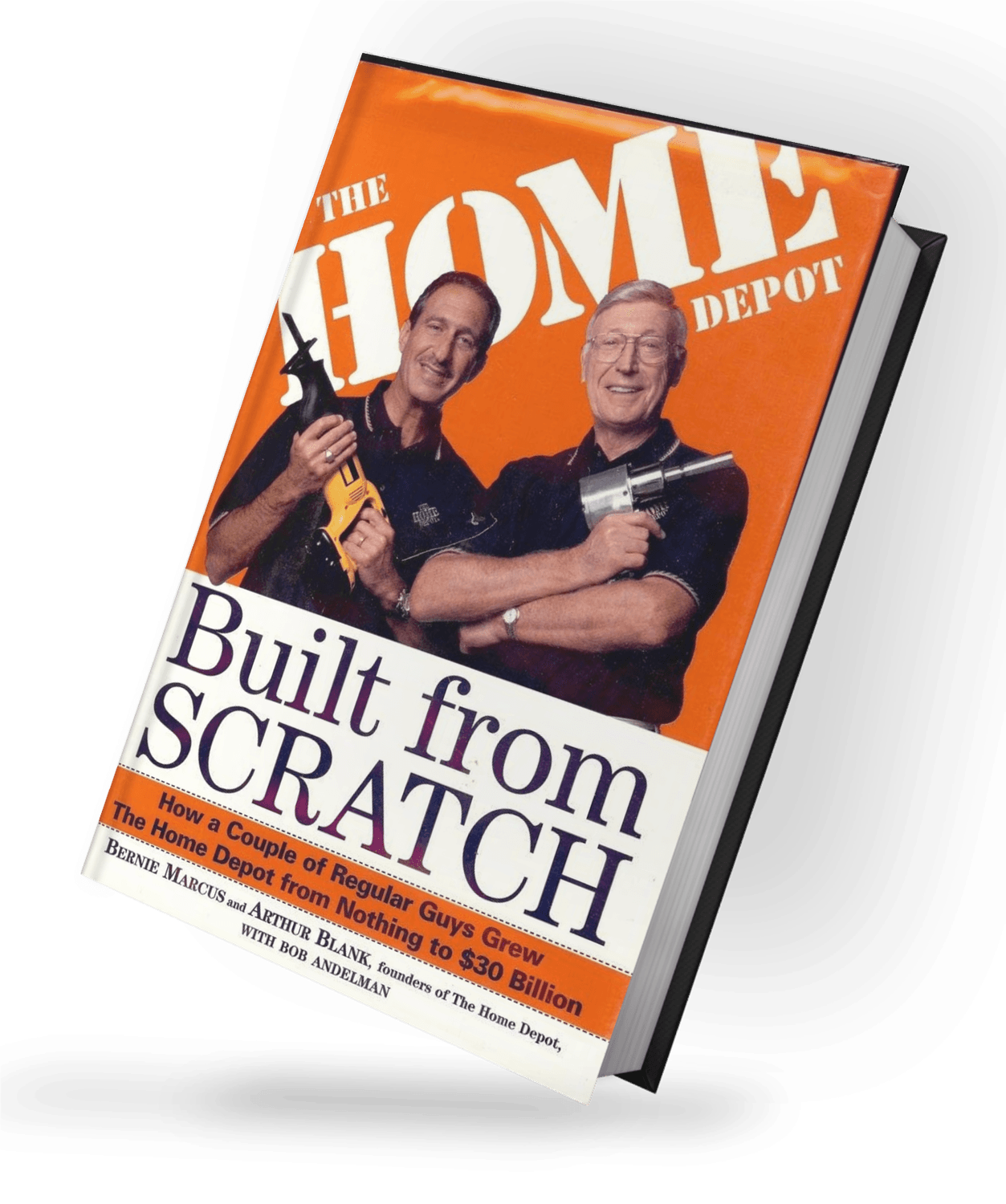
"We had to be psychologists, lovers, romancers, and con artists to get our suppliers aboard." - From Built from Scratch by Bernie Marcus and Arthur Blank, as read on the episode
"When you tap into people's basic instincts, good things happen." - Ken Langone, in conversation with the hosts
"The best sign of cultural health is walking into the break room and seeing the associates watching the stock price." - Frank Blake, former Home Depot CEO
"I think we should promote you." - Bernie Marcus, to the associate who sold a 25-cent washer instead of a $200 faucet
"You can operationally excellence yourself out of being entrepreneurial." - Ben Gilbert
"Opening more stores is not inherently virtuous unto itself." - Ben Gilbert
"The founding values are important, but the founding tactics are probably not." - Ben Gilbert
"The hard part is actually not about the stock picking. The hard part is in the holding." - Ben Gilbert, on Ken Langone never selling a share
That last one, borrowed from Ross Perot, is worth sitting with. Building a bench of leaders isn't a mass-recruitment exercise. It's slow, deliberate, and one relationship at a time.
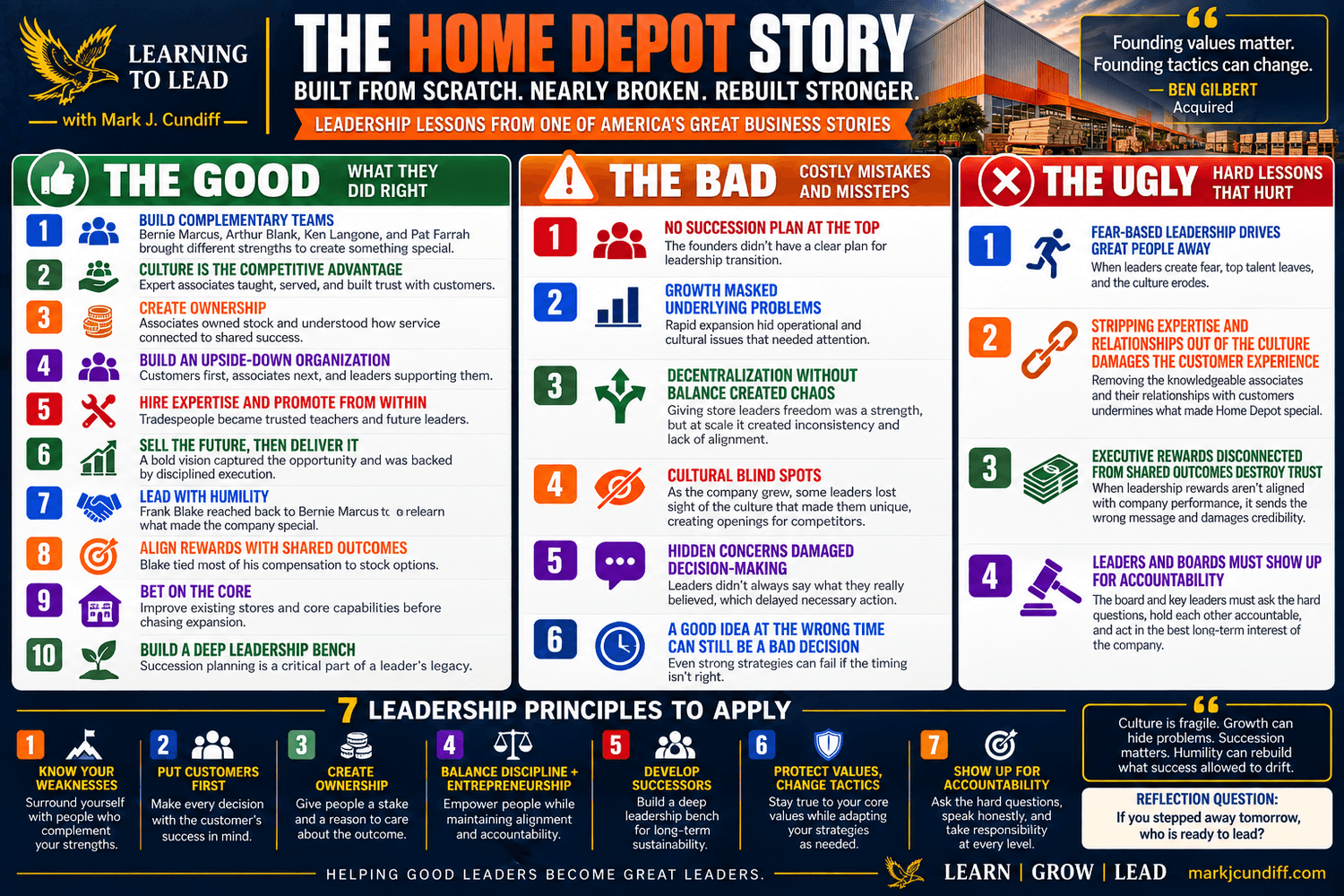
Leadership Lessons: The Good, the Bad, and the Ugly
Every organization has all three. What separates great leaders is not avoiding mistakes. It's recognizing them, owning them, and correcting course. Here is what Home Depot's journey teaches us, as Ben and David presented it.
The Good
1. Know your weaknesses and hire to them
Bernie Marcus was a brilliant retailer and a gifted leader. He also knew finance was his weak spot. So when he became CEO of Handy Dan, one of his first moves was to recruit Arthur Blank as CFO.
That self-awareness became the foundation of Home Depot. Bernie didn't need to be the smartest person in every room. He needed the right people in the room.
Ask yourself:
What is the one area where your team needs a strength you don't have? Who could you bring alongside you?
2. See potential in people others would dismiss
When Bernie, Arthur, and Ken first met Pat Farrah, he showed up an hour late in a too-small powder blue velvet leisure suit and gold chains. His business was going bankrupt because he wasn't paying suppliers. By any conventional measure, he was a bad bet.
But they saw what he could do. Ken would later compare Pat's retail gift to Michelangelo's art. Instead of buying Pat's failing store, they invited Pat to join them and protected him from the parts of the business he wasn't wired for. And Pat's character showed up later: he gave his own Home Depot shares to the HomeCo investors who lost money, to make them whole.
Great leaders look past the packaging and ask,
"What is this person uniquely great at, and how do I build around it?"
3. Build an upside-down organization
Home Depot doesn't have a headquarters. It has a Store Support Center. That name alone tells every employee what matters: corporate exists to serve the stores.
Frank Blake later revived the company's "inverted pyramid," with customers at the top, associates right beneath them, and the CEO at the very bottom. Ben shared a story from a recent store visit. An associate told him he had eight things on his to-do list and hadn't gotten to any of them because the customer always comes first.
That's not a slogan. That's culture.
4. Hire for expertise, then promote from within
The copycats hired general retail workers. Home Depot recruited plumbers, electricians, and carpenters, people who could teach a homeowner how to build a deck or retile a bathroom. Before YouTube, this was the only place many homeowners could learn.
As David explained, a Home Depot job offered tradespeople stability, regular hours, less driving, and a future when their bodies couldn't do manual labor forever. And the company built a real career path. According to the episode, 75% of Home Depot store managers don't have a college degree. You could start on the floor at 18 and run a store.
As someone who stepped into leadership without formal training, this one speaks to me. Talent is everywhere. Opportunity is not. Leaders create the opportunity.
5. Share ownership and teach people what it means
Home Depot gave salaried employees stock options and let hourly associates buy stock at a 15% discount, with a guarantee against losses in the early days. Then they educated people about equity during onboarding.
Thousands of early associates became multimillionaires.
The result was a direct line in every associate's mind: I serve customers well, they come back, sales grow, the stock rises, and I build wealth.
This is how the famous washer story happened. A customer came in expecting to buy a $200 faucet. A former plumber showed him he only needed a 25-cent washer. The customer was so grateful that he later returned for a $100,000 kitchen remodel. When someone suggested the associate would be fired for losing the faucet sale, Bernie said he should be promoted.
Reward the behavior you want repeated. Bernie did.
6. Sell the future, then make it come true
With only $2 million in startup capital, Home Depot had no business acting like a big company. They couldn't match the buying power of established competitors. They had no track record to show suppliers and no volume to promise lenders. On paper, as Bernie and Arthur admitted in Built from Scratch, they couldn't compete.
So they sold the future. They told manufacturers that someday they would have 50 stores and be the biggest in the industry, so now was the time to get on board. They got to know their vendors, learned what motivated them, and appealed to their enthusiasm for new ideas and their need to get products in front of customers. They pushed for the longest possible payment terms and turned inventory fast enough to pay suppliers before the bills came due. Even today, about half of Home Depot's inventory is effectively financed by suppliers who haven't been paid yet.
Ben called it sheer force of will: keeping all the plates spinning and convincing everyone in the ecosystem that you're legit. And he added the line every leader should remember: selling the future is fine as long as you make the future come true.
That's the difference between a promise and a pitch. Pat Farrah had the vision at HomeCo, but without Arthur's discipline, his suppliers went unpaid and the business collapsed. Home Depot paired the big dream with the hard operational work to deliver it. The dream came true, and those early suppliers who took a chance grew right alongside the company.
Vision without execution is manipulation. Vision with execution is leadership.
Ask yourself:
What future are you asking your team, customers, or partners to believe in right now?
What are you doing this week to prove it's real?
7. Humility that reaches back to the founders
When Frank Blake became CEO in January 2007, the first thing he asked the board for was permission to call Bernie Marcus. Bernie was hostile. When he heard the news, he told Ken he couldn't believe they had brought in another GE guy to run his company.
Frank called anyway. He and Ken flew to Florida to have breakfast with Bernie. Then Bernie took Frank on a store walk, but not at a Home Depot. They went to Costco, because Bernie felt his own stores no longer showed what great retail looked like.
Frank didn't arrive with a plan to prove himself. He arrived with a desire to learn. He asked, in effect, "Help me understand what made this place special."
As Ben and David point out, today Frank runs Bernie Marcus's foundation. The man Bernie didn't want became the steward of his legacy. That's what humility can do.
Ask yourself:
When you step into a new role, whose wisdom have you not tapped yet?
Who might you need to call, even if the conversation will be uncomfortable?
8. Align your rewards with the people you lead
Frank's second move was to take CEO pay out of the headlines. He asked that 90% of his compensation be paid in stock options, tying his fortunes to the same shareholders and associates he served.
That single decision rebuilt trust. It said,
"If you win, I win. If you don't, I don't either."
9. Bet on your core
Frank stopped opening new stores, closed about 30 underperforming ones, and took a billion-dollar write-off on the development pipeline. He sold HD Supply for about $8.3 billion and, with Ken's strong encouragement, used that money to buy back Home Depot stock in the middle of a collapsing housing market. Over his tenure, the company bought back about 30% of its shares.
Then the company invested in distribution centers and e-commerce, recognizing that home improvement customers often need something right now. Over the following 11 years, with store count basically flat, revenue grew from about $70 billion to $130 billion, and sales per store roughly doubled.
Sometimes the most courageous leadership move is not to expand. It's to get better at what you already do.
10. Build a bench so deep it strengthens your whole industry
Unlike the founders, Frank developed leaders. His successors, Craig Menear and Ted Decker, grew up inside the company. Former CFO Carol Tomé went on to become CEO of UPS. And Marvin Ellison, head of stores under Frank, is now CEO of Lowe's.
As Ben joked, the bench was so deep that Home Depot created its competitor's CEO. David thought Frank would be proud. I agree. A leader's legacy is measured by the leaders they leave behind.
11. Loyalty and patience pay off
Ken Langone has never sold a share of Home Depot. He held through a 66% drop in 1985, a 70% drop in 2002, and another 70% drop in 2008. His stake is now worth about $6 billion.
Ken's loyalty wasn't just financial. He was loyal to people, to relationships, and to a vision. That kind of steadiness is rare, and it is powerful.
The Bad
1. No succession plan
This is the biggest leadership lesson of the whole story. When Ken asked Arthur who could replace him if he stepped down tomorrow, Arthur went away, thought about it, and came back with an honest answer: nobody.
Home Depot had built a brilliant pipeline for store managers but never developed a successor for the top. The search that followed burned for about six months chasing Jamie Dimon, who admitted he'd never even been inside a Home Depot. Then the board turned to an outsider without a trusted internal alternative.
Succession planning is not about your exit. It's about the organization's future.
If you were gone tomorrow, who is ready?
2. Growth masked the cracks
For years, adding stores made the numbers look good. But same-store sales had already slowed before Nardelli arrived, and older stores were getting run-down. Ben made a sharp point: when growth always comes from opening new stores, you stop squeezing the most out of the ones you have.
Busy is not the same as healthy. Growing is not the same as improving.
3. Decentralization without balance
Early on, letting stores make their own decisions made them more responsive, and Bernie estimated it drove 15% to 20% higher sales per store. But at scale, it turned into chaos, with dozens of buyers negotiating separately and no shared systems.
Ben's balanced view is the right one for leaders. Centralize where it creates real benefits, like purchasing power and data. Push decisions as close to the customer as possible everywhere else.
4. Cultural blind spots
In 1997, Home Depot agreed to one of the largest corporate gender discrimination settlements in history up to that point. Bernie and Arthur disputed the claims in their memoir, but David noted that simply ending up there showed management wasn't where it needed to be. The stores had become a man's world, and Lowe's capitalized by welcoming women and younger homeowners who wanted a more comfortable shopping experience.
Who your culture excludes becomes your competitor's opportunity.
5. Saying "I'm okay" when you're not
When Nardelli demanded the CEO job immediately, Arthur told the board he was okay with it. Later, he said he thought Nardelli was the wrong choice by a lot. Ben suspects Arthur was hoping the board would push back. They didn't. They took him at his word.
This is a crucial conversation lesson. When we hide our real concerns, others make decisions without the full truth. The fallout here damaged relationships between Arthur, Bernie, and Ken for years.
6. The right idea at the wrong time
Nardelli's expansion into adjacent businesses like HD Supply wasn't necessarily wrong. Home Depot later bought back the most valuable part of it and, in 2024, made its largest acquisition ever, SRS. As Ben and David concluded, it was the wrong timing and the wrong way to do it, while the core business was struggling.
Good ideas still need the right moment and a healthy foundation.
The Ugly
1. Leading through fear
Sandy Sigoloff, the Daylin CEO who fired Bernie and Arthur, called himself "Ming the Merciless" after a comic book villain. He launched a labor relations investigation against his own company to manufacture an excuse to get rid of them, because he couldn't stand them getting credit for success.
This is the fear trap at its worst. Leaders who feel threatened by their best people eventually drive those people away. In this case, Sigoloff drove away the team that would go on to build one of the most valuable companies in the world. Handy Dan went out of business in 1989, beaten by the new HD.
2. Stripping out the heart of the culture
Nardelli brought GE's Six Sigma thinking to a business built on relationships. As David explained, at GE, the system matters more than the people. At Home Depot, the people were the system.
According to research cited by Arvind Navaratnam at Worldly Partners, associates per store dropped from about 200 to 170 between 2000 and 2006. Experienced tradespeople were replaced with part-time general retail workers. Store managers now needed college degrees, which cut off the promotion path for the very associates who knew the business best.
The result? Customer satisfaction fell from near the top to dead last among major U.S. retailers, even as revenue and profits doubled. The charts looked great. The culture was dying.
What you measure is not always what matters.
A 25-cent washer that leads to a $100,000 kitchen never shows up in a spreadsheet.
3. Pay disconnected from shared outcomes
Nardelli received roughly $200 million over six years and refused to tie his pay to the stock price, arguing it was the one measure he couldn't control. But the entire Home Depot model rested on associates believing that great work led to a rising stock and shared wealth.
In the New York Times coverage the hosts read, Joe Nocera reported the stock had fallen 12% during Nardelli's tenure while Lowe's rose 173%. When leaders win while their people lose, trust breaks.
4. Abandoning the people you're accountable to
At the 2006 annual shareholder meeting, Nardelli took the stage alone. The board didn't come. When a shareholder stood up to say the board was too afraid to face them, his microphone was cut off when the timer hit zero. Many of those shareholders were current and former Home Depot employees.
Ben and David agree: it was bad on Nardelli and bad on the board. Home Depot became a symbol of what was wrong with corporate America. When Nardelli was fired in January 2007 with a massive exit package, associates in the stores were reportedly high-fiving.
Leaders don't get to choose when accountability shows up. We only get to choose whether we show up for it.
Bringing It Home
Near the end of the episode, Ben offered what I think is the most important insight of the entire story: the founding values are important, but the founding tactics are probably not.
Home Depot today has aisle numbers, pro pricing, distribution centers, and weekly sales, all things the founders once rejected. That's okay. What had to survive was the heart: serve the customer, empower the people closest to them, and let everyone share in the success.
When Home Depot lost those values, it nearly lost itself. When Frank Blake restored them, the company came roaring back.
Here's the encouraging part for you and me. We don't have to be founders to lead like this. We can do it with the team in front of us, today.
Reflection Questions for Your Leadership Journey
What are the founding values in your team or organization that must never change, and which old tactics are you holding on to out of habit?
If you stepped away tomorrow, who is ready to lead? What are you doing this month to develop them?
Where might growth or busyness be hiding a problem you haven't faced?
Is there a concern you've been saying "I'm okay with" that you actually need to speak up about?
How are you rewarding the people who do the right thing for the customer, even when it doesn't show up in this quarter's numbers?
Who, like Frank calling Bernie, do you need to reach out to and learn from?
Your Call to Action
Pick one of these questions and take one step this week. Have the succession conversation. Tell someone on your team the truth you've been holding back. Recognize the associate who sold the washer instead of the faucet.
As Home Depot's old slogan put it:
You can do it. We can help.
I believe you can.
Enjoyed this breakdown? Subscribe to the Learning to Lead Newsletter for weekly book summaries, leadership frameworks, and practical encouragement.
Source and Credit
This article is based on Acquired, "The Home Depot," Fall 2026 Season, hosted by Ben Gilbert and David Rosenthal. Available at acquired.fm and on major podcast platforms.
The hosts also drew on Built from Scratch by Bernie Marcus and Arthur Blank, Ken Langone's I Love Capitalism, research by Arvind Navaratnam of Worldly Partners, and conversations with Ken Langone and Frank Blake.
All historical facts, figures, and quotes are as presented on the episode.
Enjoyed this breakdown? Subscribe to the Learning to Lead Newsletter for weekly book summaries, leadership frameworks, and practical encouragement.

Join over 4,000 Growth-Minded Leaders reading The Learning To Lead Newsletter each week!
Latest Blog Post
Join over 4,000 Fellow Leaders reading The Learning To Lead Newsletter each week!
©2025 Learning To Lead | Helping Good Leaders Become Great Leaders