
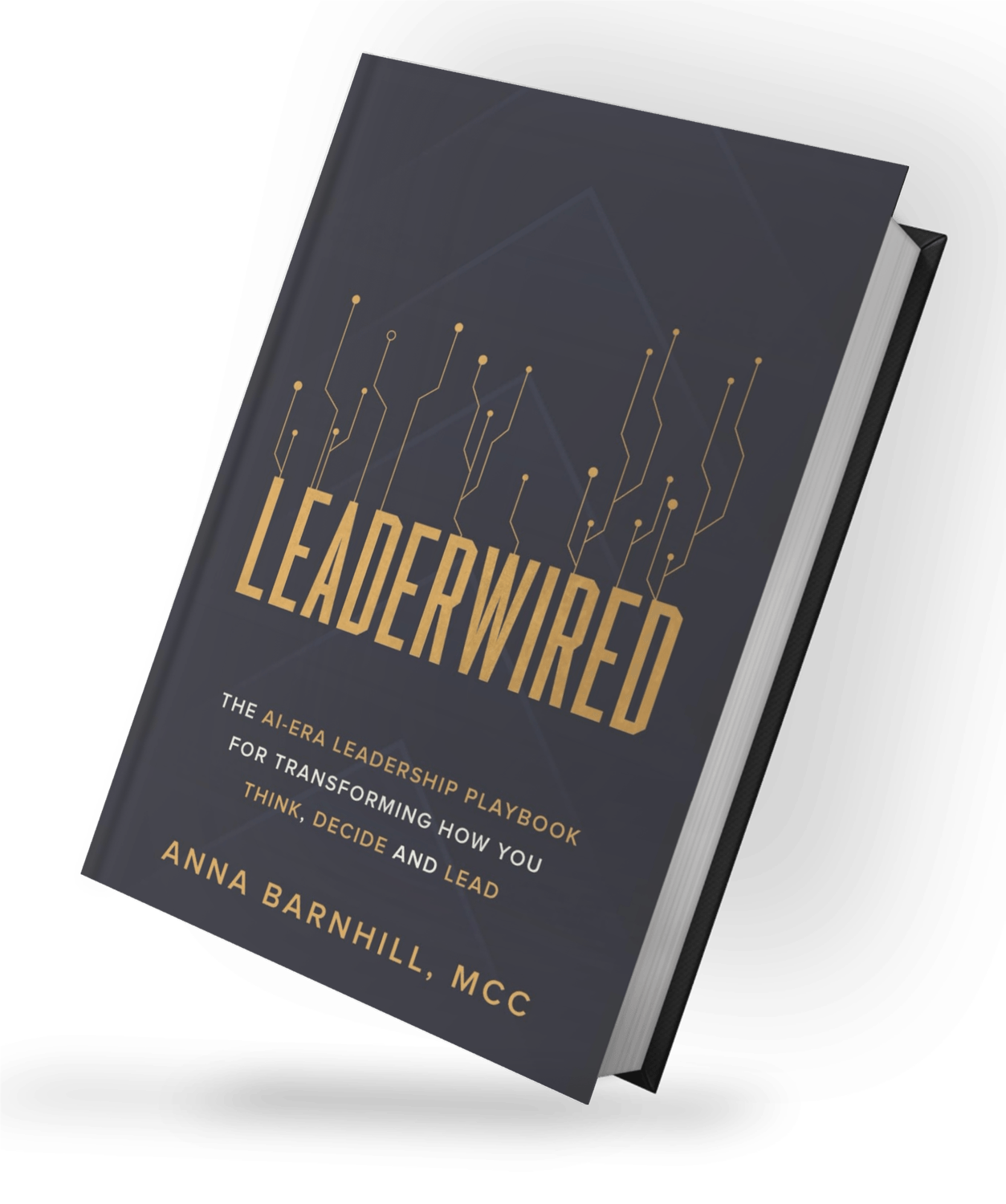
Leaderwired by Anna Barnhill - Book Summary
Have you ever known exactly what you should do as a leader, and then done the opposite anyway?
Not because you're lazy. Not because you don't care. You read the book, sat through the workshop, nodded along in the feedback session, and then the pressure hit, and the old pattern ran anyway. If that's ever happened to you, you're not undisciplined, and you're not a hypocrite.
You're running an outdated operating system. That's the entire premise behind Anna Barnhill's Leaderwired: The AI-Era Leadership Playbook for Transforming How You Think, Decide and Lead, and it might be the most honest explanation I've read for why so many capable leaders feel stuck in the exact same spot year after year.
Grab a coffee. Let's talk about why knowing isn't the same as doing, and what actually closes that gap.
Why You Should Read This Book
There's a strange trap that catches accomplished leaders more than anyone else. The more capable you become, the more your own instincts start to work against you; the certainty that made you decisive becomes rigidity; the control that made you reliable becomes the bottleneck; the expertise that made you credible becomes the thing AI quietly outpaces.
Leaderwired names the traps and hands you a methodology for getting out of them. Anna Barnhill, an ICF Master Certified Coach who has spent sixteen years inside executive coaching rooms with Fortune 500 leaders, built this book around a single idea: your leadership isn't limited by what you know. It's limited by the internal architecture, beliefs, mindsets, emotions, thought patterns, behaviors, values, and communication that run beneath what you know.
You should read this book if:
You've done the reading and still revert under pressure. This book explains why insight alone was never going to be enough, and what actually needs to change instead.
You're leading — or dreading — an AI transformation at your organization. Barnhill makes a compelling case that the technology was never the hard part. Your operating system is.
You want a diagnostic, not just inspiration. This isn't a pep talk. It's a step-by-step methodology for finding your own blind spots and rebuilding from there.
You lead people. Understanding your own operating system changes how you read your team's resistance, your culture's friction points, and what it actually takes to build psychological safety that sticks.
This is a substantial book, fourteen chapters built around one architecture: the 7-5-3 Human Upgrade Code™. But once you see that framework, you'll start using it as a lens everywhere: in your own reactions, in your team's stuck patterns, in the meeting that went sideways for reasons nobody could quite name.
Key Takeaways
Here's the big picture before we walk through it chapter by chapter.
Your leadership runs on an operating system, not just a skill set. Beliefs, mindsets, emotions, thought patterns, behaviors, values, and communication, installed over decades, mostly without your consent, determine what you actually do under pressure, regardless of what you know.
Your greatest strengths carry the deepest blind spots. The certainty, control, and expertise that built your career are the patterns most resistant to change, precisely because they've worked so well for so long.
Awareness has to come before choice. You cannot upgrade a pattern you cannot see. Diagnosis isn't a warm-up exercise — it's the beginning of the actual change.
Emotional regulation is a leadership skill, not a soft one. Most executive derailments trace back to it, and the pressure AI creates will only test it further.
You don't get credit for your intent. You only get the results of your impact. Communication isn't what you meant to say — it's what actually landed on the other side.
Values are a compass, not a mission statement. They only count if your calendar and your decisions reflect them, not just your words.
Personal transformation has a ceiling. Culture is what determines whether it scales. You can upgrade yourself completely and still hit a wall if the environment around you hasn't changed too.
AI doesn't fix dysfunction — it amplifies whatever it's connected to. A weak operating system, amplified by AI, gets weaker. A strong one multiplies.
Now let's slow down and go deeper into each part of the book.
Memorable Quotes from Leaderwired
A few lines worth writing on a sticky note and putting on your monitor:
"You don't need a new strategy. You need a new operating system."
"The leadership approach that built my career is destroying it."
"Your leadership OS is full of screensavers — beliefs and behaviors that made perfect sense when they were installed but are now creating friction without your awareness."
"The safest strategy is now the riskiest one."
"Awareness precedes choice. You cannot upgrade patterns you cannot see."
"You don't get credit for your intent. You only get the results of your impact."
"AI doesn't fix broken cultures, but it will expose them."
"AI amplifies whatever operating system it's connected to."
"Not becoming someone different but becoming more fully who you already are, with an operating system capable of expressing it."
That last one is worth sitting with. This isn't a book about reinventing yourself. It's a book about clearing out the code that's been quietly blocking the leader you already are.
About Anna Barnhill

Anna Barnhill has spent sixteen years studying why even the most accomplished leaders get stuck — and exactly how they break through. But her real education in this material didn't start in a coaching certification program. It started in Soviet Ukraine.
Anna grew up in a culture with a rigid gender divide, where emotional intelligence was dismissed as weakness and simply being different, she was left-handed and gifted in a society that punished both, was reason enough to be bullied. What could have simply been a wound became, in her words, "the foundation of my success as Leadership Strategist and Executive Coach." Reading subtle cues, understanding emotional dynamics, and navigating complex group tension weren't optional skills for her growing up. They were survival skills. Later, they became her methodology.
Her grandmother gave her the words that still anchor her work today:
"You're not broken — you're different. And different is exactly what the world needs."
The next defining chapter came in 2013, when a cancer diagnosis and multiple surgeries forced a reckoning. Anna has called it both the unluckiest and luckiest year of her life — the year her body delivered a message her spirit already knew: a fragmented life, where professional success came at the cost of personal authenticity, was unsustainable. She quit law school. She rebuilt her path around a single, hard-won conviction: tension isn't something to eliminate. It's energy to channel.
That conviction became a career. Anna holds the ICF Master Certified Coach credential — a distinction earned by fewer than 4% of coaches worldwide, and one that makes her Southern Oregon's only MCC. She's also a Marshall Goldsmith Certified Executive Coach, a Lean Six Sigma Black Belt, and holds an MSc in Industrial-Organizational Psychology.
She's a Professional Fellow at McLean Hospital/Harvard Medical School, a Learning Facilitator for the Leadership and Innovation program at MIT Professional Education, an official member of the Forbes Coaches Council, and a regular contributor to Forbes. Her frameworks have been refined across thousands of coaching hours with Fortune 500 executives at companies including Google, PayPal, Cigna, and the Federal Reserve.
Leaderwired is the distillation of all of it — sixteen years of watching brilliant, capable leaders hit the same invisible ceiling, and the methodology she built to help them see it, name it, and finally move past it. As she puts it:
"The gap between knowing and doing is where leadership dies."
This book is her answer to that gap.
You can learn more about Anna's coaching, assessments, and speaking at AdvantEdgeLeadership.com and AnnaBarnhill.com, or connect with her on LinkedIn.
Introduction and Overview of the Book
Your Operating System Is Running the Show
"Your leadership OS is the underlying architecture of thoughts, beliefs, mental models, emotional patterns, behavioral defaults, values, and communication habits that determine how you process reality and respond to it."
Barnhill opens with Jackie, a healthcare COO standing in a hospital corridor at midnight, having just snapped at her Chief Medical Officer in a way she swore she'd never become. Jackie wasn't failing from lack of skill or commitment. She was running new demands, an AI-driven transformation requiring experimentation, ambiguity, and trust, on an internal operating system built for an entirely different era.
That's the pattern Barnhill sees everywhere. Seventy percent of transformation efforts fail, and it's rarely the strategy. It's the knowing-doing gap: leaders who intellectually understand what needs to change but whose automatic patterns override that understanding the moment pressure rises.
The fix isn't more knowledge. It's upgrading the operating system itself — a framework Barnhill calls the 7-5-3 Human Upgrade Code™: seven internal components that form your foundation, five premium skillsets that emerge once those components integrate, and three cultural foundations that let the upgrade scale beyond just you. Let's walk through how.
Part One: Diagnosis
The first three chapters are about naming what's actually running before you try to change anything.
Chapter 1: The Operating System Crisis
Why Knowing Isn't Doing
"The leadership approach that built my career is destroying it."
Barnhill opens with Jackie, a healthcare COO standing in a hospital corridor at midnight, having just snapped at her Chief Medical Officer in a way she swore she'd never become. Jackie isn't failing from lack of skill or commitment, she's running an AI-driven transformation that demands experimentation, ambiguity, and trust on an internal operating system built for a completely different era.
This is the pattern Barnhill has watched for sixteen years of coaching: seventy percent of transformation efforts fail, and it's rarely bad strategy. It's the knowing-doing gap — leaders who intellectually understand what needs to change but whose automatic patterns override that understanding the moment pressure rises. Barnhill introduces the "screensaver" metaphor here, a belief installed to solve a problem that no longer exists, still running because nobody ever went back to check, and lays out the full 7-5-3 Human Upgrade Code™ that structures the rest of the book.
Reflection Questions:
Where in your own leadership have you noticed the gap between what you know you should do and what you actually do under pressure?
What would you say if you finished Jackie's sentence for your own career: "The leadership approach that built my career is now ___"?
Chapter 2: The Anatomy of an Outdated Operating System
How the Code Gets Installed
While destructive moods take years to build, constructive ones can take root with astonishing speed.
"Your leadership OS is full of screensavers — beliefs and behaviors that made perfect sense when they were installed but are now creating friction without your awareness."
If Chapter 1 names the problem, Chapter 2 shows you how it got built. Through Marcus, a firm leader whose "if I don't do it, who will?" belief traces directly back to caregiving responsibilities at age twelve, and Sarah, a tech executive whose analytical rigor curdles into paralysis the moment she's asked to lead an AI initiative, Barnhill walks through three ways operating systems form: early programming, career encoding, and success that hardens patterns into identity.
The chapter introduces all seven components in full,
Belief Architecture
Mindsets
Emotional Processing
Thought Patterns
Behavioral Defaults
Values Alignment
Communication Protocols
This demonstrates what Barnhill calls the "cascade effect": one unexamined belief doesn't just sit quietly in a corner. It contaminates mindset, emotion, thought, behavior, values, and communication all at once.
Reflection Questions:
Trace one of your strongest leadership instincts back to its origin. Was it installed by early programming, career encoding, or hardened success? Does it still fit who you need to be now?
What's one strength of yours that, on closer look, might actually be the cascade effect of a single unexamined belief?
Chapter 3: Mapping Your Current OS
Building Your Own Diagnostic
"Awareness precedes choice. You cannot upgrade patterns you cannot see."
This is the book's first fully practical chapter. David, a technology VP, discovers through 360-degree feedback that his "listening" was actually performance — his questions were tests in disguise, designed to confirm what he'd already decided rather than genuinely take in new information.
Barnhill walks through diagnostic prompts for each of the seven components and names five common friction patterns leaders fall into: the Certainty Trap, the Control Paradox, the Emotional Bypass, the Expertise Anchor, and the Values Gap. The chapter closes with a full exercise for building your own personal Operating System Map — the diagnostic foundation everything in Part Two builds on.
Reflection Questions:
Of the five friction patterns, Certainty Trap, Control Paradox, Emotional Bypass, Expertise Anchor, Values Gap, which one describes you most honestly right now?
Where has feedback ever revealed a gap between how you thought you were showing up and how you actually landed, the way David's did?
Part Two: Internal Architecture
Seven chapters, one for each component of the operating system.
Chapter 4: Belief Architecture
The Foundation Everything Else Sits On
"You don't need a new strategy. You need a new operating system."
Belief Architecture is the foundation the other six components sit on, and Barnhill opens with Alison, a marketing director whose belief that she "wasn't quite enough" kept her silent in rooms she'd more than earned a seat in. Barnhill names four limiting beliefs she sees most often in leaders: "I must have all the answers," "If I don't do it, who will?", "I can't make mistakes," and "I don't belong here" — and shows the specific, costly implication each one carries in the AI era.
The chapter offers a four-stage upgrade process: Surface the belief, Trace the Origin, Test the Accuracy, and Install the Alternative, a sequence you'll see echoed throughout the rest of the book.
Reflection Questions:
Which of the four limiting beliefs — "I must have all the answers," "If I don't do it, who will," "I can't make mistakes," "I don't belong here" — is quietly running your leadership?
Run that belief through the four-stage process. Where did it come from, and does it hold up to an honest test today?
Chapter 5: Mindsets
Five Shifts for the AI Era
"The safest strategy is now the riskiest one."
This chapter maps five internal mindset upgrades built specifically for AI-era leadership: from Certainty to Curiosity, Control to Orchestration, Expertise to Learning Velocity, Risk Avoidance to Experimentation, and Individual Decisions to Collaborative Intelligence. Barnhill is careful to note the goal isn't abandoning the old mode entirely, it's expanding your range so you can consciously choose which mode fits the moment in front of you, rather than defaulting to the one that built your career.
Reflection Questions:
Of the five mindset shifts, which one would feel the most uncomfortable to actually practice this week?
Where have you defaulted to certainty, control, or expertise recently when curiosity or experimentation would have served you better?
Chapter 6: Emotional Processing
The Three-Second Gap
"75% of executive derailments stem from poor emotional regulation, not lack of skill."
Perhaps the most powerful chapter in the book. Using polyvagal theory and the concept of the amygdala hijack, Barnhill explains why emotional regulation, not competence, is the single biggest predictor of executive derailment. She introduces the "three-second gap" between stimulus and reaction, and offers three concrete practices for widening it: the Physiological Reset, the Naming Intervention, and the Perspective Shift.
David's story anchors the chapter, the moment he catches himself mid-hijack in a tense meeting and, for the first time, actually uses the gap instead of reacting through it.
Reflection Questions:
Think of your last amygdala hijack at work. How wide was your three-second gap, honestly, and what would the Physiological Reset or Naming Intervention have looked like in that exact moment?
What situation reliably triggers you? What would it look like to practice one of these three tools the next time it happens?
Chapter 7: Thought Patterns
The Cognitive Habits Running Beneath Awareness
"Awareness precedes choice. You cannot upgrade patterns you cannot see."
This chapter names seven cognitive habits running beneath most leaders' awareness:
Confirmation Bias
Attribution Error
Catastrophizing
Availability Heuristic
Sunk Cost Fallacy
Negativity Bias
The Inner Critic
Each one is illustrated through a leader we've already met, David's confirmation bias in how he interprets feedback, Marcus's double standard between how he judges himself and others, Sarah's catastrophizing spiral during a stalled project.
Barnhill offers a five-step process for catching and correcting these patterns in real time:
Notice
Label
Generate Alternatives
Choose Deliberately
Track Progress
She also shows how AI itself can be used as a thinking partner to challenge your own defaults rather than just confirm them.
Reflection Questions:
Which of the seven thought patterns, confirmation bias, attribution error, catastrophizing, availability heuristic, sunk cost fallacy, negativity bias, the inner critic, do you catch yourself in most often?
Next time you notice it, can you walk yourself through Notice, Label, Generate Alternatives, Choose Deliberately, Track Progress before you act?
Chapter 8: Behavioral Defaults
Where the Internal Work Meets the Outside World
"The certainty and control that defined great leadership in 2015 are liabilities in 2025."
This is where all the internal work of the previous chapters finally meets the outside world. Barnhill names five common leadership defaults:
Control
Expert
Accommodation
Harmony
Urgency
She also gives a practical, five-part upgrade methodology:
Awareness Before Choice
Alternative Behavior Installation
Repetition Under Progressive Challenge
Environmental Support
Stakeholder Involvement
Reflection Questions:
Which of the five behavioral defaults, Control, Expert, Accommodation, Harmony, Urgency, shows up most under pressure for you?
Who in your life could serve as the "stakeholder involvement" piece, someone who could tell you honestly when your default has kicked back in?
Chapter 9: Values Alignment
The Quiet Crisis of Outward Success
"Authentic values feel vitalizing, not obligating."
Jackie returns here to confront a quieter crisis than the one that opened the book: outward success that feels hollow. Barnhill draws a sharp distinction between values, goals, and feelings, values are directions, not destinations, and you can act with courage without ever feeling brave.
She offers three tools for discovering, and then actually living, your genuine values, rather than the ones you've merely absorbed:
The Values Yardstick
The Life Review
The Priority Test
Reflection Questions:
Run one of your stated values through Barnhill's test: does it feel vitalizing, or does it feel obligating? What does that tell you?
Where does your calendar tell a different story than your stated values do?
Chapter 10: Communication Protocols
Intent Versus Impact
"You don't get credit for your intent. You only get the results of your impact."
The interface layer where everything upgraded internally either lands or doesn't. This chapter is built around David's failed feedback conversation, good intentions, careful wording, an engineer left in tears anyway, and introduces the CLEAR PACE™ framework: Context, Listen first, Empathize, Articulate clearly, Request response, Presence, Authenticity, Calibration, and Emotional awareness.
Reflection Questions:
Think of a conversation where your intent and your actual impact clearly diverged. Which piece of CLEAR PACE™ was missing?
Which single letter of CLEAR PACE™, Context, Listen, Empathize, Articulate, Request, Presence, Authenticity, Calibration, Emotional awareness, do you skip most often under time pressure?
Part Three: From Insight to Integration
Chapter 11: The Five Emerging Skillsets
What Happens When the Seven Components Integrate
"These five upgrades don't operate in isolation. They form an interconnected system where each mindset upgrade supports and enables the others."
This chapter explains the "5" in the 7-5-3 code — the five premium skillsets that naturally emerge once the seven internal components integrate:
Cognitive Flexibility
Emotional Intelligence at Scale
Human-AI Collaboration Design
Strategic Sensemaking
Exponential Thinking
Barnhill makes a claim worth sitting with: you can't develop these directly through training. They only emerge once the underlying components are upgraded and working together.
Sarah's turnaround of a stalled AI initiative shows all five skillsets in motion at once, and Barnhill is careful to note they don't simply add up, they multiply each other. A self-assessment tool closes the chapter, pointing you back to exactly which of the seven components to revisit if a given skillset feels underdeveloped.
Reflection Questions:
Of the five skillsets — Cognitive Flexibility, Emotional Intelligence at Scale, Human-AI Collaboration Design, Strategic Sensemaking, Exponential Thinking — which is weakest for you right now?
Trace that weak skillset back to Part Two. Which of the seven components is most likely the real root cause?
Part Four: Systems, Culture and the Future
Chapter 12: The House of Empathy™
Scaling the Upgrade Beyond Yourself
"AI doesn't fix broken cultures, but it will expose them."
Personal transformation has a ceiling, and this chapter is about what happens once you hit it. Jackie, having done her own internal work, discovers her organization hasn't caught up, people still hide problems until they're crises, and nobody experiments for fear of failure.
Barnhill's answer is the House of Empathy™: a foundation of Curiosity, Care, and Courage, supported by nine pillars, Build Trust, Understand One Another's World, Express Appreciation and Recognition, Prioritize Active Engagement, Embrace Positive Perspective, Navigate Conflict Constructively, Build Emotional Intelligence, Promote Authentic Leadership, and Foster Psychological Safety, capped by a roof of Shared Purpose and Growth.
The chapter's turning point is Jackie's public apology to five hundred people in her organization — proof, as Barnhill puts it, that psychological safety has to be demonstrated "hundreds of times before they believe it."
Reflection Questions:
Of the nine pillars, which one is weakest in your team or organization right now?
What would it cost you to make a Jackie-style public acknowledgment to your own team, and what might it earn you?
Chapter 13: The Five AI Leadership Shifts™
Translating the Internal Work Into AI Leadership
"AI amplifies whatever operating system it's connected to."
The book's payoff chapter, translating everything you've built internally into how you actually lead through AI transformation: from AI as Tool to AI as Collaborator, from AI as Threat to AI as Amplifier, from AI Expertise to AI Fluency, from AI Implementation to AI Integration, and from AI Efficiency to AI Capability.
The core insight ties the whole book together: weak leadership, amplified by AI, gets weaker. Strong leadership, amplified, multiplies.
Reflection Questions:
Which of the five AI shifts is your organization furthest behind on — and is that really a technology gap, or a leadership one?
If AI amplifies whatever operating system it's connected to, what exactly is your team's AI adoption currently amplifying?
Chapter 14: The Ongoing Journey
Development as Identity, Not a Project
"Not something you do, but Who You Are."
This isn't a book you finish and shelve. Barnhill closes with a weekly reflection practice, Five Questions she gives every coaching client, and introduces the "discomfort ratio," the idea that roughly 25–35% productive discomfort is the sweet spot for sustainable growth. Too little, and nothing changes. Too much, and you burn out or retreat. The chapter's core argument is that sustainable leaders stop treating development as a project with an end date and start treating it as identity.
Reflection Questions:
Where in your leadership right now are you sitting outside that 25–35% discomfort zone, too comfortable, or too overwhelmed?
What would change if you treated your own development as identity rather than a project you'll eventually finish?
Conclusion (And Your Next Step)
"Not to complete the journey, that's not how this works. But to begin, and to keep beginning, for as long as your leadership matters."
Here's what stays with me most after sitting with this book. Leaderwired isn't really a book about AI, even though AI is the pressure that makes its argument urgent. It's a book about the gap between the leader you know you should be and the leader who actually shows up when the stakes are high, and it refuses to let you close that gap with more information alone.
You don't need another framework you understand intellectually and then struggle to apply. You need to go looking for the screensaver beliefs still running your leadership, decades after they stopped being true.
So here's your call to action. Don't just close this out and move on to the next thing. Tonight, pick one friction point in your leadership, the one that keeps showing up no matter the circumstance, and ask Barnhill's question:
What belief might be generating this pattern, and how long have I been operating from it?
You've built more capability than you're currently using. Go find out what's been quietly blocking it.

Join over 4,000 Growth-Minded Leaders reading The Learning To Lead Newsletter each week!
Latest Blog Post
Join over 4,000 Fellow Leaders reading The Learning To Lead Newsletter each week!
©2025 Learning To Lead | Helping Good Leaders Become Great Leaders