
The All-In Manager by Ali Merchant - Book Summary
Do you remember the day you became a manager?
Not the title change. The actual day. The meeting where someone handed you a team and walked away, assuming you'd figure it out. No training. No support. Just a new title and a room full of people now watching you for direction.
If that sounds familiar, you're not alone, and you're definitely not broken. You just started the way almost every manager starts.
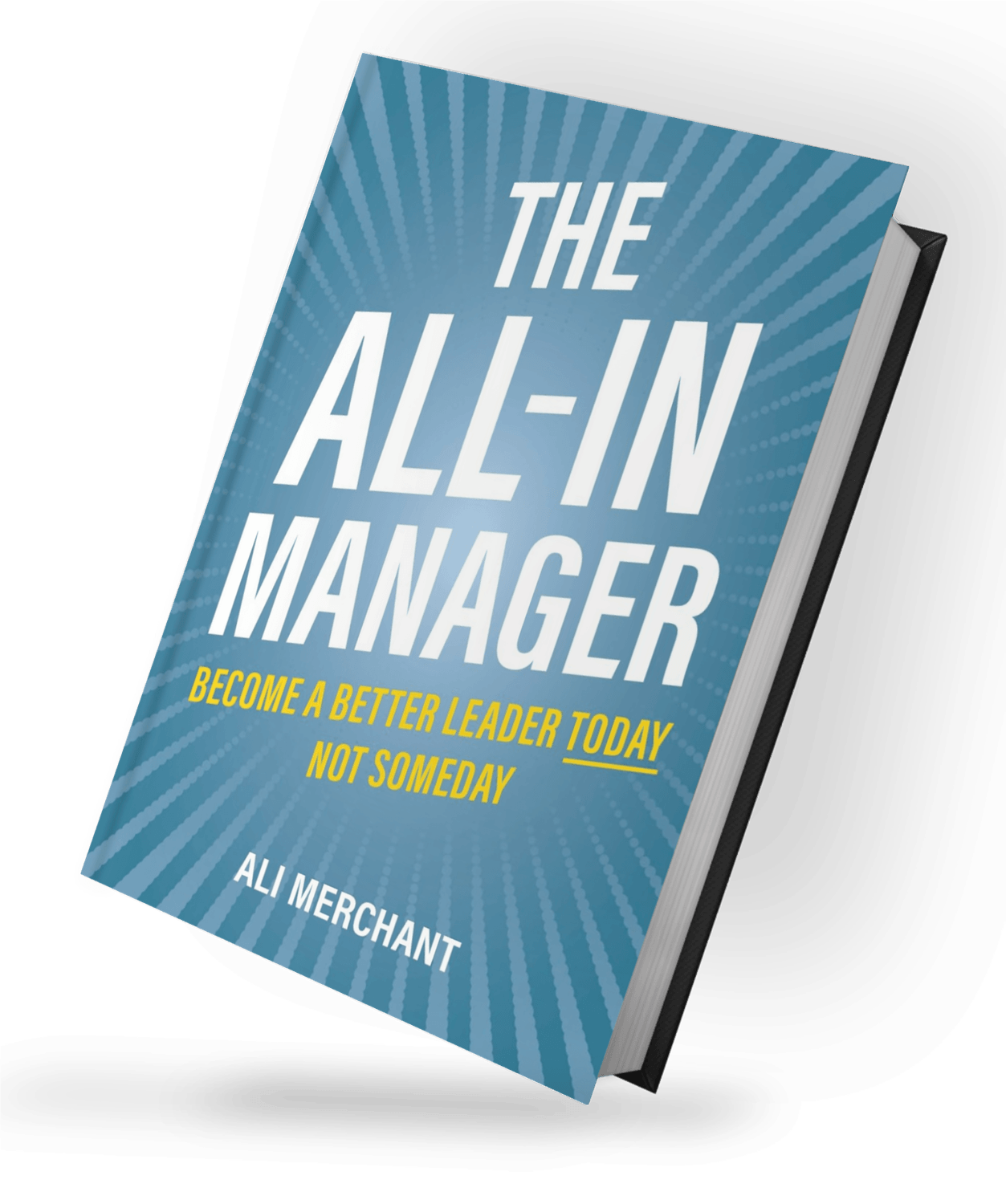
That's the exact moment Ali Merchant opens with in The All-In Manager: Become a Better Leader Today. Not Someday., and it might be the most honest starting point I've read for a leadership book in a long time.
Grab a coffee. Let's talk about the difference between an accidental manager and an All-In manager, and how you can close that gap starting today.
Why You Should Read This Book
Here's a stat that should stop you in your tracks. Nearly two-thirds of all managers never received any leadership training before being handed a team. Most of them stay stuck as accidental managers for the rest of their careers, not because they don't care, but because they stop learning and start winging it.
Ali Merchant spent two decades leading teams, training managers, and coaching senior leaders before packing everything he's learned into fourteen practical chapters. This isn't a book about theory. It's a toolkit.
You should read this book if:
You were promoted without any real training. This book is the training you never got, broken into practical, apply-it-today chapters.
You want tactics, not just inspiration. Every chapter ends with a clear summary and a framework you can use in your very next 1:1, feedback conversation, or performance review.
You're carrying more than you should. Between delegation debt, unclear expectations, and burnout, this book gives you a structured way to hand things off while protecting your energy.
You lead people, and you're leading up, too. This book doesn't stop at managing your team. It gives you a system for managing your own manager with confidence.
The book is built on Merchant's All-In system, a three-tiered model: foundation, performance, and impact. Once you see the shape of it, you'll start noticing exactly which layer is wobbling in your own leadership.
Key Takeaways
Here's the big picture before we walk through it chapter by chapter.
Leadership isn't reserved for a chosen few. It's for anyone with access to the right information and the motivation to apply it. You don't need seventeen years to become a better leader. You need the willingness to apply the tactics.
Trust is a bank account, not a birthright. Your title doesn't automatically earn you trust. Every interaction with your team is either a deposit or a withdrawal.
Your team doesn't hear the melody in your head. You know what good looks like because you're the one who's been thinking about it. Your team is only catching disjointed beats unless you spell it out.
Psychological safety separates teams that report mistakes from teams that hide them. High-performing teams aren't making more mistakes. They're the ones willing to talk about them.
Delegation isn't dumping. It's a debt you're either paying down or letting compound. Every task you hold onto that someone else could do adds interest, and eventually it comes due as burnout.
Coaching beats fixing. Your job isn't to hand out all the answers. It's to build an environment where your people find their own.
Managing up is alignment, not manipulation. You have more influence over your relationship with your manager than you think.
Productivity is about doing less and delivering more, not doing more of everything. And burnout has identifiable causes you can actually address with structure and self-compassion.
Now let's slow down and go deeper into each part of the book.
Memorable Quotes from The All-In Manager
A few lines worth writing on a sticky note and putting on your monitor:
"Expectation gaps lead to execution gaps."
"Difficult conversations rarely ruin relationships. Avoiding them often does."
"If you want to do a few small things right, do them yourself. If you want to do great things, learn to delegate."
"Your job isn't to come up with all the great ideas. Your job is to create an environment in which great ideas can happen."
"If you don't measure performance, you can't improve it."
"Managing up is not manipulation. It's alignment."
"Remember that if you don't prioritize your life, someone else will."
"Self-care is your fuel. Whatever the road ahead, it's what keeps your motor running and your wheels turning."
That last one is worth sitting with. This is a book about performance, but Merchant refuses to let you build results on a foundation that burns you out along the way.
Meet Ali Merchant

Ali Merchant has spent two decades leading teams and scaling Learning and Development departments for public companies, tech brands, and some of the world's largest ad agencies.
His own leadership story starts in 2008, in the middle of the financial crisis, when a COO pulled him into an "urgent" meeting and told him he was moving to Customer Success to lead a team of five, effective immediately. Merchant had never managed anyone before. No leadership training. No support. No coaching. He became, in his words, an accidental manager.
Instead of staying stuck there, he became obsessed with getting better. He read every leadership book he could find and, more importantly, put what he learned into action. His career moved from accidental first-time manager to director, and eventually to global head of learning and development at two world-class organizations.
In 2018, he launched All-In Manager, a leadership development firm that trains and coaches managers to become leaders. Since then, he's taught the All-In system to thousands of managers, and his insights now reach more than 50,000 leaders in over 100 countries. He also runs the All-In Manager masterclass, a six-week group coaching program built around applying tactics, not just learning theory.
Merchant lives in Chicago with his wife, Sarah, and their dog, Lenny.
Introduction and Overview of the Book
From Accidental to All-In
Merchant opens with his own story, the 2008 layoffs, the sudden reassignment, the team of five he had no idea how to lead. If you were promoted because you were great at your previous job, or because someone needed to fill a gap, and nobody trained you, you started as an accidental manager too. Research shows nearly two-thirds of managers do.
Here's where most careers stall. Accidental managers stop learning, start winging it, and stay stuck for the rest of their careers. The fact that you're reading a book like this tells Merchant you're different.
An All-In manager isn't a guru with all the answers. All-In managers are committed to three things: delivering meaningful results, personally caring about their employees' success, and staying insatiable learners. You need all three. Two won't do.
The book is organized around the All-In system, pictured as a three-tiered wedding cake:
Foundation layer: Become a trustworthy leader, set clear expectations, and create psychological safety.
Performance layer: Run engaging 1:1s, give and receive feedback the right way, pay off your delegation debt, stop fixing and start coaching, transform your performance reviews.
Impact layer: Manage up with confidence, boost your productivity, protect yourself from burnout, lead smarter with AI.
Let's walk through how you build each layer.
Part One: Foundation
Chapters 3 through 5 are about building the base that everything else stands on.
Chapter 3: Become a Leader Your Team Trusts
Trust Isn't Pre-Packaged With Your Title
"As you work to develop your leadership craft, you must inspire trust at every step along the way."
Merchant opens with a leader who had decades of experience and came from a top competitor, but was gone within nine months because he routinely over-promised clients and left his team scrambling. Experience didn't save him. Trust would have.
Most of us assume our team trusts us because we have the title, because we deliver results, or because we're nice people. Merchant pushes back on all three. He asked one question through his research: for your employees to trust you, they need answers to whether you're competent, whether they can rely on you, and whether you actually care about them. Miss any one of those three deposits, and trust breaks down.
He uses Claire Hughes Johnson, former COO at Stripe, as an example of competence that isn't about technical mastery but about sound judgment and unblocking your team. He also draws on Kim Scott's idea of "ruinous empathy," the trap of avoiding hard truths by telling yourself you're being kind when, in reality, you're withholding what your employee needs to hear.
Reflection Questions:
Think of the last time your team's trust in you took a hit. Was it a gap in competence, reliability, or care?
Where might you be practicing ruinous empathy right now, avoiding a hard conversation and calling it kindness?
Chapter 4: Share Your Expectations Clearly
You're the Tapper. Your Team Are the Listeners.
"Expectation gaps lead to execution gaps."
Merchant leans on Elizabeth Newton's famous "Tappers and Listeners" experiment from Stanford. Tappers tapped out the rhythm of a well-known song and were confident listeners would recognize it half the time. Listeners got it right only 3% of the time. The tappers could hear the melody in their heads. The listeners only heard disjointed taps.
That's the exact gap between what you know and what your team actually hears. Merchant breaks expectations into two categories: team expectations (how you collaborate, communicate, and treat each other) and role expectations (what's in scope, what good looks like, and where to aim). His practical tool here is the leadership operating manual, a document that spells out how you expect your team to work with you, paired with an employee operating manual your team fills out in return.
Reflection Questions:
If your team had to guess your top three expectations right now, would they get it right?
What would change if you and your team both filled out an operating manual this month?
Chapter 5: Make It Safe for Your Team to Speak Up
High Performers Don't Make Fewer Mistakes. They Report More of Them.
"The key to any great achievement is having a team unafraid to say what they think."
Merchant opens with Netflix's disastrous 2011 decision to split its DVD and streaming services, a move some employees privately disagreed with but never voiced. Even at a great company, psychological safety can be missing.
He walks through Amy Edmondson's landmark research at Harvard, where she discovered that high-performing hospital teams weren't making more medication errors than low-performing teams; they were simply willing to report them. Low-performing teams were hiding mistakes out of fear, which meant they never learned from them.
Merchant offers three tactics for building safety: champion candor, seek dissent rather than squash it, and normalize sharing mistakes. He borrows Pixar's "candor code", clear guidelines for what's acceptable and unacceptable when giving feedback, as a model for your team to build together.
Reflection Questions:
When was the last time someone on your team disagreed with you openly? If you can't remember, that's worth sitting with.
What would your team's version of a candor code look like?
Part Two: Performance
Chapters 6 through 10 are where the day-to-day work of leading actually happens.
Chapter 6: Run 1:1s Like Never Before
The Single Most Important Variable in Retention
"The quality of the relationship between employees and their direct supervisors" matters more than pay, perks, or workplace environment.
Merchant tells the story of a manager who ran their weekly 1:1 like a checklist, distant, distracted, and clearly counting down the minutes. Contrast that with an engaging 1:1, which Merchant says needs three ingredients: frequency, format, and focus.
Frequency means meeting weekly or biweekly, consistently. Format means a clear structure that covers priorities, position (career), and person (relationship), not just task updates. Focus means staying flexible enough to follow whatever your employee actually needs to talk about that day, work or otherwise.
Reflection Questions:
Of the three P's, priorities, position, and person, which one is missing most often from your 1:1s?
Do you show up to your 1:1s on time, present, and in an upbeat mood, or is it the meeting that gets pushed first when your calendar fills up?
Chapter 7: Give, Ask and Receive Feedback the Right Way
Rich Recognition and the Triple-R Framework
"Difficult conversations rarely ruin relationships. Avoiding them often does."
This is one of the meatiest chapters in the book. Merchant opens with the story of David Novak, former COO of Pepsi, who discovered a route salesman named Bob had spent forty-seven years at the company without ever hearing how much his colleagues valued him. Bob cried at the news, on his way out the door to retirement.
Merchant calls positive feedback done right rich recognition, and it needs to be specific, sincere, and timely, not vague, not transactional, and not delivered as an afterthought weeks later. He also names the "feedback sandwich" as a trap: sandwich constructive feedback between two layers of praise often enough, and your team starts tuning out the praise altogether.
For constructive feedback, he splits it into in-the-moment feedback and behavioral feedback, and for receiving feedback yourself, he offers the Triple-R framework: request specific input, reward the person's honesty, and respond with action. He also names three triggers that make feedback hard to hear: truth triggers, relationship triggers, and identity triggers.
Reflection Questions:
The next time you praise someone, can you make it specific, sincere, and timely, all three, not just one?
Which of the three triggers, truth, relationship, or identity, tends to derail you most when you're on the receiving end of feedback?
Chapter 8: Pay Off Your Delegation Debt
The Delegation Ladder
"If you want to do a few small things right, do them yourself. If you want to do great things, learn to delegate."
Merchant tells his own story here, landing his dream VP role in 2013 and immediately saying yes to everything and everyone, a habit that quietly built what he calls delegation debt. Every task you hold onto that someone else could own adds interest, and eventually it comes due as stress and burnout.
His tool for paying it off is the delegation ladder: identify the task, pair it with the right employee, and communicate the hand-off clearly. He layers in a skill-and-will matrix, plotting your employees by their skill level and motivation, so your delegation approach fits the actual person in front of you, not a one-size-fits-all script.
Reflection Questions:
What's one task sitting on your plate right now that's really delegation debt in disguise?
Looking at your team's skill and will profiles, who's ready for more ownership that you haven't offered yet?
Chapter 9: Stop Fixing, Start Coaching
The Ask vs Tell Matrix
"Your job isn't to come up with all the great ideas. Your job is to create an environment in which great ideas can happen."
Merchant names two mistaken assumptions managers make about coaching: that it's only for low performers, and that it means giving advice and telling people what to do. Neither is true. Great coaching is contextual, and it works for your best people just as much as your struggling ones.
He introduces the Ask vs Tell matrix to help you decide, in any given moment, whether to ask a question or give direction. To ask better questions, he recommends mixing open-ended and closed-ended questions, avoiding leading questions, and reaching for "what" rather than "why" to reduce defensiveness. He also breaks down listening barriers into external (the pings, dings, and rings around you) and internal (the mental noise inside you), the latter of which is far harder to catch.
Reflection Questions:
The next time an employee brings you a problem, can you catch yourself before jumping straight to advice?
What's your most common internal listening barrier, and what would it take to notice it in the moment?
Chapter 10: Transform Your Performance Reviews
Prepare, Deliver, Follow Up
"If you don't measure performance, you can't improve it."
Merchant opens with a friend whose performance review blindsided him with feedback his manager had never shared before. That's not a rare story. It's the default outcome when managers hold back feedback all year and then unload it all at once, annually.
His fix is a three-step process: prepare thoughtfully, deliver with clarity, and follow up. Preparation means watching for recency bias and reviewing the full year, not just the last few weeks, and collecting peer feedback from three to five colleagues rather than relying only on your own view. Delivery means avoiding feedback overload and focusing on the two or three behaviors that matter most. Follow-up means the review can't be a one-and-done. High performers need a co-created growth roadmap. Underperformers need a clear, specific improvement plan.
Reflection Questions:
If your next review surprised your employee, what does that tell you about the feedback you've been giving all year?
For your strongest performer, what would a real growth roadmap look like, beyond just "keep doing what you're doing"?
Part Three: Impact
Chapters 11 through 14 take everything you've built and point it outward, up, and forward.
Chapter 11: Manage Up With Influence
The POWER Framework
"Managing up is not manipulation. It's alignment."
Merchant opens with a simple but sobering number: roughly 80,000 hours, the amount of time you'll spend working in your lifetime, much of it shaped by your relationship with your own manager. His argument is that you have more control over that relationship than you think.
He offers the acronym POWER: pay attention to your manager's style, own your 1:1s by showing up prepared, work on the right priorities, exchange honest feedback, and report your roadblocks, results, and recommendations. None of it is about flattery. It's about deliberately building the same kind of trust upward that you're building with your own team.
Reflection Questions:
Which letter of POWER are you already strong at, and which one have you been neglecting?
When's the last time you gave your own manager honest, constructive feedback, not just took it?
Chapter 12: Boost Your Productivity
The AWI Framework for Saying No
"Remember that if you don't prioritize your life, someone else will."
Merchant reframes productivity from the start. It isn't about doing more; it's about doing less and delivering more. It isn't about speeding up; it's about slowing down to speed up. And it isn't about saying yes to everything; it's about learning to say no with confidence.
His tool is the AWI framework: articulate your position clearly, state your why with honest context, and invite input to show you're willing to flex. He pairs this with a classic urgent/important matrix for prioritizing tasks: attack what's urgent and important, schedule what's important but not urgent, delegate or eliminate what's urgent but less important, and cut what's neither.
Reflection Questions:
What's one commitment on your calendar right now that you'd say no to if you had the AWI script in hand?
Looking at your task list, how much of it actually falls into the "urgent and important" box, honestly?
Chapter 13: Protect Yourself From Burnout
The ReST Framework
"Self-care is your fuel. It's what keeps your motor running and your wheels turning."
Merchant opens with a coaching client calling him in the midst of a crisis, ready to volunteer for layoffs just to escape a job that had worn him down. Before you can protect yourself from burnout, Merchant argues, you need to understand what's actually causing it: six core factors: excessive workload, lack of control, insufficient reward, weak community, unfairness, and a mismatch of values.
His answer is the ReST framework: routines to reduce decision fatigue through consistent structure, such as sleep, workouts, and meal timing. Self-compassion, learning to be kind to yourself and set healthy boundaries rather than pushing through everything. And Time on energy-building activities, deliberately blocking time for whatever actually recharges you, whether that's music, nature, or people you love.
Reflection Questions:
Of the six burnout drivers, workload, control, reward, community, fairness, or values, which one is quietly running highest for you right now?
What's one routine you could put in place this week to reduce decision fatigue?
Chapter 14: Lead Smarter With AI
From Search Engine to Thinking Partner
"The only way to make sense out of change is to plunge into it, move with it, and join the dance."
Merchant opens with an unlikely teacher, his mother-in-law, who wasn't just asking ChatGPT generic questions. She was uploading photos of her actual backyard and asking for design ideas tailored specifically to her space. That's the shift Merchant wants for you: most managers still treat AI like a search engine, when it's far more useful as a thinking partner.
His advice is to give AI context-rich prompts, the more detail, the better the response, and to use it for three things in particular: creating something from scratch, analyzing existing data, and polishing your own thinking. The chapter closes with a practical example, using a version of the AWI framework from Chapter 12 as an actual AI prompt to draft a difficult message.
Reflection Questions:
Are you still using AI like a search engine, or have you started treating it like a genuine thinking partner?
What's one leadership task this week, a difficult message, a tricky delegation, a tough 1:1 prep, where AI could actually help you think it through first?
Conclusion (And Your Next Step)
"Nothing will change unless you change."
Here's what stays with me most after sitting with this book. The All-In Manager isn't really about any single tactic, the trust account, the delegation ladder, or the ReST framework. It's about the decision to stop winging it. Most managers are handed a team and never given a manual. Merchant just wrote the one you were missing.
You don't need to apply all fourteen chapters at once. Merchant's own advice is to pick one leadership behavior and focus on improving it over the next 30 days. Treat this book less like something you read once and more like a problem-solving guide you keep coming back to.
So here's your call to action. Tonight, pick the one chapter that hit closest to home, trust, expectations, feedback, delegation, burnout, whatever it was, and take the very next step it outlines. Not someday. Today.
Enjoyed this breakdown? Subscribe to the Learning to Lead Newsletter for more book summaries, leadership frameworks, and practical encouragement delivered weekly.
Connect with Ali Merchant

Join over 4,000 Growth-Minded Leaders reading The Learning To Lead Newsletter each week!
Latest Blog Post
Join over 4,000 Fellow Leaders reading The Learning To Lead Newsletter each week!
©2025 Learning To Lead | Helping Good Leaders Become Great Leaders