
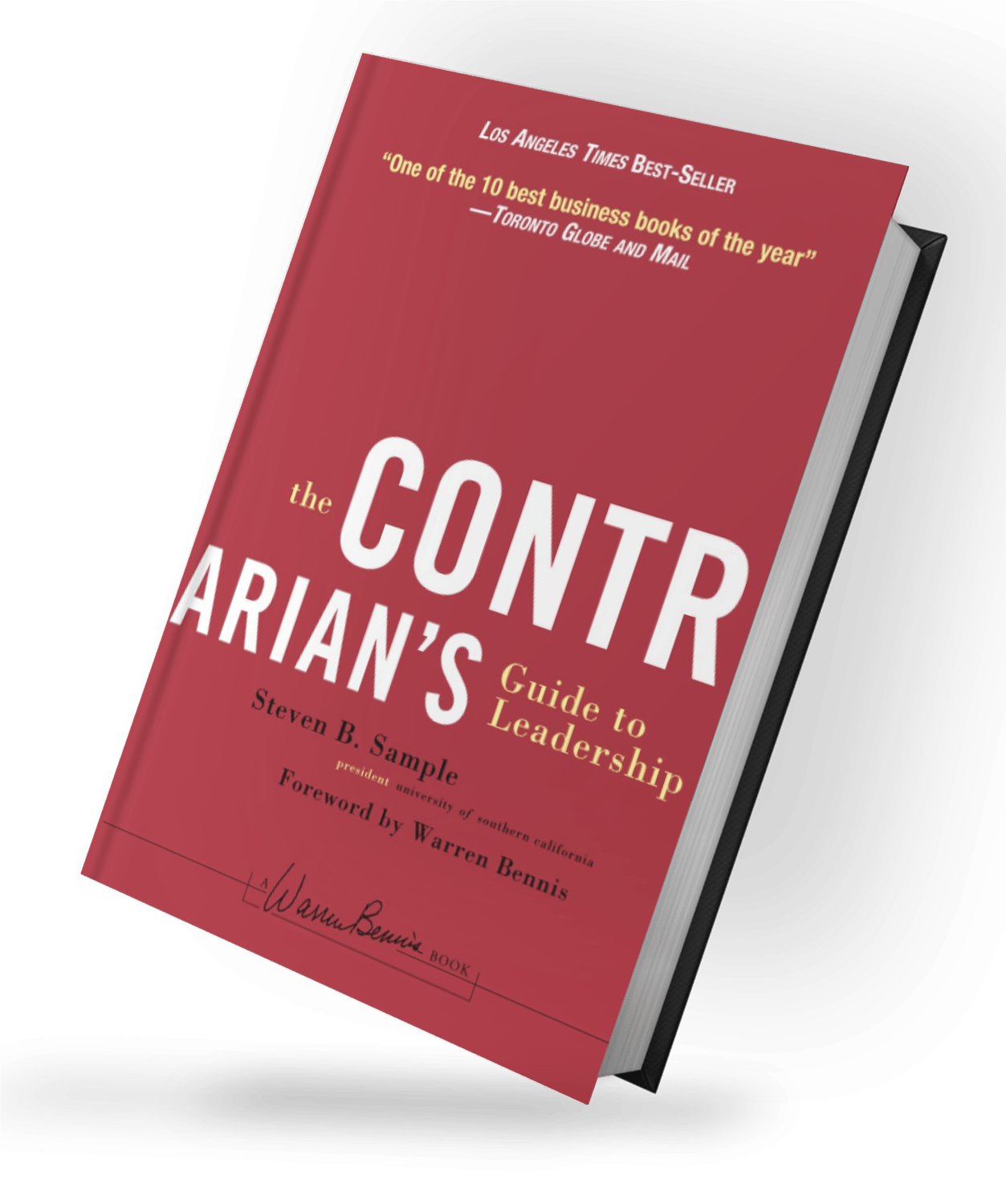
The Contrarian's Guide to Leadership by Steven B. Sample - Book Summary
The Leadership Wisdom Most Leaders Never Learn
Lessons from The Contrarian's Guide to Leadership by Steven B. Sample That Will Challenge Everything You Think You Know About Leading Well
What If Everything You've Been Taught About Leadership Is Wrong?
Let me ask you something.
When a big decision lands on your desk, what's your instinct?
Do you move fast? Weigh in quickly? Project confidence before you've heard all the sides?
If you answered yes, you're not alone. That's what most leadership culture rewards.
But here's the uncomfortable truth:
Speed isn't always wisdom.
Confidence isn't always clarity.
And the leadership advice that feels the most natural to follow is often the advice most likely to get you in trouble.
That's the central provocation of The Contrarian's Guide to Leadership by Steven B. Sample, the longtime president of the University of Southern California, and one of the most original leadership thinkers I've encountered.
Sample isn't interested in telling you what you want to hear.
He's interested in telling you what actually works.
And what works, it turns out, often runs directly against the grain of conventional wisdom.
The Danger of the Herd
Before we get into Sample's framework, there's something you need to understand about why conventional leadership wisdom so often fails.
Most people are binary thinkers.
Something is good or bad. Right or wrong. A friend or an enemy. A good idea or a waste of time.
It feels decisive. It feels strong.
But Sample argues that binary thinking is one of the most dangerous habits a leader can fall into, for three very real reasons.
First, you form opinions before you've gathered all the facts. The moment you land on a conclusion, your mind stops collecting information that might change it.
Second, you become a flip-flopper. You hear a compelling argument on Monday and decide it must be right. You hear the counter-argument on Tuesday and decide it must be wrong. Many failed leaders believe whatever the last person they talked to told them.
Third, you lose your intellectual independence. You start believing what you sense others believe, rather than what the evidence actually supports.
This isn't hypothetical. In a famous experiment by psychologist Solomon Asch, subjects were asked which of three lines matched the length of a reference line on a card. The answer was obvious.
But when planted actors in the room all confidently chose the wrong answer, about three-quarters of the real participants went along with the group, against their own better judgment.
That's the power of the herd.
And the most effective leaders in history learned how to resist it.
1. Think Gray — and Think Free
The first and most foundational principle in Sample's leadership philosophy is what he calls thinking gray.
Here's the essence:
Don't form an opinion about an important matter until you've heard all the relevant facts and arguments — or until circumstances force you to decide.
Suspend judgment. Sit in the tension of not knowing. And resist the pressure to classify everything as true or false, good or bad, right or wrong before you have the full picture.
Sample points to the American jury system as the best real-world model of thinking gray. Jurors are explicitly instructed to withhold judgment until all evidence is presented from all sides. Only then do they begin deliberating. That structure exists for a reason; it produces better, more considered verdicts.
Contrarian leaders apply that same standard to themselves.
But thinking gray alone isn't enough. Sample pairs it with something he calls thinking free, and this is where leadership gets genuinely creative.
Thinking free means allowing your mind to consider ideas without any constraints, before applying filters of practicality, cost, legality, or convention.
He offers a vivid image: imagine stepping out of a heated swimming pool on a cold day. When you think outside the box, you step out briefly, feel slightly uncomfortable, then dive back in. But when you truly think free, you stay in the cold until you're shivering, pushing past discomfort long enough to reach the ideas that never emerge in warmth.
The greatest innovations don't come from mild discomfort.
They come from the willingness to stay in the creative cold far longer than feels natural.
Both of these, thinking gray and thinking free, are unnatural acts. Sample is honest about that. Not one person in a thousand does them without enormous, intentional effort.
Which is exactly why the leaders who do them are so rare.
Reflection:
Where are you forming judgments too quickly?
What decision on your plate right now deserves more gray before you act?
2. Master the Art of Listening
If thinking gray is about how you process information, artful listening is about how you receive it.
And most leaders, including good ones, are much worse at this than they think.
Sample doesn't mince words: most people believe that talking is more important than listening. But contrarian leaders reverse that priority. They listen first, talk later, and when they listen, they do it with genuine skill.
What does artful listening actually look like?
It means absorbing stories, complaints, accusations, bold claims, and emotional reactions, without rushing to judgment. You don't dismiss the person. You don't defend yourself. You don't immediately jump into problem-solving mode. You acknowledge what you've heard, promise to look into it, and route it through the appropriate channel.
Sample calls this listening gray, the interpersonal equivalent of thinking gray.
He also offers important guidance on who to listen to. Every leader needs an inner circle, a small group of no more than eight trusted advisers who are deeply committed to the organization and whose biases and filters you understand well. These relationships must be built on genuine mutual trust.
But here's the counterintuitive part: don't only listen to your inner circle.
Unsolicited advice, from the critic you'd rather avoid, from the front-line employee, from the person who's been waiting for a chance to be heard, often contains insight you'll never get from your official advisers.
The contrarian leader's test: always ask yourself, "Who is saying what, to whom, and why?" Never take counsel completely at face value. Evaluate the source, the motive, and the context.
And if you're stepping into a new leadership role, here's perhaps the most important piece of advice in the entire book:
Your first job is not to lead. It's to listen.
Unless there's an immediate crisis, wait before you act. Ask questions. Listen deeply. Ask better questions. The leaders who make the most damaging mistakes in a new role aren't incompetent — they're ignorant. They haven't listened long enough to know what they don't know.
A few months of artful listening before making major decisions almost guarantees a better start.
Reflection:
Are you in a new season or role?
What would it look like to prioritize listening over speaking for the next 90 days?
3. Read What Lasts, Not What's Latest
This one might be the most counterintuitive principle in the book, and it's the one I think about most.
Sample's argument: the most effective leaders don't stay current by consuming more news. They stay wise by consuming fewer ephemeral things and more enduring ones.
He challenges leaders to think about published material as a spectrum. On one end: today's newspaper, social media feeds, trending trade journals, highly current, highly forgettable. On the other end: what he calls supertexts, works so foundational that they've shaped culture for centuries.
The Bible. Plato's Republic. Shakespeare. Dante's Divine Comedy. Machiavelli's The Prince.
These works continue to wield influence even among people who've never read them, because they've become the very bedrock of how we think about human nature, power, and meaning.
The logic is compelling:
Any book still being read fifty years after publication has proven something that almost no other book can claim. Less than one in a hundred books published today will still be in print a decade from now.
Meanwhile, Sample says you can miss a week of newspapers without any real consequence. But missing an opportunity to reread a supertext is a genuine loss.
Here's why it matters for leadership: in a world that feels like it's changing faster than ever, the greatest competitive advantage isn't knowing the latest news cycle. It's about discerning what doesn't change, and nothing reveals that better than a deep relationship with enduring works.
Let your lieutenants read the trade journals. You build the kind of mental foundation that no single news cycle can shake.
Reflection:
What's one classic you've been meaning to read or reread?
What would it mean for your leadership to give 15 minutes a day to a supertext instead of a feed?
4. Use Experts — But Never Fully Trust Them
No modern leader can function without specialists. Lawyers. Financial advisers. Consultants. Architects. Engineers. They're essential.
And they're also one of the most common ways leaders get brought low.
Dr. Sample is direct about this: many experts are more interested in serving their own egos than serving their clients. They convince themselves they know what's best for you better than you do.
Some achieve what Sample colorfully calls a "Rasputin-like presence," a grip on their clients so powerful that the clients become afraid to question them.
The contrarian leader's posture: pay close attention to experts, but never take them too seriously. Never trust them completely.
The key is keeping the roles clear.
The expert's job is to give you greater insight in their specific, narrow domain.
Your job, as the leader, is to integrate the advice of multiple experts into a coherent course of action that serves your actual goals.
You're the integrator. The synthesizer. The one holding the whole picture.
No matter how credentialed or confident the expert sounds, never outsource your judgment entirely.
5. Make Decisions Like a Contrarian
Most leadership culture worships speed and decisiveness.
Move fast. Trust your gut. Don't second-guess yourself.
Sample offers a completely different model, and it's one that most leaders I know have never seriously considered.
His contrarian approach to decision-making rests on two foundational rules:
Rule 1: Never make a decision yourself that can reasonably be delegated to a lieutenant.
Rule 2: Never make a decision today that can reasonably be put off until tomorrow.
Both rules feel wrong at first. They sound like weakness or avoidance.
But they aren't.
When Jack Welch ran General Electric, business decisions involving $25 million or less were made by operating officers, not Welch. He'd listen. He might offer perspective. But he refused to make the call himself.
Why? Because doing so would have undermined his lieutenants' authority and stunted their development as decision-makers. Welch understood that delegation isn't abdication; it's investment.
And what Sample calls artful procrastination, the discipline of not deciding until you must, is equally misunderstood. Waiting doesn't mean dithering.
It means staying in the gray long enough for options to emerge that weren't visible under pressure. It means avoiding the trap of prematurely closing off possibilities.
Of course, some decisions belong to the leader and only the leader.
Hiring and firing key people. Decisions that will most profoundly shape the organization's trajectory. Major strategic pivots. These aren't for lieutenants. These require the leader.
The skill is learning to distinguish the genuinely important from the merely urgent, and giving each the right amount of your attention.
Reflection:
What decisions are you holding that could, and should, be delegated?
What situation are you rushing toward a conclusion that might benefit from a little more gray?
6. Know Which Hill You're Willing to Die On
This is the chapter that stayed with me longest after I closed the book.
Sample draws a distinction that most leadership conversations avoid: the difference between effective leadership and good leadership.
Hitler was an extraordinarily effective leader. Few would call him a good one. The same could be said of many figures throughout history, people who achieved results by morally catastrophic means.
Effectiveness is a measure of outcomes. Goodness is a moral category. And as a leader, you will eventually face a moment when you have to choose which side of that line you stand on.
Sample calls this "knowing which hill you're willing to die on."
He uses the story of Sir Thomas More to illustrate the point. More served as Lord Chancellor under Henry VIII and was ultimately beheaded when he refused to publicly swear an oath supporting the king's marriage to Anne Boleyn.
Here's what's instructive: More didn't resign the moment Henry announced his intention to divorce.
He didn't openly protest when Henry established the Church of England. He accommodated, navigated, and stayed in the room. He tolerated a great deal that troubled him.
But when they demanded his public oath, when they required him to publicly affirm something that violated his deepest convictions, he said no.
He had found his hill.
The wisdom for growth-minded leaders is this: you don't have to die on every hill. You shouldn't. Pick your battles with care and discernment. Understand the difference between a genuine moral line and a personal preference or inconvenience.
But know, clearly and deeply, what you will not compromise.
And when you find that line, hold it.
One more piece of advice from Sample that I found quietly powerful: once you know which hill is yours, keep it to yourself. You don't need to announce it or broadcast it. You just need to live it.
And be honest with yourself about the distinction between what's legal and what's ethical. They aren't always the same. Good leaders know the difference, and choose accordingly.
Reflection:
What are your non-negotiables as a leader?
Have you ever written them down — even just for yourself?
7. Work for Those Who Work for You
Here is where Sample flips the leadership script entirely.
Most people picture a leader as someone their team works for. Sample says the most effective leaders understand it the other way: they work for their team.
Spend 90% of your time supporting your people. The remaining 10% covers hiring, evaluating, and when necessary, firing. Accept your team as equals, not subordinates, and pour yourself into their success.
That also means hiring people who are stronger than you in the areas that matter most.
This sounds obvious. It rarely happens.
Human nature pulls us toward people who are similar to us, who affirm our instincts, and who feel comfortable being around. But a team that mirrors the leader in every way is fragile. They share the same blind spots. They get sick together.
Real diversity in perspective, background, approach, and even values creates organizational resilience. It generates the kind of productive friction that produces better thinking, better decisions, and better results.
And here's a truth that squeamish leaders avoid: you have to be willing to fire people.
Not out of cruelty, out of responsibility.
The leader who indefinitely avoids the hard conversation isn't protecting anyone. They're protecting themselves. And they're doing a disservice to the person, the team, and the mission.
Reflection:
Are the people around you genuinely challenging your thinking, or mostly confirming it?
Who on your team is stronger than you in ways you actually need?
8. Lead People, Not Just an Organization
The final and most fundamental lesson in the book is this: before you can lead, you need followers.
And followers don't follow titles.
They follow people.
Dr. Sample is clear: leaders must sell themselves first, and their vision second. People follow leaders who are warm, credible, and real, not polished avatars of authority. Storytelling is one of the most powerful tools available because stories transmit vision, build trust, and create connection faster than any strategy document ever will.
The best organizations have a creation story, something like Hewlett and Packard launching a company in a garage, or Washington holding his army together at Valley Forge. These stories communicate instantly what the organization stands for and what it's made of.
As a leader, you need to be comfortable with words. Not because communication is a "nice to have," but because finding and keeping followers requires it.
And there's one more concept from Sample that I think every aspiring leader needs to hear honestly:
There is a massive difference between being president and doing the job of president.
Many people want the title, the platform, and the authority. They want to be president.
But being president means that 70% of your time, even in the most significant leadership roles, goes to things that feel routine, administrative, or unglamorous. Only 30% is genuinely substantive leadership work.
That 30% matters enormously. But it doesn't feel like enough.
If you're not ready for that reality, let someone else have the job.
But if you can lead from that place, with patience, with clarity, and with the quiet confidence that your 30% genuinely shapes what happens, then you're already thinking like a contrarian.
The Invitation
Here's what Steven B. Sample ultimately asks of us:
Don't think the way everyone else thinks.
Don't make decisions the way everyone else makes them.
Don't consume what everyone else consumes, follow what everyone else follows, or lead the way everyone else leads.
The conventional wisdom isn't wrong because it's wrong. It's wrong because it's conventional — adopted by the masses, optimized for the average, and applied without the kind of independent thinking that genuine leadership demands.
The most enduring leaders in history were the ones with the intellectual courage to think gray when the world demanded a snap verdict, the patience to listen when everyone expected them to speak, and the moral backbone to hold their hill when the pressure to cave was enormous.
That's not rebellion for its own sake.
That's wisdom.
And it's available to every leader willing to put in the uncomfortable, countercultural work of developing it.
You can start today.
What challenged you most in this post?
Which principle are you already practicing, and which one do you need to lean into?
Share this with a leader in your circle who needs a different way of thinking.
About the Book: The Contrarian's Guide to Leadership by Steven B. Sample was published in 2002. Sample served as president of the University of Southern California for 19 years, leading the institution through a remarkable period of growth.
He was also an electrical engineer, inventor, musician, and professor whose own life was a study in contrarian thinking. Despite its publication date, every principle in this book grows more relevant with time.

Join over 4,000 Growth-Minded Leaders reading The Learning To Lead Newsletter each week!
Latest Blog Post
Join over 4,000 Fellow Leaders reading The Learning To Lead Newsletter each week!
©2025 Learning To Lead | Helping Good Leaders Become Great Leaders