
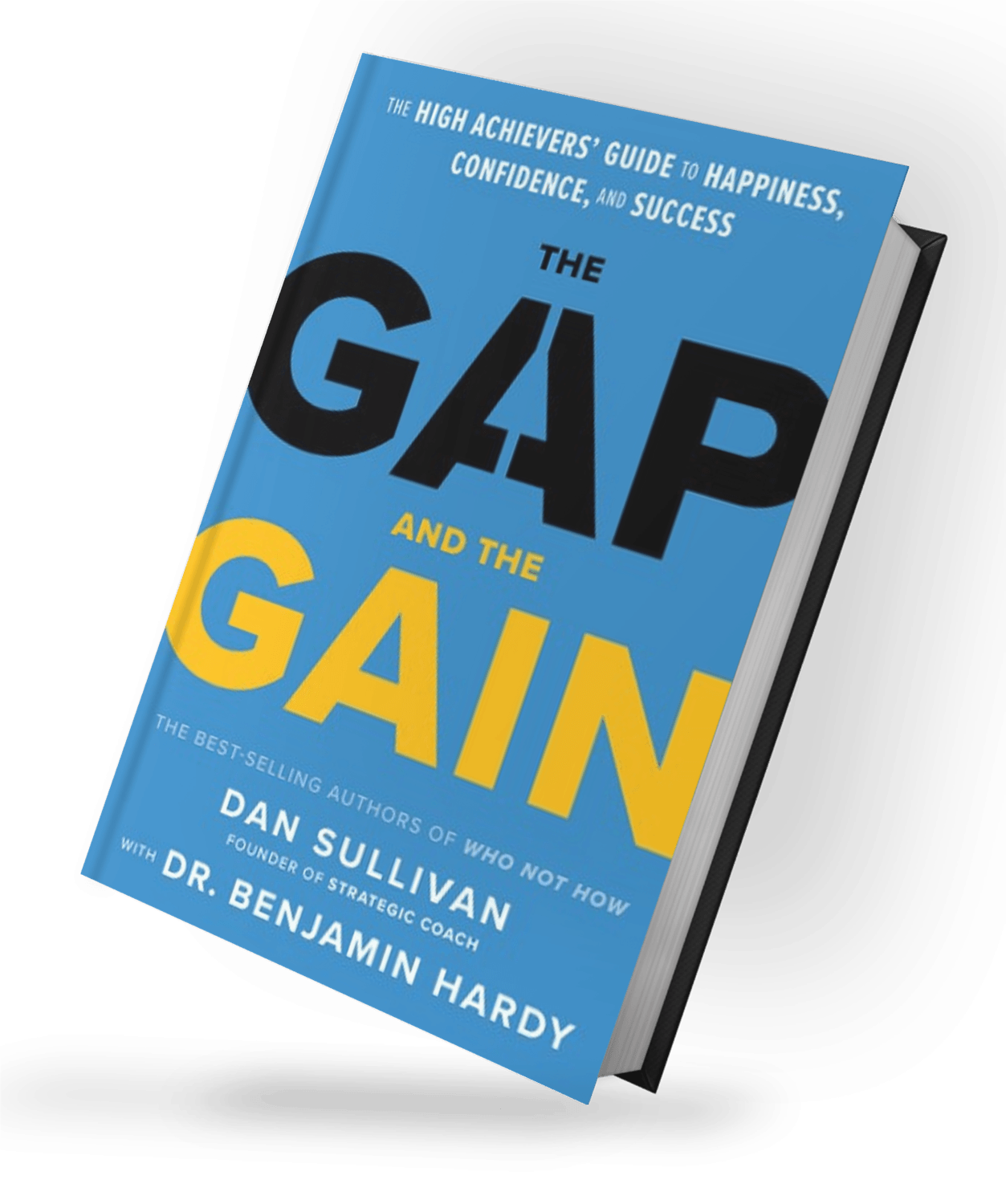
The Gap & The Gain by Dan Sullivan & Benjamin Hardy - Book Summary
Have you ever hit a goal you worked years for and felt nothing?
No fireworks. No relief. Just a quiet slide into the next thing you haven't done yet. If that's ever happened to you, you're not broken, and you're not ungrateful.
You're just measuring your progress the wrong way. That's the entire premise behind Dan Sullivan and Dr. Benjamin Hardy's The Gap and the Gain, and it might be the single most useful mindset shift I've come across in years of reading leadership books.
Grab a coffee. Let's talk about why so many high achievers feel perpetually behind, and what to do about it.
Why You Should Read This Book
There's a strange trap that catches ambitious people more than anyone else. The harder you work and the more you accomplish, the further away "enough" seems to get. You'd think success would feel like success. Instead, it often feels like a longer to-do list.
The Gap and the Gain are names that trap you and give you a way out. Dan Sullivan, who has coached entrepreneurs for over forty years through his company Strategic Coach, teamed up with organizational psychologist Dr. Benjamin Hardy to explain why so many successful people are quietly unhappy and how a simple shift in how you measure progress can fix it.
You should read this book if:
You've hit goals and still feel empty. This book explains why, and it's not because you picked the wrong goals.
You're driven by ideals that never seem to get closer. Ideals are useful for direction, but terrible as a measuring stick.
You want a practical, daily tool, not just a mindset shift. The book gives you specific exercises you can start using tonight.
You lead others. Understanding the Gap and the Gain changes how you coach, encourage, and recognize progress in the people around you, not just yourself.
I'll be honest, this is a short book with one core idea. But it's an idea that, once you see it, you can't unsee. It shows up in your business, your marriage, your parenting, your health, and your walk with God.
Once you know the language of the Gap and the Gain, you'll start catching yourself in real time, and that's where the real change happens.
Key Takeaways
Here's the big picture before we walk through it piece by piece.
The Gap is measuring yourself against an ideal. It guarantees you'll always feel behind, no matter how much you've actually accomplished, because the ideal keeps moving.
The Gain is measuring backward. You look from where you are now to where you started, and you see real, undeniable progress that no ideal can erase.
Ideals are meant for direction, not measurement. The moment you use them as your yardstick, they stop inspiring you and start discouraging you.
Success has to be self-determined. If you're chasing someone else's definition of winning, you'll never feel like you've arrived, because it was never your race to begin with.
Wanting is healthier than needing. When you shift from need to want, you stay committed to your goals without your identity being on the line.
Small daily wins compound. Naming three wins each day trains your brain to look for evidence of progress, and the more you look, the more you find.
Every experience, even a painful one, can become a Gain. The meaning of what happened to you isn't fixed. You get to decide what it taught you and what you'll build with it.
Now let's slow down and go deeper into each of these.
Memorable Quotes from The Gap and the Gain
A few lines from the book that are worth writing on a sticky note and putting on your mirror:
“If you focus on what you lack, you lose what you have. If you focus on what you have, you gain what you lack.”
“When your happiness is tied to something in the future, then your present is diminished.”
"The way to measure your progress is backward against where you started, not against your ideal."
“The day you stop racing is the day you win the race.”
"Everyone who grows achieves their progress and improvement by transforming frustrating and painful failures into rules and measurements for satisfying success."
“In psychology, inattentional blindness occurs when you are so fixated on one thing that you fail to see everything else going on around you. It’s easy to miss the GAINS happening throughout our lives or businesses because we may have tunnel vision on the problem in front of us.”
"The Gap makes you more psychologically rigid, while the Gain increases your psychological flexibility."
"When you're in the GAIN, you become increasingly unique and incomparable as a person."
That last one is worth sitting with. The moment you stop measuring yourself against everyone else's highlight reel and start measuring against your own starting line, comparison loses its grip on you.
Introduction and Overview of the Book
“Ideals are meant to provide direction, motivation, and meaning to our lives. They are not the measuring stick. Our society has trained us to measure ourselves against our ideals, which by definition are unreachable. Goals, conversely, are reachable.”
Dan Sullivan built his career coaching entrepreneurs, and after decades of it, he noticed a pattern that troubled him. The people in his rooms had accomplished more than most people ever will, and yet many of them were miserable. Not because they lacked success. Because they had no reliable way to actually see it.
Sullivan partnered with Dr. Benjamin Hardy (whom he had already co-written the bestseller Who Not How with) to put language and structure around a concept Sullivan had been teaching his clients for years. The result is simple enough to explain in a sentence, but powerful enough to change how you experience your entire life.
The Gap is what happens when you measure yourself against an ideal, a future goal, a past version of your plans, or someone else's life. Since an ideal is always out ahead of you, measuring against it guarantees you'll always come up short, no matter how far you've actually come.
The Gain is what happens when you measure backward—from where you are today to where you started. That's a fixed point. It doesn't move on you. And when you measure against it, you almost always find real, tangible proof that you're moving forward.
Unsuccessful people, Hardy argues, tend to live in the Gap without realizing it. Successful and happy people learn to live in the Gain, on purpose, every single day. Let's walk through how.
Chapter 1: Stop Chasing, Start Gaining
“Don’t let your past be forgotten. Always measure backward.”
Most of us were never taught how to measure our own progress. So we default to measuring against an ideal, and we wonder why success never feels like enough.
Sullivan and Hardy open with a story about Olympic speed skater Dan Jansen. Jansen was favored to win a medal in the 1984 Olympics and didn't. For a decade, every race carried the weight of every previous failure.
He was chasing a Gap that kept growing. In his final Olympic race in 1994, something shifted. Instead of racing to finally close the gap on medals he "should have" won, he raced from gratitude for everything the sport had already given him. He won gold and broke a world record in that final race, and he did it by getting out of the Gap.
High achievers are especially vulnerable to this trap. The bigger your goals, the further away "enough" feels, and the harder it becomes to recognize the real progress happening right in front of you.
Happiness isn't something you pursue once you hit the next milestone. It's something you build right now, by recognizing and owning the Gains you've already made.
“Don’t let your past be forgotten. Always measure backward.”
Reflection Questions:
Where in your life have you accomplished something significant, but still felt behind because you were measuring against an ideal instead of your starting point?
What would change if you spent ten minutes today writing down three real Gains from the last ninety days?
Chapter 2: Define Your Own Win
“Your happiness as a person is dependent on what you measure yourself against.”
From the time we're kids, we're handed someone else's definition of success. Grades. Titles. Income. Followers. We're told to measure ourselves against it. But when you let outside standards decide whether you're winning, you hand over the controls, and you'll never feel truly free.
Hardy points to marketing expert Dean Jackson, who built a personal list titled "I know I'm being successful when..." He uses that list, not outside opinion, to guide his decisions and evaluate opportunities. That's what it looks like to be self-determined. You decide what winning looks like for you, and nobody else needs to sign off on it.
There's also an important distinction the book draws between wanting and needing. When you need something, you lose your independence and your peace, because your worth becomes tied to an outcome you can't fully control. When you want something, you can be fully committed to the goal while staying secure and grounded, because your identity is never riding on it.
Reflection Questions:
What does your current definition of success actually belong to, you or someone else?
Complete this sentence ten times this week: "I know I'm being successful when..." Circle the answers that feel most true to you.
Chapter 3: The Compound Effect of the Gap and the Gain
“If you focus on what you lack, you lose what you have. If you focus on what you have, you gain what you lack.”
This chapter gets practical about what living in the Gap actually costs you. It's not just a feeling. It's a habit that compounds, and it takes a real toll on your mind and your body.
Research cited in the book found that optimistic people tend to live roughly ten years longer than pessimistic people, and unhappy employees take significantly more sick days than happy ones.
In one striking study, people with higher levels of happiness entering a cold virus trial fought off the virus better and had fewer symptoms than less happy participants.
The Gain works the opposite way. It's healing and restorative. Hardy encourages readers to build simple language around this idea, so it becomes second nature. When you catch yourself in the Gap, call it out, then consciously ask, "What's the Gain here? How do we turn this into a Gain?"
Reflection Questions:
What is being in the Gap actually costing you physically and emotionally right now, even if you haven't named it that way before?
What language could you start using this week to catch yourself the moment you slip into Gap thinking?
Chapter 4: Always Measure Backwards
“The way to measure your progress is backward against where you started, not against your ideal.”
It's easy to forget your own past wins. Hardy tells the story of Jill Bishop, a school physical therapist who works with children who have severe physical and mental disabilities. A year earlier, Jill had celebrated teaching a young girl named Rosie to walk on grass, a genuine milestone. But in the day to day grind of new challenges, that win had already faded from memory.
It wasn't until an annual review forced Jill to look backward that she saw how much progress Rosie had actually made, progress doctors once said wasn't possible.
Jill's observation is one worth sitting with: teachers and therapists burn out faster when they stay fixed on the problems still in front of them instead of the ground they've already covered. Regularly measuring backward is what sustains the motivation to keep going.
Reflection Questions:
What's a win in your own life or work that you've already forgotten about, simply because you moved on to the next challenge too quickly?
Who in your life needs you to remind them how far they've actually come?
Chapter 5: Measure Three Daily Wins
"When performance is measured, performance improves. When performance is measured and reported, the rate of improvement accelerates."
There's a sweet spot hour every day that has an outsized impact on both your short-term and long-term success, and Hardy makes the case that it's the hour before bed. What you do in that hour gets coded into your long-term memory and sets the tone for how you sleep and how you show up tomorrow.
Sullivan has taught his coaching clients for years to write down three wins from the current day, every single day. He also emphasizes having an accountability partner to track it with you.
As Pearson's Law puts it, "When performance is measured, then performance improves. When the performance is measured and reported, then the rate of improvement accelerates."
Two-time Olympic gold medalist Kayla Harrison offers a related practice. She visualizes winning before falling asleep each night, believing that the hour before bed sets the tone for everything that follows.
Reflection Questions:
What would your last hour before bed look like if you used it to name three real wins instead of scrolling your phone?
Who could you ask to be your accountability partner for a daily win streak, starting this week?
Chapter 6: Turn Every Experience Into a GAIN
"The Gap makes you more psychologically rigid, while the Gain increases your psychological flexibility."
The final chapter makes clear that being in the Gain isn't only about seeing the bright side. It's about taking every experience life throws at you, including the painful ones, and transforming it to serve you. When you're in the Gap, you ask why this is happening to you and slide into a victim mentality.
When you're in the Gain, you take control of the meaning of your own past.
Hardy tells the story of Howard Getson, who woke up one morning having lost two million dollars in a single stock market crash. His first instinct was to call it the worst day since the Great Depression. But he caught himself, realized it was only the worst day for him, and used that insight to completely rethink his investment system.
He got out of the Gap the very next day. As Getson put it, "the Gap makes you more psychologically rigid while the Gain increases your psychological flexibility."
The meaning of any experience isn't fixed. You get to decide what it taught you and what you'll build with it from here. Your past isn't something you simply recover from. It's something you build with.
Reflection Questions:
What's one painful experience from your past that you've never actually mined for the lesson it was offering you?
If you ran that experience through the "Experience Transformer," what three specific things did it give you?
Conclusion (And Your Next Step)
“When your happiness is tied to something in the future, then your present is diminished.”
Here's what stays with me most after sitting with this book. The Gap and the Gain isn't really a productivity hack. It's a lens. And once you put it on, you start noticing how many areas of your life you've been quietly measuring against a moving target, your career, your marriage, your parenting, even your walk with God, and coming up short every single time, no matter how much ground you've actually covered.
You don't need a bigger win to feel successful. You need a better measuring stick. Measure backward. Name your wins. Take ownership of what your hard seasons gave you. That's the whole shift, and it's available to you starting tonight.
So here's your call to action. Don't just close this out and move on to the next thing. Tonight, before you go to bed, write down three real wins from today. Not vague ones. Specific ones.
Then ask yourself one honest question: if you measured your progress backward from where you started instead of forward toward what's next, how would you feel about where you are right now?
You've come further than you think. Go take a look.
Other Books by Dr. Benjamin Hardy and Dan Sullivan
If The Gap and the Gain resonated with you, here's where to go next in Dan Sullivan and Dr. Benjamin Hardy's body of work:
Who Not How: The first collaboration between Sullivan and Hardy, and the book that set up everything that followed. It teaches a simple but life-changing question: instead of asking "how do I do this myself," ask "who can help me do this?"
It's a guide to multiplying your results by building a team of the right people around your goals, rather than trying to carry every goal alone.
10x Is Easier Than 2x: Sullivan and Hardy's follow-up to The Gap and the Gain, and in many ways it's a natural next step. The core idea is counterintuitive but freeing: chasing incremental 2x growth actually takes more effort than committing to 10x growth, because 10x forces you to let go of what's no longer working instead of just doing more of it.
It builds on the same foundation of self-determined success and expands it into your time, money, relationships, and purpose.
Willpower Doesn't Work (Benjamin Hardy, solo): Hardy's first major bestseller, and a book that challenges the popular idea that success comes from grinding out more discipline.
Instead, he makes the case that your environment shapes your behavior far more than willpower does, and that lasting change comes from redesigning your surroundings, not white-knuckling your way through temptation.
Personality Isn't Permanent (Benjamin Hardy, solo): Hardy takes on the popular belief that your personality is fixed and that your "true self" is something to be discovered rather than created.
Drawing on psychological research, he argues you're not defined by your past, your personality type, or a test result, and shows how to intentionally become the person you want to be.
Be Your Future Self Now (Benjamin Hardy, solo): A natural companion to The Gap and the Gain. Instead of slowly working toward the person you want to become, Hardy makes the case that you can start being that future self today, and that doing so is what actually accelerates the transformation, rather than waiting for some distant day when you'll finally have arrived.
Enjoyed this breakdown? Subscribe to the Learning to Lead Newsletter for more book summaries, leadership frameworks, and practical encouragement delivered weekly.

Join over 4,000 Growth-Minded Leaders reading The Learning To Lead Newsletter each week!
Latest Blog Post
Join over 4,000 Fellow Leaders reading The Learning To Lead Newsletter each week!
©2025 Learning To Lead | Helping Good Leaders Become Great Leaders