
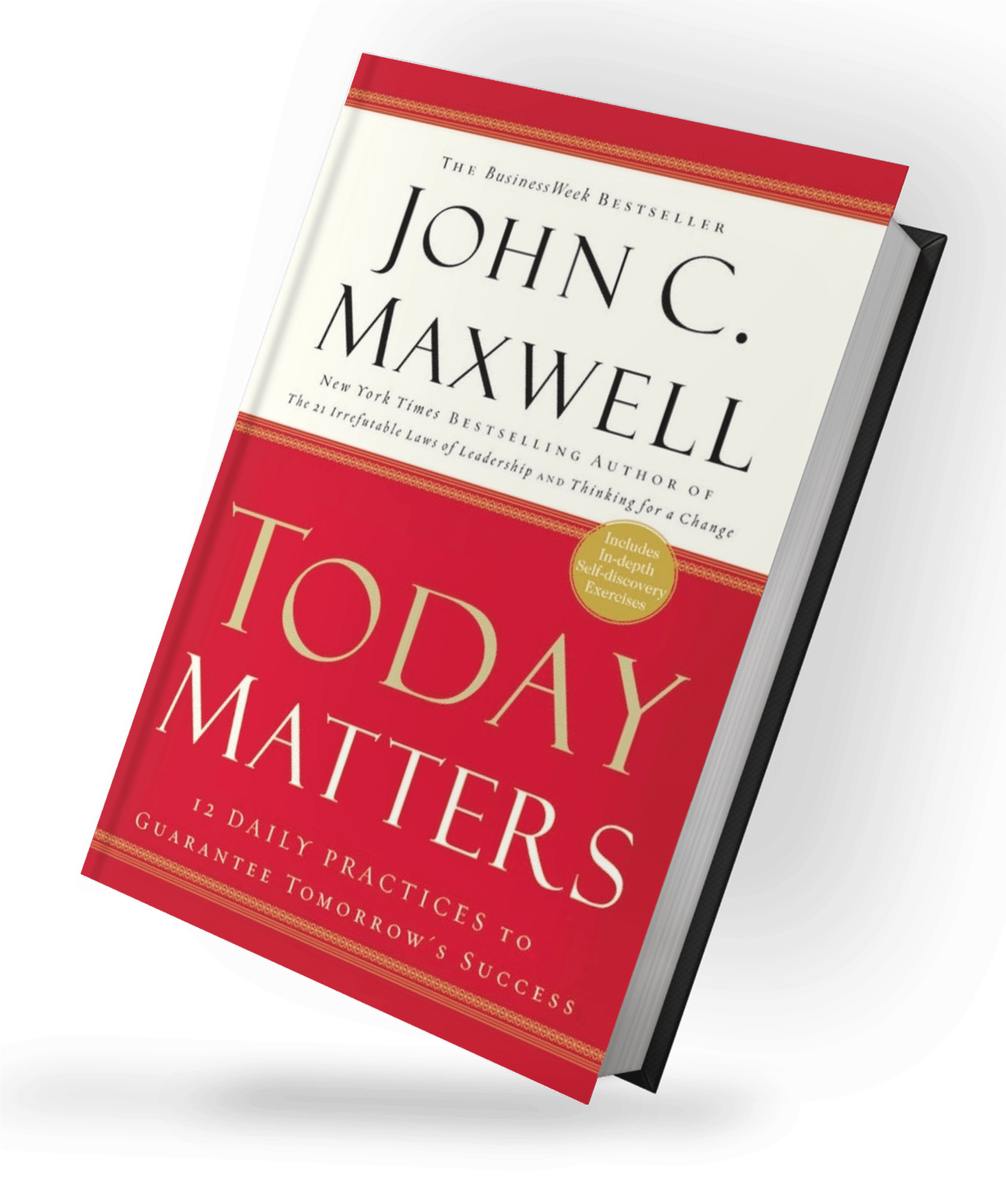
Today Matters by John C. Maxwell - Book Summary
Have you ever set a big goal, felt fired up about it for a week, and then quietly watched it fade back into "someday"?
That's the gap John C. Maxwell set out to close with Today Matters. Not with more motivation. Not with a bigger vision board. With a simple, almost uncomfortable idea: your future isn't decided by the goals you set. It's decided by what you actually do today, repeated on purpose, for the rest of your life.
This post is the pillar: the one place that pulls together all twelve of Maxwell's "Daily Dozen," the stories behind them, the quotes worth writing on a sticky note, and the reflection questions that turn reading into doing.
Whether you're trying to get healthier, lead a team, save a marriage, or just stop feeling like life is happening to you instead of through you, this book gives you a framework. Grab a coffee, and let's walk through it.
Why You Should Read This Book
Most success books sell you on the destination. Today Matters sells you on the mechanism. Maxwell's core insight is that people don't fail because they lack big dreams. They fail because they never translate those dreams into a daily agenda. He puts it plainly:
"The secret of your success is determined by your daily agenda."
What makes this book different from the typical goal-setting playbook is that Maxwell isn't asking you to make hundreds of decisions every day. He's asking you to make 12 decisions once in 12 key areas of life, and then manage them daily for the rest of your life. That's a fundamentally different way to think about discipline. You're not white-knuckling your way through fresh willpower every morning. You're just managing a decision you already made.
You should read this book if:
You've made resolutions before that didn't stick, and you want to understand why decisions alone never change a life without daily management behind them.
You want one integrated framework for the whole of life, not just career, not just fitness, not just faith, but attitude, health, family, finances, faith, relationships, and more, all tied together.
You're in a season where "someday" keeps replacing "today", and you need a wake-up call on how quickly neglected todays add up to a life you didn't intend to live.
You want the encouragement of someone who admits he's still working on it. Maxwell isn't writing from a pedestal. He's honest about where he's failed, especially in his own health, and that honesty is part of what makes the book land.
I'll say this plainly: this isn't a book you read once and shelve. It's a book you return to every few years as a checkup, because the twelve areas Maxwell identifies don't go out of style. They're the same twelve areas your life will still be built on twenty years from now.
Key Takeaways
Before we walk through all twelve daily practices, here's the view from 30,000 feet. If you remember nothing else from this post, remember this:
The secret to your success lies in your daily agenda, not your annual goals. What you do today, repeated, is what compounds into tomorrow.
Decisions and discipline are two different things, and you need both. Good decisions without daily discipline are a plan without a payoff. Daily discipline without good decisions is regimentation without reward.
You only need to make each of the Daily Dozen decisions once. After that, your job shifts from deciding to managing.
Yesterday ended last night, and tomorrow isn't guaranteed. Today is the only time you actually have any control over.
The earlier you make these decisions, the greater the compounding effect. But it's never too late to start; it's only too late to have started sooner.
Attitude, priorities, health, family, thinking, commitment, finances, faith, relationships, generosity, values, and growth are the twelve levers. Neglect any one of them long enough, and the whole structure gets wobbly.
Reflection fuels discipline, and discipline maximizes decisions. Maxwell's closing line for every chapter says it best:
"Reflection today motivates your discipline every day, and discipline every day maximizes your decision of yesterday."
Memorable Quotes from Today Matters
This book is packed with lines that are worth keeping somewhere you'll actually see them again. Here are some of my favorites:
"The secret of your success is determined by your daily agenda."
"You will never change your life until you change something you do daily."
"Good Decisions + Daily Discipline = A Masterpiece of Potential."
"Yesterday ended last night."
"The only adequate preparation for tomorrow is the right use of today."
"Successful people make right decisions early and manage those decisions daily."
"All's well that begins well."
"Neglect enough today, and you'll experience the 'someday' you've wanted to avoid."
"Devoting a little of yourself to everything means committing a great deal of yourself to nothing." — Michael LeBoef, quoted by Maxwell
"When you accomplish something that you once believed was impossible, it makes you a new person."
That last one is worth sitting with. Maxwell didn't write this book from theory. He wrote it after a heart attack, a building program that nearly broke him, and forty years of tracking, quote by quote, what actually worked and what didn't.
Introduction and Overview of the Book
John C. Maxwell wrote Today Matters: 12 Daily Practices to Guarantee Tomorrow's Success in 2004, and it functions almost like a personal audit of his own life. Rather than teaching leadership principles for an organization, Maxwell turns the lens inward and asks a more foundational question:
What does it take to make one single day a success, and what happens if you string thousands of those days together?
His answer is what he calls the Daily Dozen: twelve critical areas of life where, he argues, you only need to make the right decision once. After that, your only job is to manage that decision on a daily basis. Here's the full list, in Maxwell's own words:
Attitude: Choose and display the right attitudes daily.
Priorities: Determine and act on important priorities daily.
Health: Know and follow healthy guidelines daily.
Family: Communicate with and care for my family daily.
Thinking: Practice and develop good thinking daily.
Commitment: Make and keep proper commitments daily.
Finances: Earn and properly manage finances daily.
Faith: Deepen and live out my faith daily.
Relationships: Initiate and invest in solid relationships daily.
Generosity: Plan for and model generosity daily.
Values: Embrace and practice good values daily.
Growth: Seek and experience improvements daily.
A few ground rules shape how Maxwell wants you to approach the book:
You don't need to tackle all twelve at once. He recommends ranking yourself, working on two strengths and one weakness at a time, and reevaluating every sixty days.
Decisions and disciplines aren't the same thing. Making the decision is the "goal setting." Managing it daily is the "goal getting." You need both, or the equation falls apart.
The earlier you settle an issue, the bigger the compounding effect. But Maxwell is careful to note this isn't an excuse for people who started late; it's an argument for starting now, whatever your age.
This isn't a to-do list. Maxwell is explicit that he's not asking you to add twelve more tasks to your calendar. He's asking you to settle twelve issues so thoroughly that you no longer have to relitigate them every day.
We'll walk through all twelve below, roughly following Maxwell's order, with a story, an application, and reflection questions for each.
Chapter 1: Today Often Falls to Pieces — What Is the Missing Piece?
The secret of your success is determined by your daily agenda.
Maxwell opens by dismantling the common myths people believe about success: that it's impossible, mystical, luck-based, purely a function of hard work, dependent on the right opportunity, gained through leverage, built on connections, measured by recognition, or created in a single event. Each of these beliefs, he argues, leads people to either give up or wait passively for something to happen to them.
His point of contrast is stark: some people exaggerate yesterday, clinging to old glory or old wounds. Others overestimate tomorrow, assuming things will simply get better without any strategy to back up that hope. And nearly everyone underestimates today, treating it as disposable while they wait for some future moment to really start living.
The fix isn't a bigger dream. It's a better daily agenda, built decision by decision across the twelve areas that follow.
Reflection Questions:
Which of the nine success myths Maxwell describes have you been quietly believing without realizing it?
Are you spending more mental energy replaying yesterday or hoping for tomorrow than you are investing in today?
Chapter 2: Today Can Become a Masterpiece
Good decisions + daily discipline = a masterpiece of potential.
Maxwell tells the story of spending an afternoon with legendary UCLA coach John Wooden, who built ten national championships not by dreaming of winning but by making every single practice a masterpiece. Wooden's line stuck with Maxwell for the rest of his life:
"You can't do anything about yesterday... You can do nothing about tomorrow... So make today a masterpiece."
The formula Maxwell builds around this idea is simple but sharp: good decisions without daily discipline are a plan without a payoff. Daily discipline without good decisions is regimentation without reward. Only when both are present do you get a masterpiece of potential.
He also makes the case for starting with yourself, starting early, starting small, and starting now, warning that the excuses people give for delay ("until my kids leave the house," "until I retire," "until summer") never actually run out on their own.
Reflection Questions:
Are you currently making good decisions without the daily discipline to back them up, or the reverse?
What's the "until" excuse you've been using to justify not starting yet?
Chapter 3: Today's ATTITUDE Gives Me Possibilities
Choose and display the right attitudes daily.
Maxwell contrasts Sigmund Freud, brilliant but chronically pessimistic and unhappy despite his achievements, with Lance Armstrong, whose positive attitude carried him through a cancer diagnosis with a 3 percent survival rate and back to five consecutive Tour de France wins. The difference wasn't circumstance. It was attitude.
Maxwell made his own attitude decision at seventeen, after his basketball coach and his teachers both noticed the same thing: his attitude was influencing everyone around him. From that point on, his decision was simple:
"I am going to keep a positive attitude and use it to influence others."
The daily discipline, he says, is that attitude isn't self-sustaining. It needs adjustment every single day, and it starts with taking full responsibility for it rather than waiting for circumstances or other people to make you happy.
Reflection Questions:
Whose responsibility have you been treating your attitude as, if not your own?
What's one negative word or phrase from Maxwell's list ("I can't," "if only," "maybe") that's crept into your daily vocabulary?
Chapter 4: Today's PRIORITIES Give Me Focus
Anyone can steer the ship, but it takes a leader to chart the course.
Determine and act on important priorities daily.
Maxwell tells the cautionary story of Howard Hughes, who inherited a fortune at eighteen and had the talent and resources to do almost anything, but scattered his focus across movies, aviation, airlines, and casinos until his lack of priorities led to isolation, broken relationships, and a mental breakdown. Contrast that with Betsy Rogers, the 2003 National Teacher of the Year, whose relentless focus on her students and her community defined a career of quiet, sustained impact.
Maxwell's own priority decision came from discovering the Pareto Principle in 1971: focusing 80 percent of his time on the top 20 percent of his priorities. His three-question filter for sorting priorities is one of the most practical tools in the whole book:
What is required of me?
What gives me the greatest return?
What gives me the greatest reward?
Reflection Questions:
Running your current calendar through Maxwell's three questions, what would you cut?
Are you a "clinger" who refuses to delegate, or a "dumper" who hands things off carelessly?
Chapter 5: Today's HEALTH Gives Me Strength
Know and follow healthy guidelines daily.
This is the one chapter in which Maxwell writes a cautionary tale about himself. Despite decades of high-energy, fast-paced living, he neglected his health until a heart attack at his own company Christmas party in 1998 nearly killed him. His decision, made at fifty-one, was straightforward:
"I will take good care of myself by exercising and eating right."
What makes this chapter honest rather than preachy is Maxwell's admission that he later relapsed, easing off the discipline once his cardiologist gave him good news, and had to recommit. His line about it is one of the sharpest in the book:
"Neglect enough todays, and you'll experience the 'someday' you've wanted to avoid."
Reflection Questions:
Where has "I feel fine, so I must be healthy" led you to skip a checkup or ignore a habit you know matters?
What would it cost you, five or ten years from now, if today's health choices simply continued on their current trajectory?
Chapter 6: Today's FAMILY Gives Me Stability
Communicate with and care for my family daily.
Maxwell opens with a striking historical contrast: the Jukes family, studied for its generational pattern of poverty and crime, against the descendants of Jonathan Edwards, who produced college presidents, judges, and senators. The point isn't genetics. It's that family environment that compounds, generation after generation, for better or worse.
In 1986, watching colleagues' marriages fall apart around him, Maxwell rewrote his own definition of success: "Success meant having those closest to me love and respect me the most." That decision put Margaret and his children at the center of everything else he built.
Reflection Questions:
If success is defined by who loves and respects you most, how would your family currently answer that question?
What family tradition could you start this year that your family will still be talking about in twenty years?
Chapter 7: Today's THINKING Gives Me an Advantage
Practice and develop good thinking daily.
Maxwell contrasts the early leadership of the Hartford family at A&P grocery stores, who repeatedly reinvented their business model to match changing customer needs, with their successor, Ralph Burger, who tried to run the company by asking "what would Mr. Hartford do?" instead of doing his own thinking. The result was decades of decline for a company that once rivaled General Motors in size.
Maxwell's own thinking decision came at fourteen after reading As a Man Thinketh:
"I will think on things that will add value to myself and others."
He also breaks thinking into 11 distinct skills, a nod to his book Thinking for a Change, and argues that you should maximize your strengths in a few of them rather than trying to master all 11.
Reflection Questions:
Where in your life or work have you been asking "what worked before?" instead of doing fresh thinking for today's circumstances?
Which one or two of Maxwell's eleven thinking skills are your natural strengths, and are you actually using them daily?
Chapter 8: Today's COMMITMENT Gives Me Tenacity
Make and keep proper commitments daily.
Maxwell tells two commitment stories side by side. Mickey Mantle, one of the most naturally gifted baseball players ever, let alcoholism erode a career that could have rivaled Babe Ruth's, admitting late in life that his lack of discipline, not his injuries, was what cut his potential short. Liz Murray, by contrast, went from homelessness in the Bronx to Harvard by refusing to let her circumstances define her commitment to change.
Maxwell made his own commitment decision at twenty-nine while leading a difficult building program at his church:
"If something is worth doing, I will commit myself to carrying it through."
His reminder is that commitment isn't a one-time event; it gets tested every single day, especially through failure, isolation, and disappointment.
Reflection Questions:
What commitment have you made that's currently being tested, and how are you holding up?
Are your choices right now based on your commitments, or on how you happen to feel today?
Chapter 9: Today's FINANCES Give Me Options
Earn and properly manage finances daily.
Maxwell opens with sobering statistics on debt and bankruptcy, then makes a case that's easy to nod along with but hard to live out: money won't make you happy, but debt will absolutely make you miserable, and having a financial margin simply gives you options everywhere else in life.
In 1985, Maxwell and his wife settled on a simple formula: 10 percent to charity, 10 percent to investments, 80 percent to living expenses. He also traces Suze Orman's path from broke waitress to financial expert, noting that her real turning point wasn't a big win. It was a $40 traffic ticket she couldn't pay, despite her expensive car and clothes, that forced her to face the truth about her finances.
Reflection Questions:
If you mapped out your "learn, earn, return" season of life right now, which phase are you actually in, and is your behavior matching it?
What's your version of Suze Orman's $40 traffic ticket, the small moment that would force you to be honest about your finances?
Chapter 10: Today's FAITH Gives Me Peace
Deepen and live out my faith daily.
Maxwell is upfront that this chapter reflects his own Christian faith, and he invites readers who see it differently to engage with it as his personal journey rather than as a prescription. He walks through the research connecting faith and better health outcomes and tells the story of astronaut Rick Husband, lost aboard the space shuttle Columbia, whose wife, Evelyn, found stability afterward not because she understood the tragedy, but because of a faith that had already been tested and deepened long before the crisis arrived.
His point:
"A faith that hasn't been tested can't be trusted."
Faith isn't a switch to be flipped in the middle of a crisis; it's a daily discipline that either has depth already built up, or doesn't.
Reflection Questions:
Whatever your own beliefs, is there a spiritual or reflective practice you've been meaning to explore more deeply?
What would it look like to build in daily rather than crisis-only spiritual reflection?
Chapter 11: Today's RELATIONSHIPS Give Me Fulfillment
Initiate and invest in solid relationships daily.
Maxwell tells the story of Armand Hammer, an industrialist who built a carefully curated public image while privately alienating nearly everyone close to him: multiple wives, an abandoned illegitimate daughter, a neglected son, and estranged siblings. When he died, his funeral was sparsely attended, and the truth behind his manufactured reputation came out almost immediately.
Maxwell's own decision about relationships came from a college psychology professor who told him that having even one or two true friends in life is genuinely rare. His response was to become intentional:
"I will initiate and make an investment in relationships with others."
His practical filter for understanding people is one of the more usable frameworks in the book, matching common human needs (insecurity, wanting to feel special, needing to be understood) with specific actions (giving confidence, offering sincere compliments, listening).
Reflection Questions:
If your funeral happened tomorrow, would the room look more like Armand Hammer's or would it be full?
Who is one person you could initiate with this week, rather than waiting for them to reach out first?
Chapter 12: Today's GENEROSITY Gives Me Significance
Plan for and model generosity daily.
Maxwell contrasts J. Paul Getty, once the world's richest man, who was so notoriously stingy that he initially refused to pay a kidnapper's ransom for his own grandson, with Dave Thomas, founder of Wendy's, who spent the last twelve years of his life championing adoption causes and famously said,
"Share your success and help others succeed. Give everyone a piece of the pie. If the pie's not big enough, make a bigger pie."
Maxwell's insight here runs counter to a common assumption: generosity isn't a function of how much money you have. Mississippi, with one of the lowest average incomes in the country, ranks near the top in charitable giving; wealthier states often rank far lower. Generosity is a decision of the heart, not a byproduct of prosperity.
Reflection Questions:
Are you waiting for more money before you start being more generous, and if so, what evidence do you have that would actually change anything?
Who is one person you could add value to today, with your time or attention rather than your wallet?
Chapter 13: Today's VALUES Give Me Direction
Embrace and practice good values daily.
Written in the shadow of the Enron, WorldCom, and Martha Stewart scandals, this chapter makes the case that values function as an anchor, a faithful friend, and a north star, especially when circumstances get chaotic. Maxwell shares his own list of twelve values (essentially the Daily Dozen itself) and describes turning down a last-minute White House meeting with President Bush because it conflicted with a prior commitment to speak at a conference.
"By choosing to embrace and practice good values every day, you may not always get what you desire, but you will always be the person you desire to be."
Reflection Questions:
If you wrote out your own top five to twelve core values right now, would your calendar and bank statement from the last month actually reflect them?
What's a recent decision where your values and your feelings pulled you in different directions, and which one won?
Chapter 14: Today's GROWTH Gives Me Potential
Seek and experience improvements daily.
Maxwell notes something telling: when researching this chapter, he and his team couldn't find a compelling story of someone who wasted their potential due to a lack of growth, because those people simply don't make headlines. They fade quietly instead.
His own growth decision came from a single question posed by a mentor over breakfast in 1974:
"John, what is your plan for personal growth?"
Maxwell had no real answer, and that gap became the turning point that led to his lifelong habit of listening to audio lessons weekly, reading two books a month, filing away quotes and ideas, and scheduling regular appointments with people who could teach him something.
He closes the chapter with Richard Carmona, who went from a Harlem housing project and high school dropout to U.S. Surgeon General, entirely because he never stopped seeking the next level of growth available to him.
Reflection Questions:
If someone asked you right now, "What is your plan for personal growth?" could you actually answer them?
What's one hour a week you could reclaim for reading, listening, or learning that's currently going somewhere less useful?
Conclusion (And Your Next Step)
Here's what I keep coming back to after sitting with this book: none of the Daily Dozen are complicated. Attitude, priorities, health, family, thinking, commitment, finances, faith, relationships, generosity, values, growth. You already know these matter. What Maxwell gives you isn't new information. It's a structure for turning what you already know into what you actually do, one day at a time, for the rest of your life.
That's genuinely good news, because it means you don't need to overhaul your entire life this weekend. You need to make one decision in one area and then manage it daily until it becomes who you are, rather than something you have to remember to do.
So here's your call to action: go back through the twelve areas above and rank yourself, honestly, from your strongest to your weakest. Pick two strengths to keep building and one weakness to finally address. Write down the decision. Then come back to this post in sixty days and see what's changed.
You don't need to master all twelve at once. You just need to start with one today.
Other Books by John C. Maxwell
If Today Matters resonated with you, here's where to go next in Maxwell's extensive body of work:
How to Get a Return on Failure (His Most Recent): Maxwell's newest book reframes failure not as a dead end but as an investment. He lays out actionable principles, including "See Failure as an Investment in Your Future" and "Practice the Cycle of Improvement," for turning losses into gains rather than letting setbacks define you.
The 21 Irrefutable Laws of Leadership: Maxwell's most famous work, shifting the focus from personal daily practices to how influence actually works when you're leading other people. If you want the leadership companion to this book, read my full summary here: 21 Irrefutable Laws of Leadership Book Summary
High Road Leadership: A response to our divided world, this book exposes the low and middle roads people default to when interacting with others and teaches what it actually looks like to value people, take accountability, and do the right thing for the right reasons.
Thinking for a Change: Maxwell breaks down eleven specific types of thinking skills, from big-picture thinking to shared thinking, that separate leaders who consistently make good decisions from those who don't.
Great Leaders Ask Great Questions: A case for curiosity as a core leadership skill, exploring why the best leaders lead with questions rather than answers, and how the right question at the right time can unlock a team's best thinking.
The 15 Invaluable Laws of Growth: A companion to this book's law-based structure, focused entirely on personal growth, the mindset, environment, and daily practices that determine whether you ever reach your full potential.
The 16 Undeniable Laws of Communication: Another entry in Maxwell's laws series, this one zeroes in on what makes a message actually land, because influence collapses fast when a leader can't communicate clearly and connect while doing it.
Leadership Gold: Written after Maxwell promised himself he wouldn't publish it until he turned sixty, this book distills forty years of leading into twenty-six "gold nuggets," each with application exercises designed to feel like a one-on-one mentorship session.
The 17 Indisputable Laws of Teamwork: A natural companion to this book, shifting the lens from individual leadership to what makes a team of leaders actually function together at a high level.
Developing the Leader Within You: One of Maxwell's earliest and most foundational works, focused on the internal shifts required before you can lead others well.
Winning with People: Explores the relational side of leadership, including the specific people skills that determine whether your influence grows or stalls.
The 5 Levels of Leadership: Maxwell's framework for understanding leadership as a progression, from position, to permission, to production, to people development, to the pinnacle of leadership defined by legacy.
Leadershift: A more recent work examining the mindset shifts that today's leaders need to stay effective in a constantly changing world.
Everyone Communicates, Few Connect: A deep dive specifically into the Law of Connection, exploring what it actually takes to reach people on an emotional level, not just an informational one.
Each of these builds on the same foundation Maxwell laid in The 21 Irrefutable Laws of Leadership: leadership is influence, influence is earned, and it's a lifelong process of daily growth. Read them in whatever order serves you best right now; each one will sharpen a different piece of the leader you're becoming.
Enjoyed this breakdown? Subscribe to the Learning to Lead Newsletter for more book summaries, leadership frameworks, and practical encouragement delivered weekly.

Join over 4,000 Growth-Minded Leaders reading The Learning To Lead Newsletter each week!
Latest Blog Post
Join over 4,000 Fellow Leaders reading The Learning To Lead Newsletter each week!
©2025 Learning To Lead | Helping Good Leaders Become Great Leaders