
What to Make of a Life: Jim Collins Shows Us How to Navigate Life's Cliffs, Fog, and Fire
What to Make of a Life: Jim Collins Shows Us How to Navigate Life's Cliffs, Fog, and Fire
Global Leadership Summit Speaker Series 2026
By the time Jim Collins took the stage as the fifth keynote speaker at the Global Leadership Summit 2026, the day had already challenged us in remarkable ways, thanks to three great speakers.
Craig Groeschel taught us to recognize the patterns that quietly shape our leadership and culture.
Vanessa Van Edwards reminded us that extraordinary leadership is built through small habits that help people feel seen, valued, and capable.
Julio García called us to lead not for power or position, but through sacrificial service.
Then the leadership legend, Jim Collins, took the stage. He has been a hero of mine for decades. I've read nearly everything Jim Collins has written over the past twenty-five years.
Like so many leaders, I've recommended Good to Great, Built to Last, Great by Choice, and Beyond Entrepreneurship 2.0 more times than I can count. His research has shaped how I think about organizations, leadership, and enduring greatness.
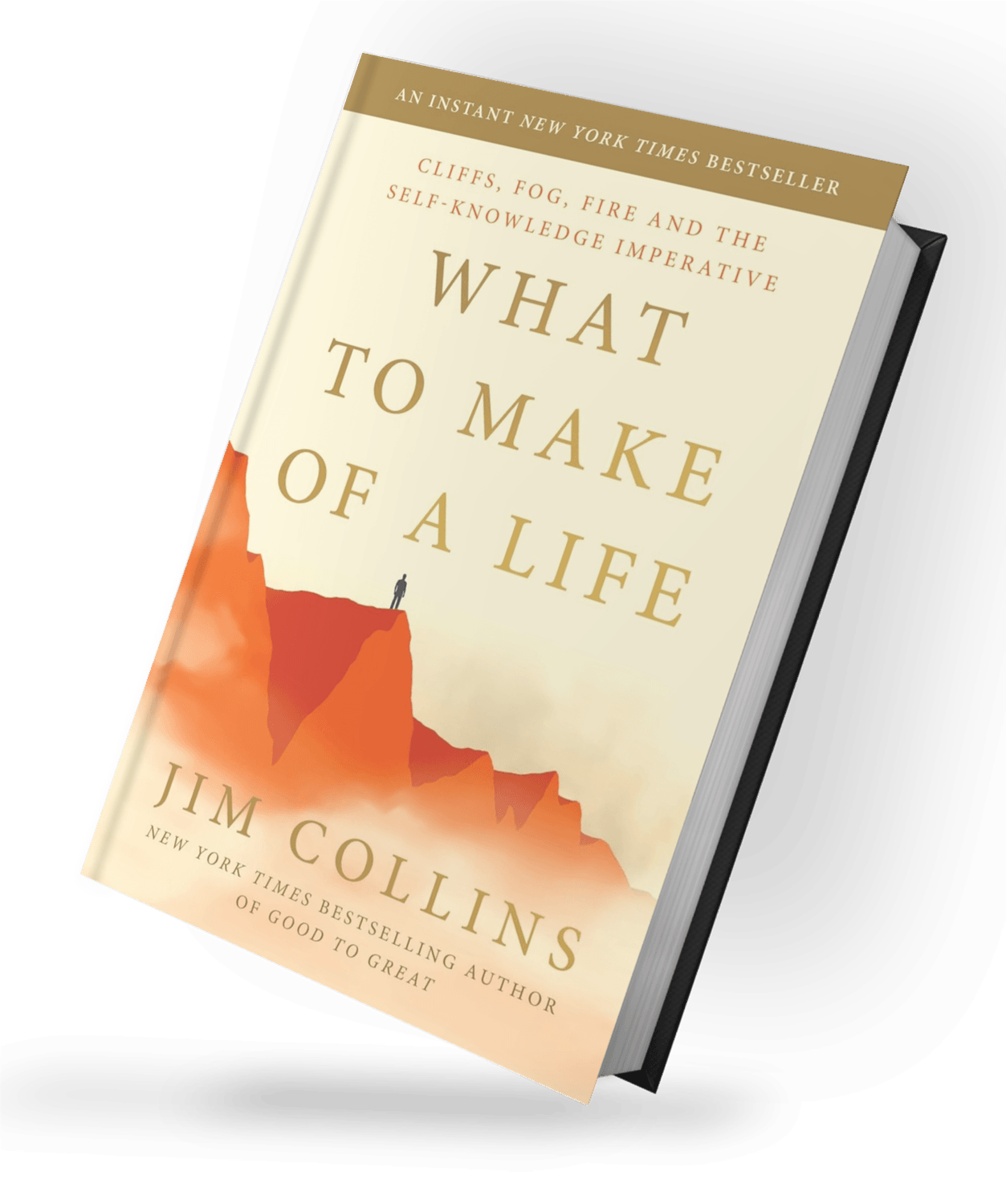
So when Jim Collins took the stage at the Global Leadership Summit 2026 to introduce his newest book, What to Make of a Life: Cliffs, Fog, Fire, and the Self-Knowledge Imperative, I expected another masterclass on leadership.
Instead, I got something even better.
This wasn't a talk about building great companies.
It was about building a great life.
And in many ways, it may be Jim Collins' most personal work yet.
Meet Jim Collins
Jim Collins is one of the world's foremost researchers on leadership and organizational excellence.
Over more than three decades, he has studied why some organizations become exceptional while others never make the leap. His books, including Good to Great, Built to Last, and Great by Choice, have sold more than 11 million copies and introduced leadership concepts that have become part of our everyday vocabulary:
Level 5 Leadership
First Who, Then What
The Hedgehog Concept
The Flywheel
Big Hairy Audacious Goals (BHAGs)
His newest book shifts the focus from organizations to individuals.
Rather than asking, "What makes a company great?"
Jim asks a far more personal question:
"What do you make of a life?"
The Question That Started It All
Early in the session, Jim shared something deeply personal.
"I lost my father while he was still alive."
He wasn't speaking about death. He was describing the heartbreaking experience of watching Alzheimer's slowly steal the man he had known.
That experience launched more than a decade of research.
Jim began studying people who had experienced life's biggest turning points—career failures, devastating losses, unexpected opportunities, illnesses, retirement, scandal, reinvention, and one question emerged again and again:
Why do some people discover renewed purpose while others never recover?
The answer became this new book.
We All Encounter Cliffs
One of Jim's central ideas is that every life eventually encounters what he calls a cliff.
Sometimes it's expected.
Retirement
An empty nest
Graduation
Other times, it arrives without warning.
A diagnosis
A layoff
The loss of someone you love
A business failure
A betrayal
A career ending overnight
The cliff changes everything. The life you knew is gone. And suddenly you're asking,
"Who am I now?"
Jim's message was both realistic and hopeful.
Cliffs aren't exceptions. They're part of every meaningful life.
Fog Isn't Failure
Perhaps my favorite insight of the afternoon centered on what happens after the cliff. Jim called it the fog.
The fog is that season when you feel disoriented, uncertain, and lost. Like you've lost your compass.
His encouragement was simple but profound:
"Fog is not a defect. It is an artifact of living."
What a freeing thought. Too often, we assume uncertainty means we've done something wrong.
Jim argues the opposite. If you're living a meaningful life, you'll eventually find yourself in the fog.
The goal isn't avoiding it. The goal is learning how to walk through it.
Don't Make Permanent Decisions in Temporary Fog
Jim offered one of the most practical pieces of advice from the session.
Avoid big, irreversible decisions while you're in the fog.
When we're hurting...
Confused...
Emotionally exhausted...
We're rarely seeing the full picture. Instead of demanding complete clarity, Jim encouraged us to practice what he calls Simplex Stepping.
Take the next best step.
That's it.
Not the perfect step.
Not the final step.
Just the next one.
Movement creates momentum. Momentum creates clarity. Clarity comes after movement, not before it.
I immediately thought about how often leaders wait until they have all the answers before acting. Jim reminded us that life rarely works that way.
Discover Your Encodings
One of the most fascinating concepts Jim introduced was something he calls encodings.
These aren't simply strengths. They're deeper than strengths.
As Jim explained,
"You can be good at something and still not be encoded for it."
Many of us spend years becoming competent at work we were never uniquely created to do.
Encodings are different. They represent the unique combination of passions, abilities, curiosities, and motivations that bring you to life.
Jim illustrated this through people like John Glenn, whose life moved through multiple "frames"—fighter pilot, astronaut, business executive, and U.S. senator.
Each role looked different. Yet each expressed something deeply consistent about who he was.
The lesson?
There may not be one thing you're called to do. There may be several different ways your unique wiring can be expressed over a lifetime.
Don't Change the Person. Change the Frame
This may have been the most practical leadership lesson of the afternoon. Jim drew a simple illustration.
Imagine a lightning bug. If you view it from the wrong frame, it seems insignificant. Move the frame. Suddenly, it becomes a lightning bolt.
His point?
We don't always need to change people. Sometimes we need to change the frame.
How much emotional energy do we waste being frustrated by what people aren't?
Jim challenged us instead to ask:
What's the right frame for this person?
He summed it up beautifully:
"Stop getting frustrated about what people are not. Feel grateful for what they are."
As leaders, our job isn't to force everyone into the same mold. It's to help people find the environment where they're most alive.
One question from my notebook keeps coming back:
Are my team members in or out of the right frame?
That's a leadership question worth asking often.
Flip the Arrow of Money
Another memorable moment came when Jim challenged our relationship with success.
He encouraged us to flip the arrow.
Most people work to earn money. Jim suggested something different.
Money becomes the means to do your true work rather than the reason you work.
That's a profound shift. Purpose comes first. Money becomes a tool to support it, not replace it.
Burn On, Not Burn Out
One quote quickly spread across social media during the Summit.
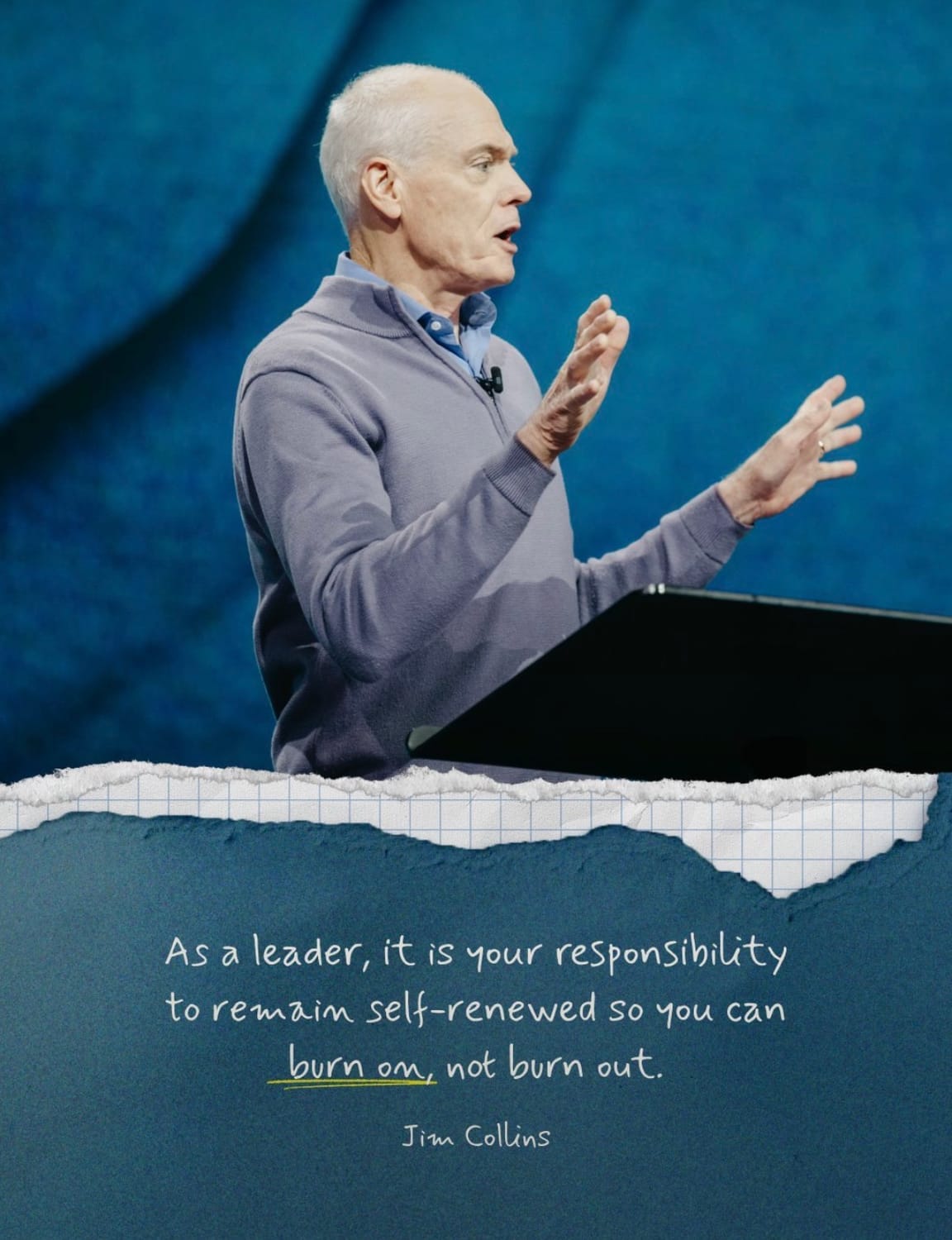
"As a leader, it is your responsibility to remain self-renewed so you can burn on, not burn out."
I love that distinction. Burnout isn't a badge of honor.
It's often a warning sign that we've neglected the very renewal that allows us to lead others well.
Leaders don't just manage organizations. They steward themselves.
Freedom Means Choosing Your Responsibilities
Jim also challenged our definition of freedom.
"Freedom does not mean the absence of responsibilities. It is the ability to choose your own responsibilities."
That sounds remarkably similar to the Level 5 Leadership he introduced years ago.
Great leaders don't chase status. They choose meaningful responsibilities. Even when no one notices. Even when someone else gets the credit.
Recognize the Natalie Moments
One concept that particularly intrigued me was what Jim called "Natalie Moments."
Not every season of life carries equal weight. Some moments become major inflection points that shape everything that follows.
Jim challenged leaders to recognize those moments, not only in their own lives but also in the lives of the people they lead. When someone on your team is standing at one of those crossroads...
They may need more than advice
They may need your presence
Your encouragement
Your belief
Those moments often determine the trajectory of a life.
My Biggest Takeaway
If I had to summarize Jim Collins' keynote in one sentence, it would be this:
A meaningful life isn't built by avoiding cliffs or escaping fog; it's built by continually discovering where your unique gifts can make the greatest contribution.
Craig Groeschel challenged us to recognize patterns.
Vanessa Van Edwards taught us to elevate people.
Julio García reminded us to lead through service.
Jim Collins invited us to do something even more foundational.
Know yourself. Find your frame. Keep taking the next best step. And never stop becoming who you were uniquely encoded to be.
As I closed my notebook, one question lingered in my mind:
Am I spending too much time trying to become someone else... or am I discovering the person I was created to be?
That may be the most important leadership question of all. Because before we can lead organizations well...
We must first learn to lead our own lives well.
Enjoyed this breakdown? Subscribe to the Learning to Lead Newsletter for more book summaries, leadership frameworks, and practical encouragement delivered weekly.
Jim Collins Books
What to Make of a Life: (His Latest): Collins turns his research lens from companies to people. After a decade studying the lives of remarkable individuals, from Olympians to scientists to public figures who weathered scandal, Collins examines the "cliffs" that upend a life's direction, the disorienting "fog" that follows, and what it takes to keep your inner "fire" burning long after. For the first time, Collins also shares his own story, tracing how the project changed him. It's a fitting capstone to a body of work that's always really been about one question: what does it take to build something that matters, whether that something is a company or a life?
Good to Great: What separates companies that merely survive from those that achieve enduring greatness? In Good to Great, Jim Collins and his research team dig into decades of data to uncover the disciplined leadership, rigorous thinking, and unwavering focus that transform good organizations into great ones. It's a must-read for any leader ready to move beyond "good enough" and build something that lasts.
Built to Last: Co-authored with Jerry Porras, this is the book that started it all: what makes visionary companies endure across generations, built around core ideology and the discipline to preserve the core while stimulating progress.
How the Mighty Fall: A sobering companion piece exploring the five stages of decline, and how even great companies can unravel if they stop confronting the brutal facts.
Great by Choice: Written with Morten Hansen, this one studies companies that thrived in uncertain, turbulent environments, introducing concepts like "fanatic discipline," "productive paranoia," and "return on luck."
BE: 2.0 (Beyond Entrepreneurship 2.0): Co-authored with his late mentor, Bill Lazier, this is Collins' guide for entrepreneurs and founders building a company from the ground up. Originally published nearly thirty years before Good to Great, this updated edition adds four new chapters and fifteen new essays, pulling together three decades of Collins' research into a single integrated framework he calls "The Map." If Good to Great is about the leap from good to great, BE 2.0 is about laying the right foundation from day one, so your company has something worth sustaining.
Good to Great and the Social Sectors: The monograph adapting the framework for nonprofits, schools, and mission-driven organizations.
Each one builds on the same foundation: disciplined people, disciplined thought, disciplined action. Read them in order, or read them out of order; either way, you'll come away with a sharper, more honest picture of what it actually takes to build something great and make it last.
Enjoyed this breakdown? Subscribe to the Learning to Lead Newsletter for more book summaries, leadership frameworks, and practical encouragement delivered weekly.

Global Leadership Summit Speaker Post Index
Craig Groeschel: The Invisible Language of Leadership
Vanessa Van Edwards: The Surprising Micro-Habits of High-Impact Leaders
Julio García: Leadership is not a Privilege
Jim Collins: What to Make of a Life: How to Navigate Life's Cliffs, Fog, and Fire
Kelly Merryman Hoogstraten: Make the Call: Stop Waiting for Certainty
Kwame Christian: Why Being Right Isn't Enough: What Every Leader Can Learn About Difficult Conversations
David Ashcraft: Leadership That Outlasts You: Succession, Humility, and the Hidden Danger of Pride
Priscilla Shirer: What’s Blocking Your Vision? Readiness, Excellence, and Staying Focused on What Matters Most
Arthur Brooks: Why Happiness Is More Than a Feeling
Alison Levine: Backing Up Isn't Backing Down
Andy Stanley: Great Leaders Ask Great Questions
Tara-Leigh Cobble: Following Before Leading
Ryan Leak: Build a Culture People Don’t Want to Leave
75 Great Quotes from the Global Leadership Summit 2026
Enjoyed this breakdown? Subscribe to the Learning to Lead Newsletter for more book summaries, leadership frameworks, and practical encouragement delivered weekly.

Join over 4,000 Growth-Minded Leaders reading The Learning To Lead Newsletter each week!
Latest Blog Post
Join over 4,000 Fellow Leaders reading The Learning To Lead Newsletter each week!
©2025 Learning To Lead | Helping Good Leaders Become Great Leaders