
21 Irrefutable Laws of Leadership by John C. Maxwell - Book Summary
Have you ever wondered why some people can walk into any room, any organization, any crisis, and people just start following them, while others with the title, the office, and the org chart in their favor can't get anyone to move?
That's the question John C. Maxwell set out to answer with nearly four decades of leadership study, and it's a question I come back to constantly in my own leadership journey.
This post is the pillar: the one place that pulls together all 21 laws in one sitting, with the stories, the quotes, and the reflection questions you need to actually put them to work.
Whether you're leading a team, a company, a classroom, a church, or your own household, these laws apply. Grab a coffee, and let's walk through one of the most practical and enduring leadership books ever written.
Why You Should Read This Book
There's no shortage of leadership content promising a hack, a hustle, or a five-step framework that changes everything overnight. The 21 Irrefutable Laws of Leadership isn't that. It's the opposite. Maxwell, a former pastor turned leadership consultant, built this book on decades of observation, mentorship, and hard-won experience, and it's sold over three million copies precisely because it doesn't chase trends. It teaches principles.
Here's what makes this book different: Maxwell isn't offering theory. Every law is "irrefutable" because he tested it in the real world, in churches, in Fortune 500 boardrooms, on battlefields, and in his own life, and found it held up every single time.
You should read this book if:
You've ever been given a title and discovered a title alone doesn't make people follow you. Maxwell calls this the difference between position and influence, and it's one of the most freeing distinctions a new leader can learn.
You want a complete leadership curriculum, not just one idea. These 21 laws work together as a system. Learn one, and you become a better leader. Learn several, and you start compounding your impact.
You're building or leading a team and want to know how to attract, develop, and empower other leaders, not just manage followers.
You want proof that leadership can be learned. Maxwell is emphatic on this point: leadership is not a mystical gift reserved for the naturally gifted. It's a set of skills anyone can develop with intentional effort.
I'll say this plainly: if you only ever read one leadership book cover to cover, this is a strong candidate. It's dense with principle, but written in plain language, and every law comes packaged with a story that makes it stick. That's why it belongs on your shelf, dog-eared and revisited often.
Key Takeaways
Before we walk through all 21 laws individually, here's the view from 30,000 feet. If you remember nothing else from this post, remember this:
Leadership ability is the lid on everything else. Your talent, your resources, your team's potential; all of it is capped by how well you lead. Raise the lid, and everything underneath it rises too.
Influence, not position, is the true measure of leadership. You can be given a title. You cannot be given followers. Those have to be earned.
Leadership develops daily, not in a day. There's no shortcut. It's a process, built through years of intentional growth.
People buy into the leader before they buy into the vision. Credibility comes first. Vision follows.
Trust is the foundation everything else is built on. Lose it, and your influence collapses with it.
Your inner circle determines your ceiling. Who you surround yourself with either expands or limits your potential impact.
Empowering others is a sign of security, not weakness. The leaders who develop other leaders multiply their impact far beyond what they could do alone.
A leader's true legacy is measured by succession. What happens to the organization after you're gone says everything about the kind of leader you actually were.
Now let's slow down and go through the laws one at a time.
Memorable Quotes from The 21 Irrefutable Laws of Leadership
This book is loaded with lines you'll find yourself repeating to your team for years. Here are some of my favorites:
"True leadership cannot be awarded, appointed, or assigned. It comes only from influence, and that can't be mandated. It must be earned."
"Personal and organizational effectiveness is proportionate to the strength of leadership."
"The higher you want to climb, the more you need leadership. The greater the impact you want to make, the greater your influence needs to be."
"How do leaders earn respect? By making sound decisions, admitting their mistakes, and putting what's best for their followers and the organization ahead of their personal agendas."
"Character makes trust possible. And trust makes leadership possible."
"Hire the best staff you can find, develop them as much as you can, and hand off everything you possibly can to them."
"When leaders have momentum on their side, people think they're geniuses. They look past shortcomings... Momentum changes people's perspective of leaders."
"The leader finds the dream and then the people. The people find the leader and then the dream."
"Leaders don't flock. You have to find them one at a time."
That last one, borrowed from Ross Perot, is worth sitting with. Building a bench of leaders isn't a mass-recruitment exercise. It's slow, deliberate, and one relationship at a time.
Introduction and Overview of the Book
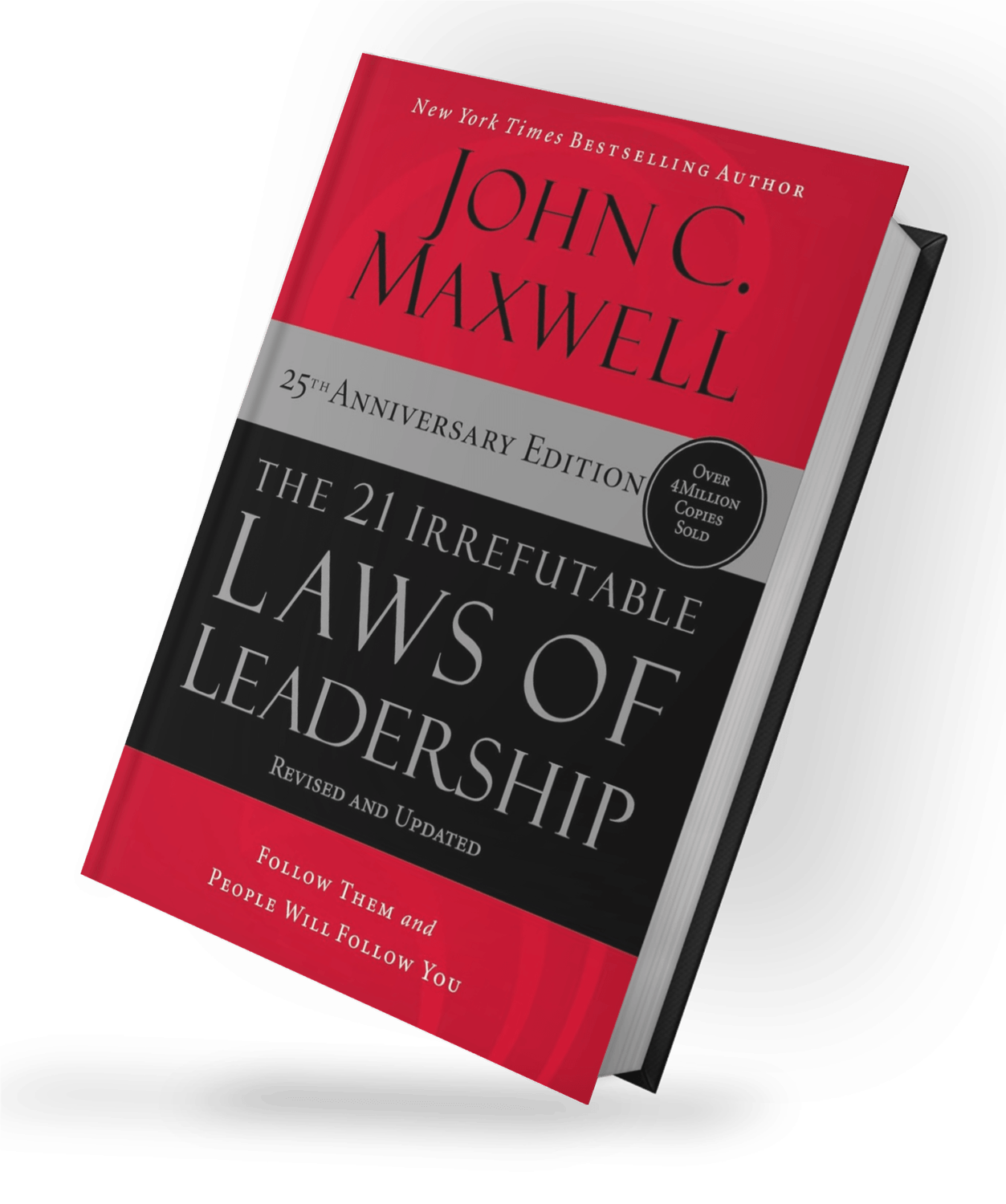
John C. Maxwell wrote The 21 Irrefutable Laws of Leadership: Follow Them and People Will Follow You in 1998, distilling what he'd learned across a lifetime of leading churches, organizations, and leadership seminars.
His premise is simple but bold: leadership is governed by laws, the same way physics is governed by laws of gravity or motion. You can violate them, but you can't get around the consequences.
A few ground rules shape how Maxwell wants you to approach the book:
The laws can be learned. Some will come more naturally to you than others, but every single one is learnable with intention and practice.
The laws stand alone, but they also work together. You don't have to master them in order. Learning even one law will make you a better leader. Learning several compounds the effect.
No one masters all 21. That's precisely why you need a leadership team: surround yourself with people who are strong in the laws where you're weak.
You can't opt out of the laws' consequences. Whether you apply them or ignore them, the laws produce results either way. Apply them, and you get traction. Ignore them, and you create friction, whether you intended to or not.
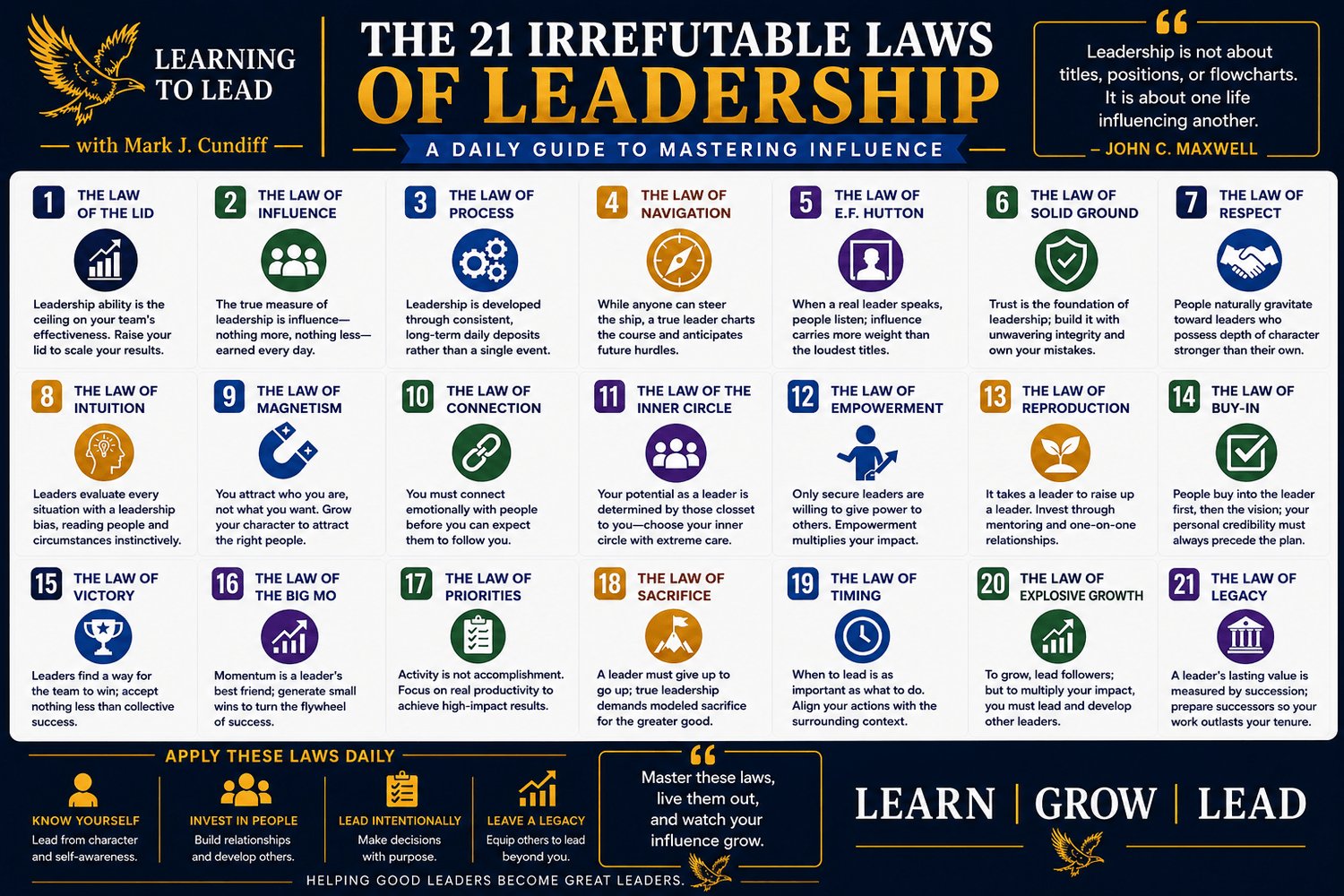
Maxwell organizes the laws loosely around a few themes: how people naturally respond to leadership, what character traits define trustworthy leaders, what behaviors set leaders apart, and how leaders develop other leaders. We'll walk through all 21 below, roughly following the order Maxwell presents them, with a story, an application, and reflection questions for each.
Law #1: The Law of the Lid
Leadership ability determines a person's level of effectiveness.
This is the law that opens the whole book, and for good reason: it explains why talent, hard work, and resources alone never guarantee success. Your leadership ability acts as a lid on everything else you bring to the table.
Maxwell's go-to illustration is the McDonald brothers, Dick and Maurice. They were brilliant restaurant innovators. They pioneered fast, efficient food service for a car-dependent culture, and their single hamburger stand became so famous that restaurateurs from across the country traveled just to study their methods.
But when they tried to franchise the concept, they failed. They had the vision and the operational genius. What they lacked was the leadership ability to scale it. It took their partner, Ray Kroc, whose leadership lid was simply higher, to turn McDonald's into a global phenomenon.
The lesson: dedication, intelligence, and talent will only take you so far. Without leadership ability, you hit a ceiling, and everything and everyone connected to you hits it with you.
You can go deeper into this law here: The Law of the Lid
Reflection Questions:
Where in your life or career have you hit a ceiling that talent and effort alone couldn't break through?
If your leadership ability is genuinely the lid on your organization's potential, what's one specific step you could take this month to raise it?
Law #2: The Law of Influence
The true measure of leadership is influence, nothing more, nothing less.
Maxwell draws a hard line between leading and managing. Managers keep operations running smoothly. Leaders influence people. You can be an excellent manager, a brilliant entrepreneur, or a knowledgeable expert and still not be a leader, because none of those things automatically earn you influence.
He points to a 1996 London Daily Mail poll that asked the public to name the two people they considered the most caring in the world. The answers: Mother Teresa and Princess Diana, neither of whom held political office. Their influence had nothing to do with position and everything to do with the trust and respect they'd earned.
The common misconceptions Maxwell wants you to drop are that being first, holding a title, or knowing more than everyone else in the room does not make you a leader. Only sustained influence, earned through hard work, does.
You can go deeper into this law here: The Law of Influence
Reflection Questions:
If your title disappeared tomorrow, how many people would still choose to follow you?
Where have you been relying on your position instead of building genuine influence?
Law #3: The Law of Process
Leadership develops daily, not in a day.
There are no shortcuts here. Maxwell is clear-eyed about this: real leadership ability is built the same way compound interest is built: small, consistent deposits, day after day, over years.
The starting point is honest self-assessment. If you can't identify what you don't yet know, you have no idea what to work on next. Once you name the gaps, you can begin closing them, one lesson, one mistake, one hard conversation at a time, until leading starts to feel like second nature rather than a performance.
You can go deeper into this law here: The Law of the Process
Reflection Questions:
What's one leadership gap you've been avoiding naming, let alone closing?
What would a daily leadership growth habit look like for you, realistically, starting this week?
Law #4: The Law of Navigation
Anyone can steer the ship, but it takes a leader to chart the course.
Steering is reactive. Navigating is proactive. Maxwell's point is that leaders don't just respond to whatever's in front of them; they plan for it, in excruciating detail, long before the crew ever sets sail.
Preparedness is the real secret weapon here. Decide where you're going. Communicate the goal clearly to your key people. Give them time to genuinely accept the course you've proposed, not just nod along in a meeting. Anticipate the problems that are coming, but keep highlighting the wins along the way. And revisit the course regularly, because good navigators never "set it and forget it."
You can go deeper into this law here: The Law of the Navigation
Reflection Questions:
Have you actually charted a course for your team, or are you mostly steering in reaction to whatever comes up next?
Who on your team needs more time to genuinely buy into the direction you've set, rather than just comply with it?
Law #5: The Law of E.F. Hutton
When the real leader speaks, people listen.
This law is a gut check for anyone who assumes the person with the loudest title is automatically the person people are actually listening to. Maxwell's point: the real leader in any room is not necessarily the one running the meeting. It's the one people turn to instinctively, the one whose words carry weight regardless of their formal position.
What earns that kind of attention? Strength of character, strong relationships, deep knowledge of the work, sharp intuition, and a track record of getting things done. If you're new to a position and you sense someone else in the room is the "real" leader, don't panic. Maxwell's advice is to focus on developing genuine influence rather than resenting the org chart. The real test of leadership isn't where you start. It's where you end up.
You can go deeper into this law here: The Law of the E. F. Hutton
Reflection Questions:
In your organization right now, who is the "real" leader in the room, and is that person you?
What would it take for people to listen when you speak, not because they have to, but because they want to?
Law #6: The Law of Solid Ground
Trust is the foundation of leadership.
Trust is the single most valuable asset a leader has, and it's built slowly and lost quickly. People want to believe in your character before they'll ever follow your direction. The moment you make a mistake and try to hide it or spin it rather than own it, you start eroding the trust that took years to build.
Maxwell's advice is straightforward, even if it's not easy: be honest, keep your commitments, and when you're wrong, admit it fast and completely. There's no leadership hack that can substitute for a reputation for solid character.
You can go deeper into this law here: The Law of Solid Ground
Reflection Questions:
Is there a mistake you've been reluctant to fully own with your team?
What would your team say if asked, privately, whether they trust you completely?
Law #7: The Law of Respect
People naturally follow leaders who are stronger than themselves.
Maxwell's favorite illustration of this law is Harriet Tubman. She was physically small, missing two front teeth, and never dressed in a way that turned heads.
By every superficial measure, she didn't "look" like a powerful leader. And yet some of the most influential people in the country sought her out for counsel, because her depth of character and strength commanded a kind of respect that appearances never could.
People are drawn to strength, but not the kind measured in size or volume. It's strength of conviction, decisiveness, and a demonstrated ability to overcome real obstacles. When more than one leader is competing for the same group's attention, people will gravitate toward the one they respect most.
You can go deeper into this law here: The Law of Respect
Reflection Questions:
What does "strength" actually look like in your leadership, beyond title or position?
Are you earning respect through your decisions and character, or hoping your position will do the earning for you?
Law #8: The Law of Intuition
Leaders evaluate everything with a leadership bias.
Intuition is hard to define, but leaders who've been at this a while develop a kind of sixth sense: they read circumstances, people, and available resources almost simultaneously, and they act on that read quickly, even without having every fact in hand.
Maxwell holds up Steve Jobs as a prime example. Jobs had an uncanny ability to sense what would capture the public imagination before the public itself knew it wanted the product. He viewed every partnership, every piece of technology, and every employee as a resource for advancing Apple, and that leadership-biased lens shaped every decision he made.
You don't get this instinct overnight. It comes from stacking up experience, actively observing patterns, and reflecting honestly on what worked and what didn't.
You can go deeper into this law here: The Law of Intuition
Reflection Questions:
Think back to a moment your gut told you something before the data confirmed it. Did you trust it?
What's one recurring pattern in your organization that your intuition has been quietly flagging?
Law #9: The Law of Magnetism
Who you are is who you attract.
This law can be uncomfortable because it holds a mirror up to you. The people you attract as a leader tend to share your attitudes, work ethic, values, and energy level. If you're not attracting the caliber of people you want on your team, the problem usually isn't them. It's you.
Maxwell's example is Theodore Roosevelt, who recruited an all-volunteer cavalry unit during the Spanish-American War made up of two very different groups: wealthy aristocrats and rough-and-tumble cowboys. Roosevelt himself had lived in both worlds, born into East Coast wealth, later hardened by ranch life in the Dakotas, so he naturally drew people from both.
You can go deeper into this law here: The Law of Magnetism
Reflection Questions:
Look at your current team or inner circle. What does it tell you about who you are as a leader right now?
If you're not attracting the kind of people you want, what specifically about your own leadership needs to change first?
Law #10: The Law of Connection
Leaders touch a heart before they ask for a hand.
You cannot lead people effectively until you've connected with them emotionally, and that's true whether you're leading one person or ten thousand. Maxwell's reminder: even in a room full of people, you're still talking to individuals, and they need to feel that.
He tells the story of Herb Kelleher, the founder and longtime chairman of Southwest Airlines, who made a habit of genuinely knowing his people, their names, their stories, their concerns. On Boss's Day, his employees took out a full-page ad in USA Today to thank him publicly, not for a bonus or a policy, but for "being a friend, not just a boss." That's the kind of loyalty connection builds.
General Norman Schwarzkopf tells a similar story from his own leadership: one Christmas during the Persian Gulf War, he estimated he shook 4,000 hands, one soldier at a time, because he understood that connection has to happen individually, not just institutionally.
You can go deeper into this law here: The Law of Connection
Reflection Questions:
When was the last time you connected with someone on your team as a person first, before you needed something from them as an employee?
Who on your team might be waiting for you to "touch a heart" before they'll fully give you their "hand"?
Law #11: The Law of the Inner Circle
A leader's potential is determined by those closest to them.
No leader accomplishes anything significant alone. Your inner circle, the small group of people you trust most and rely on most heavily, sets a real ceiling on what you can achieve.
Maxwell's advice here is refreshingly direct: stop pouring your best energy into people with a negative attitude, hoping to convince or inspire them. Invest that energy instead in people who already share your vision and can genuinely lighten your load.
Building a strong inner circle isn't accidental. It requires being intentional about who earns a seat close to you, and continually developing the leadership capacity of the people already there.
You can go deeper into this law here: The Law of the Inner Circle
Reflection Questions:
Who currently makes up your inner circle, and are they lifting your capacity or draining it?
Is there someone in your inner circle right now who genuinely shouldn't be there?
Law #12: The Law of Empowerment
Only secure leaders give power to others.
This law exposes a quiet insecurity that undermines many otherwise talented leaders. Maxwell's cautionary example is Henry Ford, a genuine visionary whose car changed modern life, but whose personal insecurity led him to repeatedly undermine the executives around him. He'd empower people, then quietly clip their authority once they started to succeed.
Contrast that with Abraham Lincoln, who deliberately placed his political rivals and sharpest critics into his own cabinet because he wanted the benefit of advice from leaders as strong as, or stronger than, himself.
When Lincoln handed General George Meade command of the Army of the Potomac, he wrote to him plainly: "Your army is free to act as you may deem proper under the circumstances as they arise... All forces within the sphere of your operations will be held subject to your orders." That's what real empowerment sounds like. When you lift others up, Maxwell notes, you elevate yourself in the process.
You can go deeper into this law here: The Law of Empowerment
Reflection Questions:
Have you ever felt threatened by someone on your team growing more capable than you expected?
What's one piece of real authority, not just a task, that you could hand off this month?
Law #13: The Law of Reproduction
It takes a leader to raise up a leader.
Some people are naturally gifted leaders. Most, though, are shaped and mentored by other leaders. Maxwell is blunt about this: you can only give others what you already possess. If you've never developed your own leadership ability, you have nothing to reproduce in someone else.
He also warns against a common trap: leaders who quietly hold other capable people down because they feel threatened by their growth. Ross Perot's line captures the discipline this requires: "Leaders don't flock. You have to find them one at a time." Raising up new leaders isn't a mass-production process. It's slow, personal, and essential to your organization's long-term strength.
You can go deeper into this law here: The Law of Reproduction
Reflection Questions:
Who are you currently mentoring into a leadership role, one person at a time?
Is there any part of you that's been reluctant to develop someone because their growth might feel threatening?
Law #14: The Law of Buy-In
People buy into the leader, then the vision.
This one reorders something most new leaders get backward. We tend to assume a compelling vision is what wins people over. Maxwell says it's the reverse: people follow leaders first, and only then do they adopt the leader's vision.
Mahatma Gandhi is the example he leans on. Convincing millions of people that nonviolent resistance was the most effective weapon against oppression was an enormously difficult sell on paper.
It worked because people believed in Gandhi as a leader first, and their trust in him made them willing to adopt an idea that would otherwise have seemed impossibly idealistic.
The practical implication: if you're struggling to get buy-in for your plan, the real problem might not be the plan. It might be that you haven't yet built enough credibility as a leader for people to trust the plan on your word.
You can go deeper into this law here: The Law of Buy-In
Reflection Questions:
Have you been trying to sell a vision to people who haven't yet bought into you as a leader?
What would it take to build enough trust that people follow your direction even before they fully understand the destination?
Law #15: The Law of Victory
Leaders find a way for the team to win.
Real leaders refuse to accept anything less than victory, and Maxwell holds up Winston Churchill as the ultimate example. Churchill warned about the danger of the Nazis as early as 1932, years before England's leadership was ready to hear it. When he finally became Prime Minister in 1940, he made his position unmistakably clear: defeating Hitler was the only acceptable outcome, full stop. He did not waver, regardless of how long or costly the path became.
But Maxwell is careful to note that victory is rarely a solo act. It requires a cohesive vision, a range of complementary skills across the team, and a leader who keeps the whole group moving toward the same outcome. Improving how the team plays together, not just how hard the leader pushes, is what ultimately produces the win.
Reflection Questions:
Where have you settled for "good enough" instead of genuinely pursuing victory for your team?
What would it look like to strengthen your team's collective skill, rather than just working harder yourself?
Law #16: The Law of the Big Mo
Momentum is a leader's best friend.
You have to be in motion before momentum can build, and once it does, it becomes far easier to push through obstacles that would otherwise stop you cold. Maxwell's insight here is almost counterintuitive: momentum has the power to change how people perceive a leader.
When a team has momentum, people start to see the leader as a genius and look past real shortcomings. Without momentum, even a talented leader can look incompetent.
That means part of your job as a leader is to actively generate motion, even small motion, because momentum, once started, tends to compound.
Reflection Questions:
Where does your team currently have real momentum, and where has motion stalled out completely?
What's one small win you could create this week purely to get the flywheel turning again?
Law #17: The Law of Priorities
Leaders understand that activity is not necessarily accomplishment.
Busy and productive are not the same thing, and Maxwell wants leaders to stop confusing the two. His framework starts with an honest audit of your obligations: where are your strengths genuinely greatest, and where should you be delegating instead?
Where does your passion actually live, since that's what will sustain your motivation over the long haul?
Ideally, Maxwell notes, every action you take should satisfy more than one priority at once.
To sharpen your focus, ask three questions: what must I absolutely do, what generates the largest gain, and what brings the greatest reward? Then aim your energy at the intersection of those answers.
Reflection Questions:
Where has "being busy" quietly substituted for "being productive" in your week?
What's one activity you could delegate entirely because it's not actually where your greatest strength lies?
Law #18: The Law of Sacrifice
A leader must give up to go up.
Every meaningful gain in leadership costs you something. Sometimes it's a step backward before two steps forward. Sometimes it's working long hours without recognition or extra pay. And sometimes, Maxwell notes, the sacrifice is much bigger.
When Lee Iacocca took over a nearly bankrupt Chrysler, drastic measures were the only option left. He asked the federal government for a bailout, opening himself and the company up to intense public criticism.
To model the sacrifice he was asking of others, he cut his own annual salary to one dollar and asked Chrysler's executives to make real sacrifices of their own. That shared sacrifice is what ultimately turned the company around. Maxwell's blunt summary: getting where you're going requires sacrifice, and staying there requires even more.
Reflection Questions:
What have you been unwilling to sacrifice that's quietly holding your leadership back?
Are you asking your team to sacrifice anything you haven't been willing to sacrifice yourself?
Law #19: The Law of Timing
When to lead is as important as what to do and where to go.
Even the right decision, made at the wrong moment, can fail. Maxwell points to Jimmy Carter's 1976 presidential win as a case study in timing. Carter was elected largely because he was a Washington outsider, and in the wake of Vietnam and Watergate, the country was primed to trust an outsider over an insider.
That same message, delivered at almost any other point in American history, likely wouldn't have carried the same weight. Timing turned an underdog into a president.
Leaders have to factor in current circumstances, not just the merits of the plan itself, when deciding when to act.
Reflection Questions:
Is there a good idea you've been pushing that might simply be arriving at the wrong moment?
What current circumstances, inside or outside your organization, should be shaping your timing right now?
Law #20: The Law of Explosive Growth
To add growth, lead followers. To multiply, lead leaders.
There's a ceiling on how much you can grow an organization by developing followers one at a time. Real, exponential growth happens when you shift your focus to developing other leaders, because every leader you develop brings their own followers along with them.
John Schnatter, founder of Papa John's Pizza, put it simply: "It's my job to build the people who are going to build the company." His COO, Wade Oney, echoed the same idea: "The key is to develop leaders. You do that by building up people."
You can groom leaders one at a time, which is slower but steady, or you can recruit leaders who already bring their own following, which accelerates growth dramatically.
Reflection Questions:
Are you currently focused on growing your number of followers, or your number of leaders?
Who's one person you could intentionally invest in this quarter to help them become a leader, not just a strong contributor?
Law #21: The Law of Legacy
A leader's lasting value is measured by succession.
This is the law Maxwell saves for last, and it's the ultimate test of everything that came before it. In 1997, Coca-Cola's CEO Roberto Goizueta died unexpectedly. For most organizations, the sudden loss of a strong leader creates chaos. Coca-Cola didn't fall apart because Goizueta had spent years deliberately preparing the company and its future leadership for the possibility of his absence.
Since leaders lead people, and people outlast any single leader's tenure, your influence can extend well beyond your own lifetime, but only if you plan for it. Growing other leaders isn't just about strengthening the organization today. It's about making sure the organization is still standing, and still strong, long after you've moved on.
Reflection Questions:
If you left your organization tomorrow, would it be stronger or weaker for the next five years?
Who are you actively preparing right now to eventually take your place?
Conclusion (And Your Next Step)
Here's what I keep coming back to after studying this book: leadership isn't a personality trait some people are born with and others simply aren't. It's a set of learnable, teachable, practicable laws, and Maxwell's entire body of work is proof that anyone willing to put in the daily reps can raise their leadership lid.
That's genuinely good news. It means you don't need a title, a corner office, or a natural gift for charisma to become the kind of leader people are drawn to follow. You need influence built on character, a willingness to connect with people individually, the humility to empower others instead of controlling them, and the discipline to keep showing up, one law at a time, day after day.
So here's your call to action: don't just close this post and move on. Pick one law, the one that stung a little as you read it, and take one concrete step on it this week. Write it down. Tell someone you trust what you're working on. Then come back to this post and dig deeper into whichever law your team needs from you most right now.
You don't need to master all 21 laws overnight. You just need to start with one.
Other Books by John C. Maxwell
If The 21 Irrefutable Laws of Leadership resonated with you, here's where to go next in Maxwell's extensive body of work:
How to Get a Return on Failure (His Most Recent): Maxwell's newest book reframes failure not as a dead end but as an investment. He lays out actionable principles, including "See Failure as an Investment in Your Future" and "Practice the Cycle of Improvement," for turning losses into gains rather than letting setbacks define you.
High Road Leadership: A response to our divided world, this book exposes the low and middle roads people default to when interacting with others and teaches what it actually looks like to value people, take accountability, and do the right thing for the right reasons.
Thinking for a Change: Maxwell breaks down eleven specific types of thinking skills, from big-picture thinking to shared thinking, that separate leaders who consistently make good decisions from those who don't.
Great Leaders Ask Great Questions: A case for curiosity as a core leadership skill, exploring why the best leaders lead with questions rather than answers, and how the right question at the right time can unlock a team's best thinking.
The 15 Invaluable Laws of Growth: A companion to this book's law-based structure, focused entirely on personal growth, the mindset, environment, and daily practices that determine whether you ever reach your full potential.
The 16 Undeniable Laws of Communication: Another entry in Maxwell's laws series, this one zeroing in on what makes a message actually land, because influence collapses fast when a leader can't communicate clearly and connect while doing it.
Leadership Gold: Written after Maxwell promised himself he wouldn't publish it until he turned sixty, this book distills forty years of leading into twenty-six "gold nuggets," each with application exercises designed to feel like a one-on-one mentorship session.
The 17 Indisputable Laws of Teamwork: A natural companion to this book, shifting the lens from individual leadership to what makes a team of leaders actually function together at a high level.
Developing the Leader Within You: One of Maxwell's earliest and most foundational works, focused on the internal shifts required before you can lead others well.
Winning with People: Explores the relational side of leadership, including the specific people skills that determine whether your influence grows or stalls.
The 5 Levels of Leadership: Maxwell's framework for understanding leadership as a progression, from position, to permission, to production, to people development, to the pinnacle of leadership defined by legacy.
Leadershift: A more recent work examining the mindset shifts today's leaders need to stay effective in a constantly changing world.
Everyone Communicates, Few Connect: A deep dive specifically into the Law of Connection, exploring what it actually takes to reach people on an emotional level, not just an informational one.
Each of these builds on the same foundation Maxwell laid in The 21 Irrefutable Laws of Leadership: leadership is influence, influence is earned, and it's a lifelong process of daily growth. Read them in whatever order serves you best right now; each one will sharpen a different piece of the leader you're becoming.
Enjoyed this breakdown? Subscribe to the Learning to Lead Newsletter for more book summaries, leadership frameworks, and practical encouragement delivered weekly.

Join over 4,000 Growth-Minded Leaders reading The Learning To Lead Newsletter each week!
Latest Blog Post
Join over 4,000 Fellow Leaders reading The Learning To Lead Newsletter each week!
©2025 Learning To Lead | Helping Good Leaders Become Great Leaders